


The textiles and apparel sector was the biggest beneficiary of the Feb. 3 rally that took place on the back of Donald Trump and, subsequently, Prime Minister Narendra Modi’s announcement of a trade deal between the United States and India. The breakthrough lifted the market sentiment, with the Nifty closing the day with gains of 2.55%.
The rejoice was particularly visible in the textiles space, where many of the companies were hit by steep tariffs that had forced them to pivot to other markets. On Feb 3., thanks to the US-India trade deal announcement that promised tariffs to be cut from 25% to 18%, shares of these companies witnessed an unprecedented rally, with many of the stocks ending the day on a 20% upper circuit.
But with the Feb. 3 rally now done and dusted, the question stands: Will the fervour around the textiles space continue? How is the sector positioned to benefit from the lowering of tariffs? Are valuations attractive enough for a re-entry? And most importantly, is the bull case still woven into the textiles space?
NDTV Profit will take you through all these key questions, with the help of a few charts.
The Exposure Heamap
Photo Credit: Notebook LM
To understand the prospects ahead for the textiles space, it is important to point out the kind of exposure the sector has to the US markets.
Companies such as Indo Count Industries, Kitex, Gokaldas Exports, Pearl Global and Welspun India, among others, have a 60% revenue exposure to the US. That means more than half of their income comes from across the Atlantic.
More diversified companies such as Trident, Arvind, SP Apparels and others still have a sizable exposure to the US, ranging anywhere from 9% to 28%.
The V-Shaped Reaction
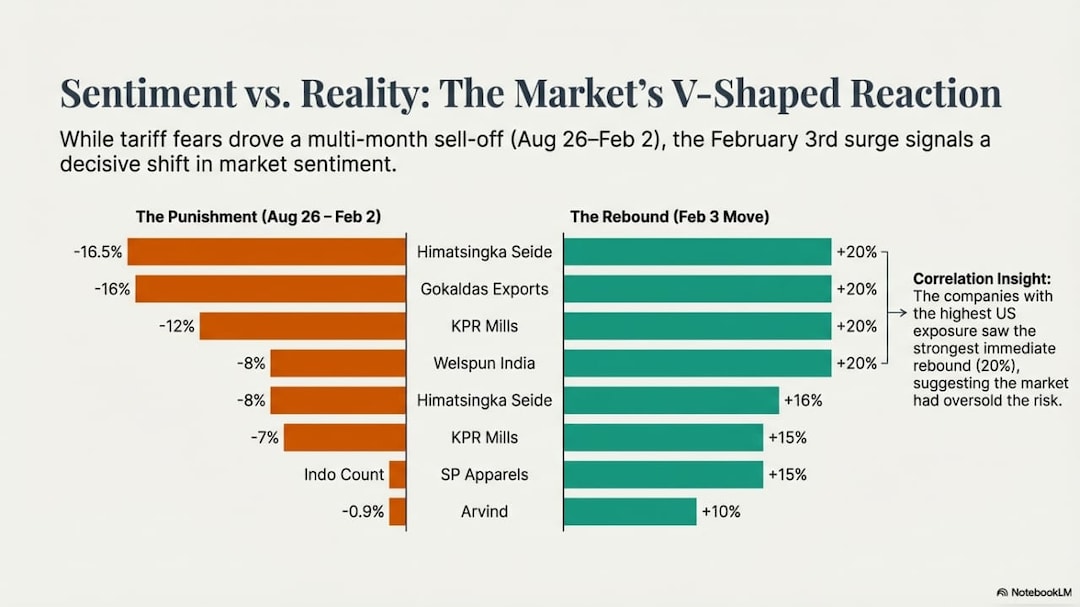
Photo Credit: Notebook LM
With that said, the tariff fears and uncertainty over the trade deal had put immense pressure on the textiles and apparel space, with many of the companies seeing significant drawdowns from the August 2025 to February 2026 period.
But the sector saw a sharp V-shaped recovery in the wake of the US-India trade deal announcement. A key correlation was that companies with the highest revenue exposure to the US, such as Indo Count or Kitex, saw the biggest impact.
Assessing The Damage
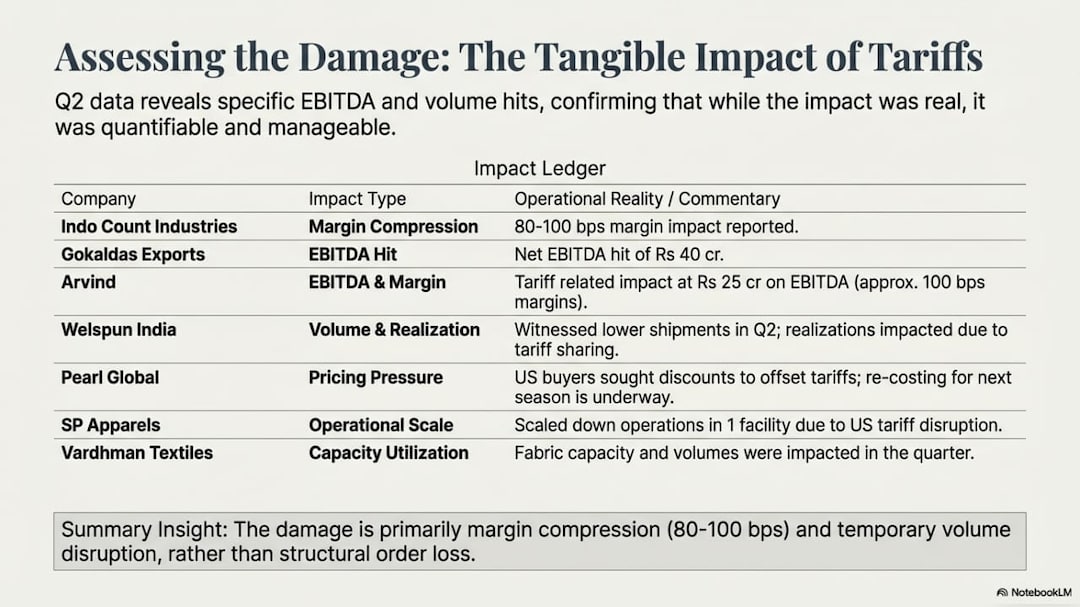
Photo Credit: Notebook LM
Looking back at the tariff impact, many companies shared differing views on how the US tariffs would impact their businesses.
Commentary ranged from the margin compression of Indo Count Industries to the pricing pressure of SP Apparels to the lower shipments for Welspun India.
The Road Ahead
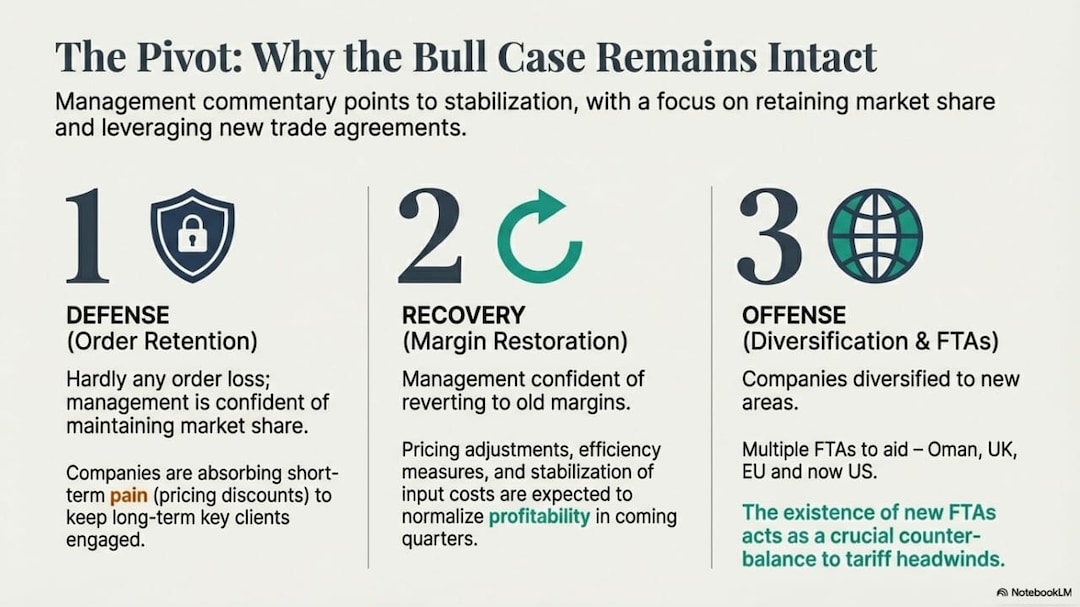
With the US tariff overhang now over, the road ahead for these textiles and apparel companies looks bright, with many companies hardly witnessing any order loss during the uncertainty phase, while others are confident of reverting to previous margin levels.
Thanks to the tariff overhang, some level of diversification has also taken place, aided by free trade agreements with Oman, the UK, and the European Union.
Let’s Talk About Valuation
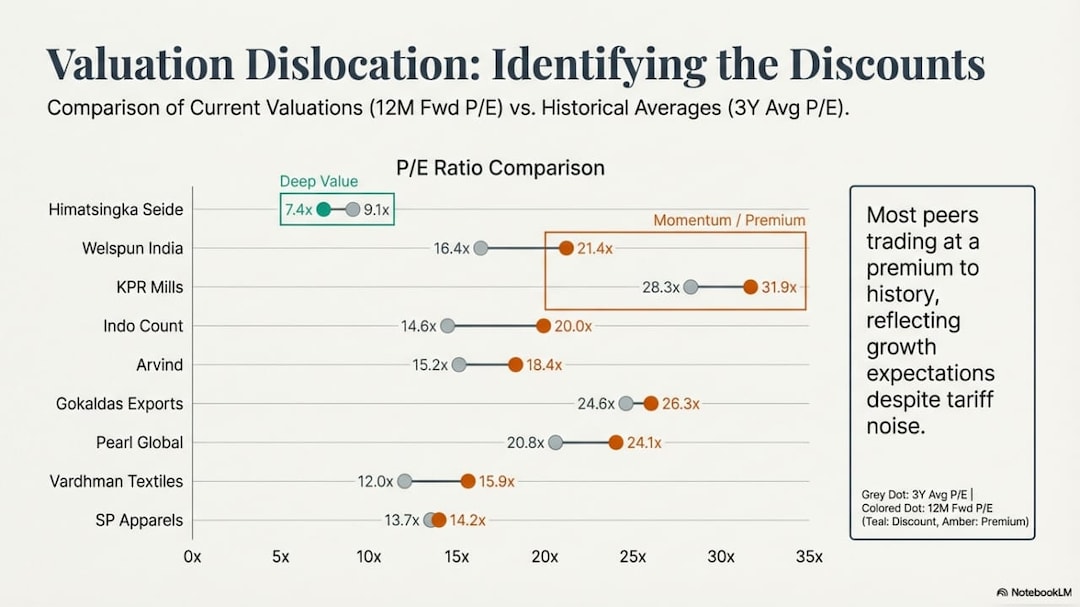
Photo Credit: Notebook LM
This leads us directly to valuation. While the prospects look good, are valuations attractive enough for a re-entry?
The majority of the companies, despite the recent drawdowns, still trade higher than their three-year price-to-earnings averages, with Himatsingka Seide being one of the exceptions.
Himatsingka Seide is currently trading with a P/E ratio of 7.4x, compared to its three-year average of 9.1x. KPR Mills, meanwhile, remains the most valued stock in the pack, with a P/E ratio of 31.9x, compared to the three-year average of 28.3x.
The Return Potential
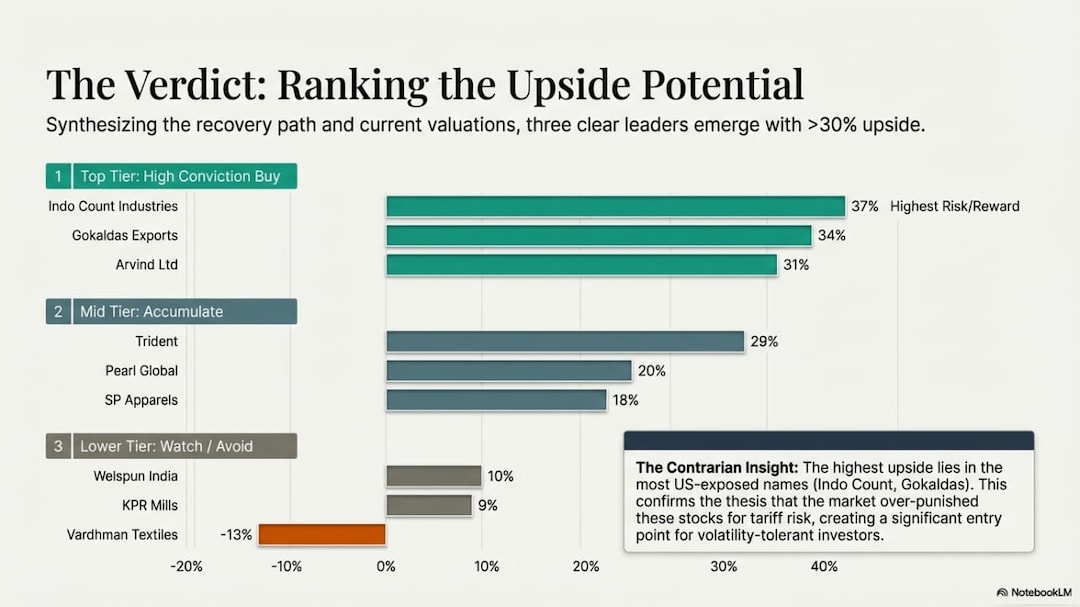
Photo Credit: Notebook LM
With that said, let’s now take a look at how brokerages are viewing the upside potential of various textiles and apparel companies.
Indo Count Industries leads the way with an upside potential of 37%, as per brokerages. Gokaldas Exports and Arvind follow close at 34% and 31%, respectively.
On the flip side, brokerages are seeing 13% downside in Vardhman Textiles, while Welspun India and KPR Mills have 10% and 9%.
ALSO READ: India-US Trade Deal Simplified: Modi And Trump Seal Mega Pact — A Story In Infographics
Comprehensive Budget 2026 coverage,
LIVE TV analysis,
Stock Market and
Industry reactions,
Income Tax changes and
Latest News on NDTV Profit.

