


Jefferies and Nuvama have issued ‘buy’ ratings for the company with a 12-month price target of ₹800. IIFL Capital is even more optimistic, projecting ₹887 over 12 months.
And, Franklin Templeton mutual fund increased its aggregate shareholding in the company to 5.07% from 4.97% of its total paid-up equity share capital earlier, as per a disclosure to market regulator Sebi in July.
The company in question is Syrma SGS Technology Ltd—its stock has risen 70% in the last one year and closed at ₹760 a share on 2 September.
An electronic system design and manufacturing services (ESDM) company, it has waited three decades for this moment to arrive. In 2023-24, it added more manufacturing capacity in a single year than it had in the previous 30 years. That was thanks to a Production Linked Incentive (PLI) scheme powered push for electronics manufacturing. And now, there seems to be no looking back.
Riding on favourable government policies, accelerating domestic demand for electronics, and global customers eager to diversify their supply chains away from China, Syrma SGS is getting into a period of rapid expansion that could redefine its place in India’s manufacturing ecosystem.
Although exports make up a quarter of its revenue, the US makes up just around 5% of the total. The manufacturer, therefore, is insulated from any potential tariff impact, going ahead.
“The company has a healthy order book and enjoys relatively high domestic exposure compared to many B2B electronic manufacturing services peers. With limited exposure to US exports, it is less vulnerable to tariff headwinds,” said Pankaj Kumar, vice president, fundamental research, Kotak Securities.
Syrma SGS has 11 factories in seven states and employs around 9,000 people, half of them women. It is reducing dependence on low-margin consumer electronics to focus on high-margin automotive, industrial, medical and other electronics (more on this later).
“Syrma SGS has stayed in low volume, but high value businesses. For instance, they don’t make mobile handsets. They have good product diversification and a lot of experience in the IT hardware space,” Vinod Sharma, chairman, CII national committee on electronics manufacturing, told Mint.
Typically, contract manufacturing companies have a higher portfolio of mobile phones, TVs, set top boxes, and other consumer appliances. While the assembly of such devices brings in high volume, their margin can be thin.
For instance, rival Dixon Technologies generates 91% of its revenue from mobile phones, hearables and wearables, telecom and IT hardware. It reported an Ebitda margin of 3.8% in the first quarter ended June 2025. Syrma, in contrast, reported an Ebitda margin of 9.2% during the same period.
Ebitda is earnings before interest, taxes, depreciation, and amortization.
Early mover
Back in 1990, four professionals, a chartered accountant, two engineers and a marketing maven, came together to start SGS Tekniks. They started out manufacturing electronics for push button telephones and expanded into automotive and industrial electronics.
About 14 years before the quartet started SGS, another entrepreneur, M.L. Tandon, had launched the Tandon Group, making electronics components, including floppy disk drive parts for technology giant IBM. It would later become Syrma Technology.
In the 1990s the Tandon Group also ventured into TV accessories, including set-top-boxes and components such as transformers, resistors, and inductors.
“The policies of that time made it cheaper to import rather than buy a locally manufactured product. The business (set-top-boxes etc) became unviable and was sold off,” recalls Jasbir Singh Gujral, managing director, Syrma SGS Technology and one of the co-founders of SGS Tekniks.
For years, both the companies, SGS and Syrma Technology, navigated the frustrating reality of an India where manufacturing was hampered by inverted duty structures encouraging imports and policy inertia.
The business that remained, including RFID (Radio-Frequency Identification) and magnetics, was rechristened Syrma Technology in 2005 by Tandon’s son, Sandeep Tandon (now the executive chairman of Syrma SGS).
For years, both the companies, SGS and Syrma Technology navigated the frustrating reality of an India where manufacturing was hampered by inverted duty structures encouraging imports and policy inertia.
By the late 2010s, signs of change were emerging—growing domestic demand, government focus on electronics manufacturing and the Make in India initiative.
In 2021, in the midst of the covid-19 pandemic, Syrma and SGS merged. What began as a conversation between two small companies seeking scale quickly became one of the most significant consolidations in the electronic manufacturing services space.
“We had no overlapping customers, no overlapping geographies,” Gujral said. Syrma was strong in exports with products such as RFID tags, and factories based in South India. SGS was domestic focused, and strong in the North India market.
“Once we merged, the bandwidth increased. We had multiple locations, and we could offer a wider portfolio to customers. Today, we are at ₹3,836 crore, and we are on track to hit ₹5,000 crore business this fiscal,” said Gujral.
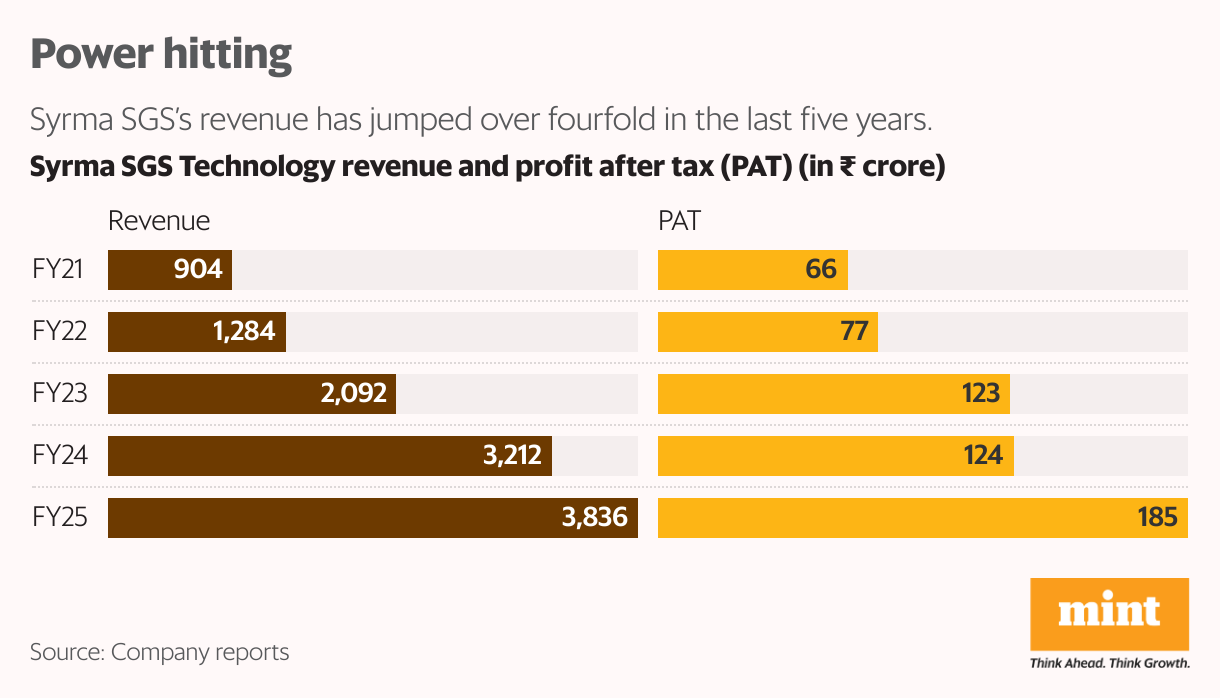
According to CII’s Sharma, “the merger gave them the scale to capitalize on emerging manufacturing opportunities.” And the company hit the public markets in August 2022.
In 2023-24, in just one year, Syrma SGS doubled its surface-mount technology (SMT) placement capacity from 3.1 million to 6.2 million components per hour—something that had previously taken 30 years. Gujral credits this to demand from India, the government’s PLI scheme (which gives cashback incentives to electronic, telecom and other manufacturers) and curbs on imports.
Surface-mount technology is a process of placing components on a printed circuit board.
The company’s factories mushroomed across India—in Himachal Pradesh, Haryana, Rajasthan, Karnataka, Tamil Nadu, and Maharashtra, with multiple facilities in hubs such as Chennai and Gurugram—and in Stuttgart, Germany, where Syrma operates a design, prototyping and repair centre. The workforce swelled to 9,000 in 2024 from around 3,500 in 2021.
The playbook
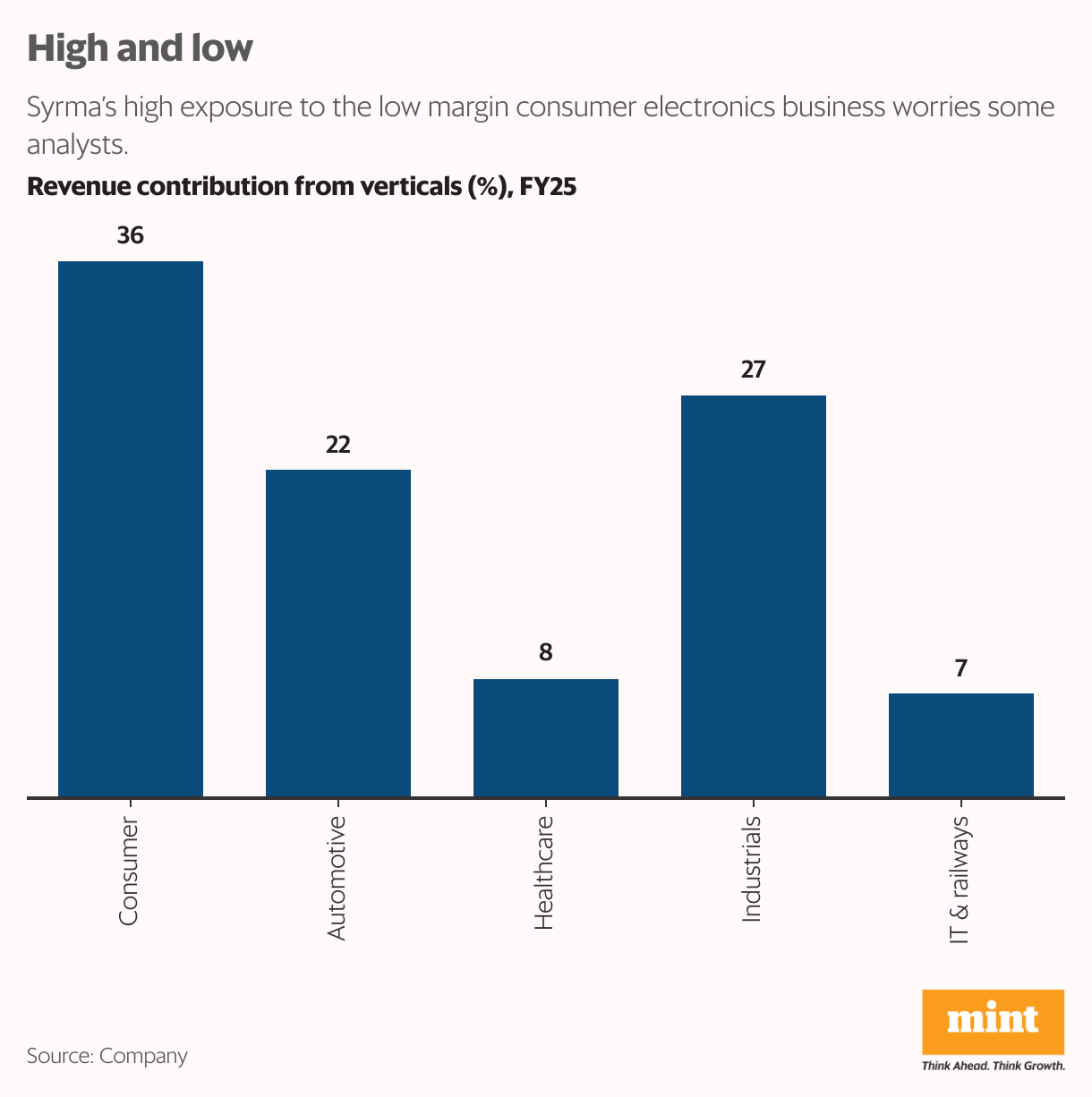
About 36% of Syrma SGS’s business is generated from the consumer sector. Other notable sectors include industrial (27%) and automotive (22%).
Syrma plans to decrease exposure to the consumer segment, bringing it down to 30% by the end of this fiscal year and focus on higher-value businesses.
“Consumer products are important for scale but do little for margins,” Gujral explained. “Medtech and RFID, on the other hand, have much better margins.”
The company makes RFID solutions for industries as varied as healthcare, solar and industrial automation. RFID is an automated identification technology that uses radio waves to transmit data from an RFID tag or ‘smart label’ to a reader, enabling contactless identification and tracking of objects.
The acquisition of Jodhpur-based Johari Medtech in 2023, now Syrma Johari Medtech, is part of the move to rise up the value chain. Johari Medtech makes medical devices for various applications, including pain management, heart monitoring, neonatal, respiration and rehab. The deal brought with it 18 US FDA approvals, access to global healthcare clients and a platform to scale in a high-margin vertical.
“It was a family-owned company with limited resources. Now, as part of our group, its growth potential is immense,” Gujral said.
In automotive, Syrma SGS supplies components to two-, three-, and four-wheeler manufacturers such as Suzuki, TVS, Hero Honda and Tata Motors, covering parts such as engine control units to battery management systems for electric vehicles. In information technology, the company does laptop assembly for Taiwan’s Micro Star International (MSI), which makes high-end gaming and graphic design laptops. It is now venturing into laptop assembly for Toshiba’s Dynabook.
On the industrial side, clients include Schneider, Bosch, Honeywell and Kärcher, where Syrma manufactures products ranging from power management units and utility meters to industrial cleaning systems.

View Full Image
The customer base is deep and varied—Syrma has over 180 clients, with the top 20 contributing around 65% of revenue. Around a quarter of the company’s ₹3,836 crore revenue in 2024-25 came from exports, making it one of the few non-mobile electronic manufacturing companies in India with significant global exposure.
Component play
Much of the company’s current momentum is driven by its entry into high-growth areas and strategic bets on component manufacturing. The jewel in that crown is its planned printed circuit board (PCB) manufacturing facility in Andhra Pradesh, set to be India’s largest.
Syrma’s PCB manufacturing unit is a 75:25 joint venture with South Korea’s Shinhyup Electronics, which has been making PCBs for over three decades. The entry into the business is also well timed, given the government’s push for local electronics manufacturing.
According to American investment bank Jefferies Group, nearly 90% of India’s PCB demand—valued at over $5 billion—is currently met through imports. In 2024, the government levied a 30% anti-dumping duty on PCBs up to six layers, translating into a strong import substitution strategy.
According to Jefferies Group, nearly 90% of India’s PCB demand—valued at over $5 billion—is currently met through imports. A strong import substitution strategy is in place now.
“We expect to get the approval for the PCB unit in September and will start within 45 days of getting the nod. We will be putting up a single layer and a multi-layer PCB line with a capacity of 2.5 million sq. feet per year, in five years,” said Gujral.
Multi-layer PCBs, which are used in various digital and analog devices, including radar systems and medical equipment, require a level of technological precision that Indian manufacturers have yet to fully master.
“We are not just adding capacity; we are building capabilities that will allow us to integrate deeper into the global supply chain,” Gujral said. For instance, flexible and high-density PCBs, critical for compact electronics such as wearables and smartphones, are also part of the PCB manufacturing plan.
“Backed by PLI incentives and starting with multi-layer PCBs, the joint venture positions Syrma to benefit from import substitution. Leveraging its strong presence in the electronic manufacturing services space, Syrma aims to secure 8% share (of the PCB market) by FY40,” stated Kotak Securities’ Kumar.
According to a Jefferies report, “Growth will be aided by the PCB foray, where PLI and anti-dumping duties provide a structural import substitution opportunity.”
The company is an applicant in the ₹22,919 crore components PLI scheme, which covers products such as camera modules, multi-layer PCBs and displays among others. Announced in April this year, the application process is expected to close this month.
A hurdle race
But navigating global supply chains is not without its challenges. No supply chain in the world can wish away China, Gujral admitted.
“We depend on China for components, just as the world depends on the US for demand,” he added.
That supply-chain ran into rough weather for manufacturers post the Galwan Valley clashes of 2020. The relationship between the two Asian neighbours is on the mend.
In the meeting between Indian Prime Minister Narendra Modi and Chinese President Xi Jinping, at the 25th summit of the Shanghai Cooperation Organization this week, both leaders welcomed the “positive momentum and steady progress in bilateral relations since their last meeting in Kazan in October 2024″ and reaffirmed that the two countries were development partners and not rivals.

View Full Image
For electronics companies, there are other obstacles. Issues such as customs delays and arbitrary interpretations of import classifications remain a thorn in the side of manufacturers. “Old habits die hard,” Gujral said, noting that while policy intent is strong, execution at the ground level still lags.
India now has to contend with multiple headwinds like tariffs, inward looking policies and geopolitical risks.
“The global trade order is unpredictable today. Europe, China could do what the US is doing (imposing high tariffs),” said Satya Gupta, president, VLSI Society of India. “To de-risk from this, electronic contract manufacturers should have a strategy of owning products.”
A playbook for sustained growth, he added, is to become an ODM (original design manufacturer) player as well. Much like Chinese companies graduated from contract manufacturing to making their own brands.
The VLSI (very large scale integration) Society promotes chip design and semiconductor technology in India.
Yet, the broader trajectory is unmistakable. Syrma’s order book stood at ₹5,400-5,500 crore as of June. And it is actively evaluating acquisitions to boost revenue as well as competence. Defence electronics is one area of interest
“We are actively pursuing acquisitions that give us access to defence sub-systems,” Gujral noted.
The mission is clear: to build scale, deepen capabilities, and integrate into global supply chains without losing sight of profitability.
Execution will be closely watched—by investors, customers and competitors—but for now, Syrma seems to be making all the right moves.
Key Takeaways
- Riding on favourable policies, accelerating domestic demand, and global customers eager to diversify their supply chains, Syrma SGS is getting into a period of rapid expansion.
- Much of the momentum is driven by its entry into high-growth areas and bets on component manufacturing.
- A planned PCB manufacturing facility in Andhra Pradesh is well timed.
- Nearly 90% of India’s PCB demand—valued at over $5 billion—is met through imports.
- Syrma can benefit from the government’s import substitution strategies.
- But, navigating global supply chains is not without its challenges.
- Indian manufacturers now have to contend with multiple headwinds like tariffs, inward looking policies and geopolitical risks.

