


Companies are now making radar systems, satellite communication tools, precision electronics, and advanced mapping technology that support every space mission.
Some small firms are creating high-grade microwave systems for defence, others are working on homegrown avionics, and a few are building digital maps that future transportation will rely on.
There are also companies focusing on optics and space hardware. These firms may seem small today, but demand is growing fast… and the future looks promising.
If you’re curious about the small companies playing a big role in this sector, read on:
Astra Microwave Products Ltd
Astra Microwave Products is a designer and manufacturer of high-performance radio frequency (RF) and microwave super components, modules, sub-systems, and complete systems, primarily focused on the defence sector.
The company has a significant and growing presence in the space sector. The company has been involved in India’s space programme for about 25 years.
It supplies critical RF and microwave components and subsystems for satellites and launch vehicles, having contributed to major missions, including the recent Isro’s CMS-03 communication satellite, by providing advanced subsystems such as C-band 15-watt SSPA and Ku-band receiver and converter.
Now the company is enhancing its role in the emerging commercial space market, which is expected to grow substantially.
To this end, it incorporated a wholly owned subsidiary, Astra Space Technologies (ASTPL), in February 2024, to engage in the design, development, manufacture, and integration of satellite equipment, including the assembly of small satellites.
The company has established satellite assembly clean rooms at its Bengaluru facility and is actively pursuing opportunities to build and launch small satellites.
It aims to generate revenue from data monetization through satellite constellations, positioning itself to capitalize on global space technology trends that focus on areas such as satellite communication, earth observation, and national security.
Although the defence sector accounts for the majority of its current business, the space sector is a strategic area of expansion. It contributes to the overall order book and reflects its intention to scale its space-related offerings substantially in the future.
Coming to its financial performance, the company has delivered a top-line growth of 12% compounded annual growth rate (CAGR) over a three-year period and a net profit CAGR of 58%. The last three-year average return on equity (ROE) has been 14%.
Data Source: Ace Equity
Looking ahead, the company is targeting substantial near-term and long-term expansion. The management is confident in achieving sales revenue between ₹1,150 crore and ₹1,200 crore for the current fiscal year (FY26).
This target is anchored by an underlying top-line growth expectation of approximately about 20% year-on-year (YoY).
The management has stated that it aims to double its turnover over the next three to four years. This growth is envisioned to culminate in Astra Microwave Products becoming a $1 billion company in the long term.
FY28 Revenue is anticipated to be around ₹1,650 crore.
The company aims to book new orders worth approximately ₹1,400 crore in FY26.
The management estimates major opportunities totalling ₹24,000-25,000 crore across all sectors until FY28.
The margin profile is projected to remain stable or improve slightly, primarily driven by the favourable shift in the product mix towards higher-value domestic business.
Gross profit margins are projected to continue in the range of 45% to 50%.
Earnings before interest, taxes, depreciation, and amortization (Ebitda) margins are generally expected to be sustained above 25% going forward.
The company plans to launch its own revenue-accretive satellite, Astra SAT-1, within 24 months.
Apollo Micro Systems Ltd
Apollo Micro Systems, established in 1985, operates as a leading provider of electronic, electro-mechanical, and engineering design solutions, specializing in high-performance, mission-critical systems for the defence, space, and homeland security sectors.
It develops subsystem-level components tailored for space-qualified performance to ensure mission success in orbit, a core competency built upon over four decades of expertise in aerospace and defence work.
Specifically, the company develops and supplies payload checkout systems and earth station acquisition systems for space applications, having notably supplied the first indigenous payload checkout system to ISRO, replacing legacy imported systems.
Coming to its financial performance, the company has delivered a topline growth of 32% CAGR over a three-year period and a net profit CAGR of 58%. The last three-year ROE has been 8%.
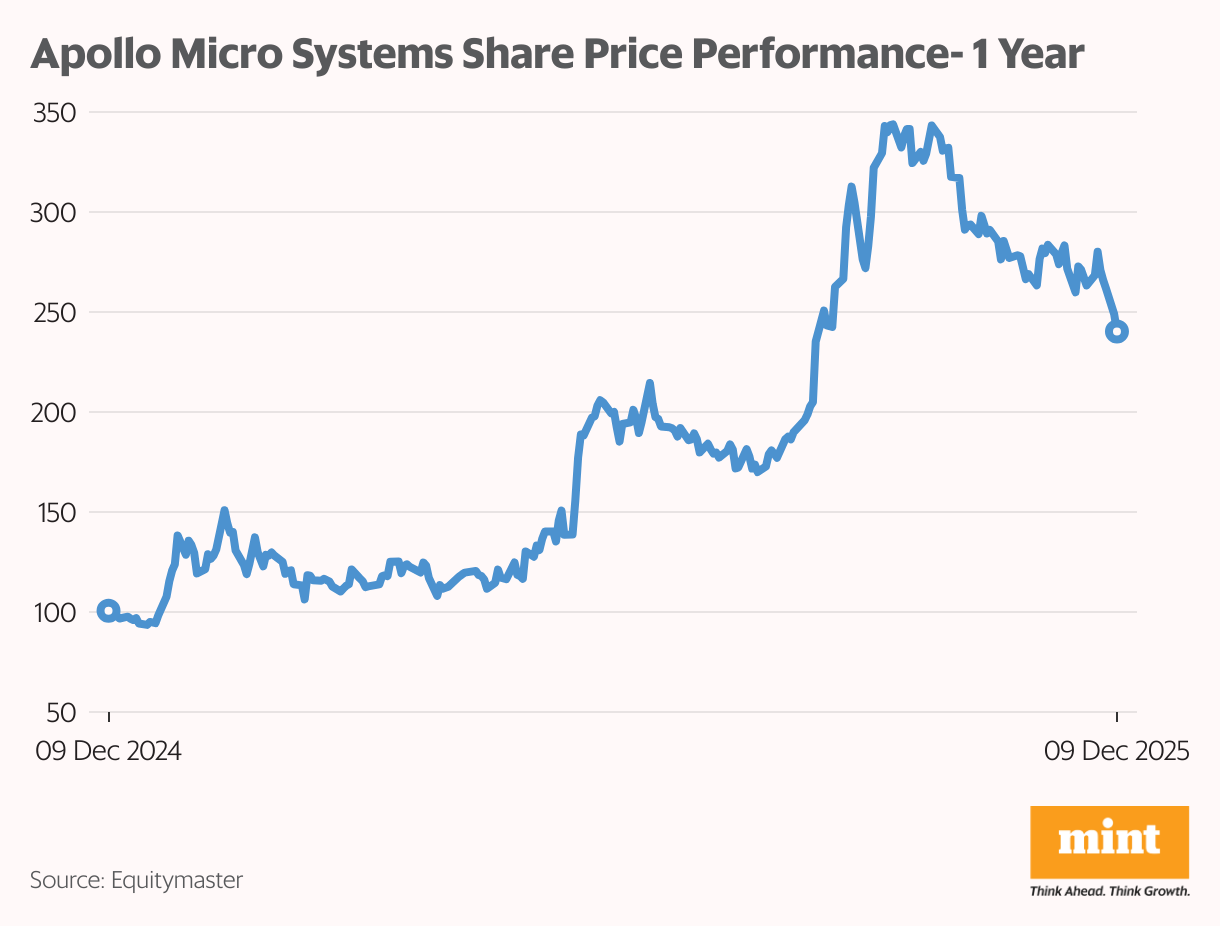
Data Source: Ace Equity
The management projects that revenue from the core business alone will grow at a CAGR of 45% to 50% over the next two fiscal years (FY26 and FY27).
When factoring in the recent acquisition, Apollo Micro Systems expects its total consolidated revenue to double in FY26.
However, due to continuous and planned capital investments (capex) and facility expansions, management expects margin expansion to moderate in the latter half of FY26 and into FY27. Despite this, the company aims to sustain the profitability balance.
A significant driver for margin improvement will be the shift toward higher-margin production orders. The management anticipates converting the mix from 25-30% production currently toward 40-45% production projects over the next two years.
The construction of unit 3 (350,000 sq. ft. integrated plant for ingenious defence Systems/IpiDS) is underway, with phase 2 civil structure having started.
The total capital expenditure allocated for unit 3 is ₹250 crore. Unit 3 is expected to become fully operational by 1QFY27.
This expansion is expected to enhance the total production capacity by up to eight times the present facility. Working capital cycle days are expected to reduce by about 100-120 days from FY27 onwards.
Paras Defence and Space Technologies
Paras Defence and Space Technologies is a premier engineering company specializing in both the defence and space sectors.
The company maintains an all-around capability encompassing the design, system engineering, manufacturing, integration, and qualification of optical systems tailored for space programmes.
Notably, Paras is the only private Indian company to have developed and manufactured hyperspectral cameras designed for both defence and space applications, with a hyperspectral camera product designed, developed, and manufactured in India that is slated for joint launch by the DRDO and Isro.
Its offerings within the optics and optronic systems vertical include ultra-high precision optics for space imaging systems, large-size space mirrors intended for high-precision imaging in earth observation satellite systems, and optical reflectors used in missile and payload assemblies.
Through its wholly owned subsidiary Quantico Technologies, the company is actively developing next-generation technologies in quantum communication and quantum sensing, providing a competitive edge in the space technology domain.
Coming to its financial performance, the company has delivered a top-line growth of 26% CAGR over a three-year period and a net profit CAGR of 32%. The last three-year ROE has been 10%.
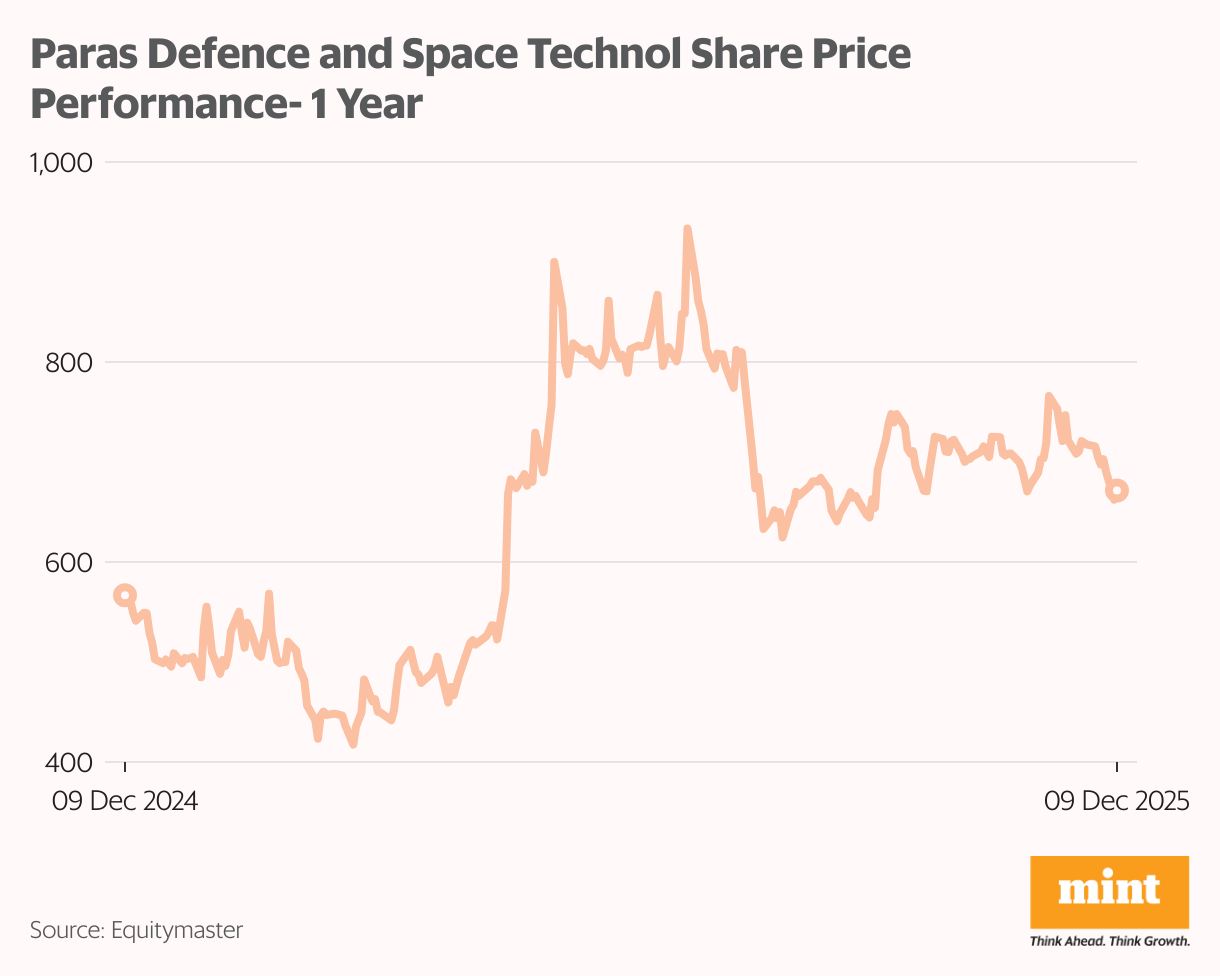
Data Source: Ace Equity
Looking ahead, the management aims to tap into a high-value opportunity funnel for the next one to five years.
The opportunity size is substantial, categorized by segment: Optical systems/drone cameras/periscopes/development projects ( ₹2,000+ crore), advanced electronics ( ₹3,000+ crore), laser systems ( ₹3,000+ crore), and optical telescopes ( ₹1,000+ crore).
Conclusion
The companies we just explored aren’t riding the space-tech wave from the sidelines.
These firms are building RF systems, optics, electronics, clean rooms, satellites, and payload technologies that India’s space sector relies on.
These smallcaps aren’t just “space-themed” stories. They’re engineering-led businesses with good order pipelines, rising capacity, and long-term roadmaps.
The upside is real, but so are the risks. The fundamentals still matter.
It’s important to conduct thorough research on financials and corporate governance before making investment decisions, ensuring they align with your financial goals and risk tolerance.
Happy investing.
Disclaimer: This article is for information purposes only. It is not a stock recommendation and should not be treated as such.
This article is syndicated from Equitymaster.com

