


Heavy investments by big tech into AI are now influencing GDP growth more than consumer spending, with industry leaders already committing to even higher AI capex in 2026.
However, as concerns grow that the AI stock rally may be edging towards bubble territory, global investors are preparing for a potential rotation of capital away from Wall Street’s Mag 7, as well as China and Korea, into relatively under-owned markets such as India.
For investors scouting for opportunities, here are a few Indian AI stocks currently trading nearly 40% below their 52-week highs.
However, these are not pure-play AI stocks.
Cyient Ltd
Cyient is a global engineering and technology solutions company that collaborates with customers to design digital enterprises, build intelligent products and platforms, and solve sustainability challenges.
Cyient is actively involved in AI. The company integrates AI and Generative AI (GenAI) extensively across its engineering, manufacturing, supply chain, compliance, and customer support workflows.
In 2024, Cyient announced the acquisition of a 27.3% stake in Azimuth AI, a fabless custom application-specific integrated circuit (ASIC) company known for its expertise in intelligent energy and power solutions.
The company is primarily an embedded silicon innovator, designing custom system-on-chips (SoCs) for efficient edge AI in smart cities, EVs, and industrial settings, focusing on power efficiency and custom AI processing.
On 17 November 2025, Azimuth AI and its wholly owned subsidiary Cyient Semiconductors announced the launch of ARKA GKT 1, India’s first-generation intelligent power silicon chip designed for ultra-low power edge AI and smart energy systems.
So far in 2025, up to 12 December, the stock has fallen from its 52-week high of ₹2,106, recorded on 16 December 2024, to ₹1,167.3, a decline of approximately 44.5%.
One of the key reasons for the decline has been consistent FII selling since the March 2024 quarter, with the highest level of selling recorded in the March 2025 quarter.
In addition, Cyient reported a 3.7% year-on-year decline in revenue for the quarter, with revenue coming in at ₹1,780 crore. The company also posted a sharp 23.42% year-on-year drop in net profit.
Overall, Cyient is expected to capitalize on market demands for engineering innovation, AI-powered solutions, and smart manufacturing, driving sustainable revenue growth and profitability in the medium to long term.
Oracle Financial Services Software Ltd
Oracle Financial Services Software (OFSS) provides financial software, custom application development, consulting, IT infrastructure management, and outsourced business processing services to the financial services industry.
The company’s solutions can be deployed in on-premises & SAAS mode and incorporate new technologies such as artificial intelligence and machine learning (AI/ML), which enable the users to provide a differentiated cloud-ready solution to its customers.
Its solutions are built on a microservices architecture, embedded with AI, and designed for seamless adoption by banks.
The company addresses critical challenges in the financial services industry by delivering embedded financial experiences across banking services, revitalizing global trade and supply chains, and modernizing finance and risk management.
So far in 2025, up to 12 December, the stock has fallen 39.5% from its 52-week high of ₹13,203.6, recorded on 30 December 2024, to ₹7,987.
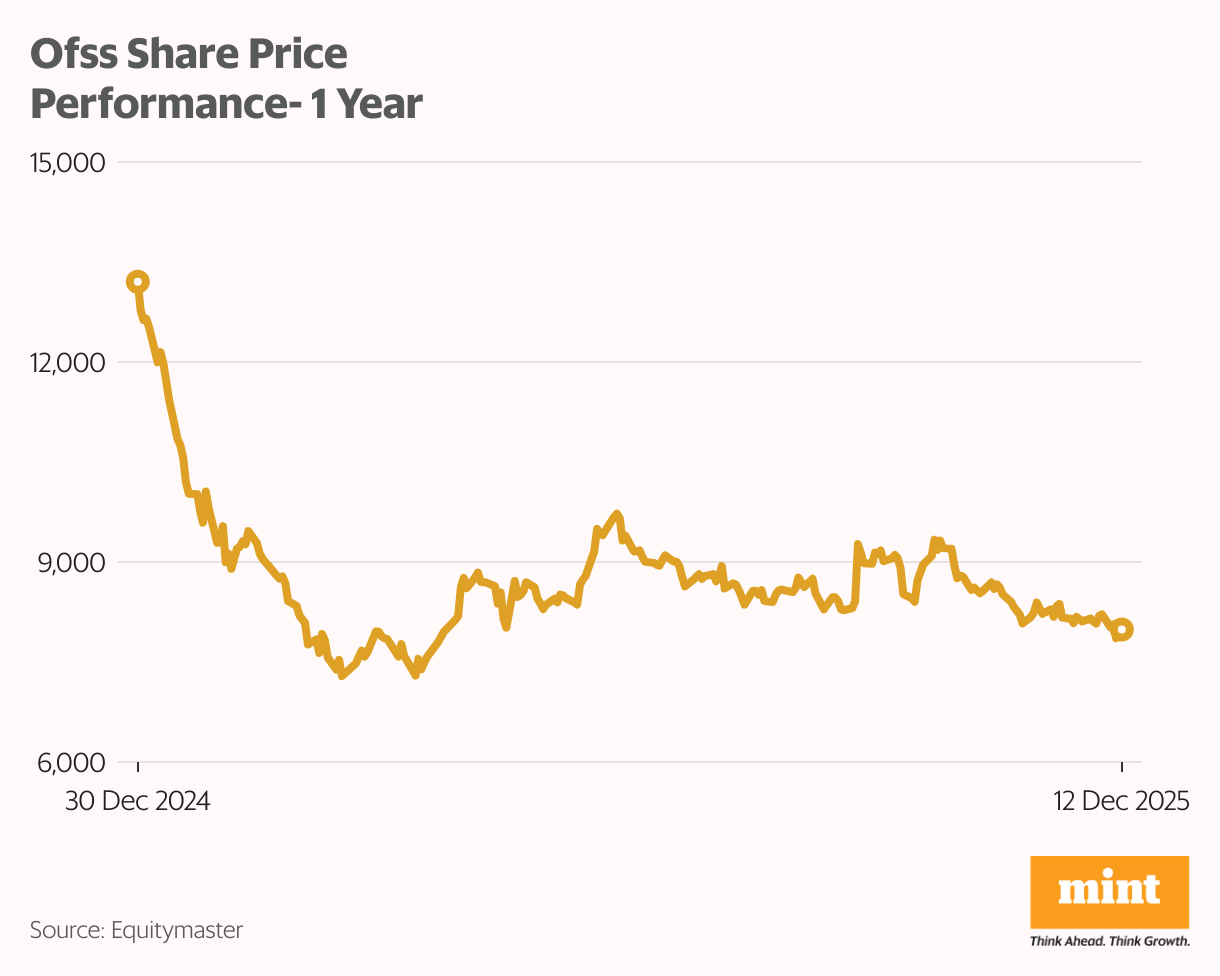
This decline could be attributed to ongoing promoter selling in the company.
Additionally, in the September 2025 quarter, revenue increased 6.9% year-on-year to ₹1,780 crore, while net profit fell 5.5% to ₹550 crore, compared with ₹580 crore in the same period last year.
The company aims to broaden and deepen its presence in global markets. Its sales and marketing teams are focused on strengthening international reach and developing new export opportunities.
Tata Elxsi Ltd
Tata Elxsi, established 35 years ago, provides design and technology services across automotive, media, healthcare, and communications sectors.
The company operates several AI platforms, including TEDAX for data intelligence, IRIS for industrial AI, TETHER for connected vehicle services, NEURON for content personalisation, and TECare for digital therapeutics.
The company continues to advance AI and analytics through its AI Centre of Excellence, focusing on autonomous mobility, video analytics, predictive analytics, GenAI, and cloud computing.
With more than a decade of experience in AI, Tata Elxsi has strengthened its capabilities further through strategic collaborations.
In July 2025, the company partnered with San Francisco-based KAVIA AI to integrate AI-powered automation across the software development lifecycle for enterprise clients.
KAVIA AI refers to its platform as “software 3.0″, a cloud-native system designed to automate the entire development process, from planning to maintenance at enterprise scale.
So far in 2025, up to 12 December, the stock has fallen 32.5% from its 52-week high of ₹7,448.8, recorded on 12 December 2024, to ₹5,029.7.
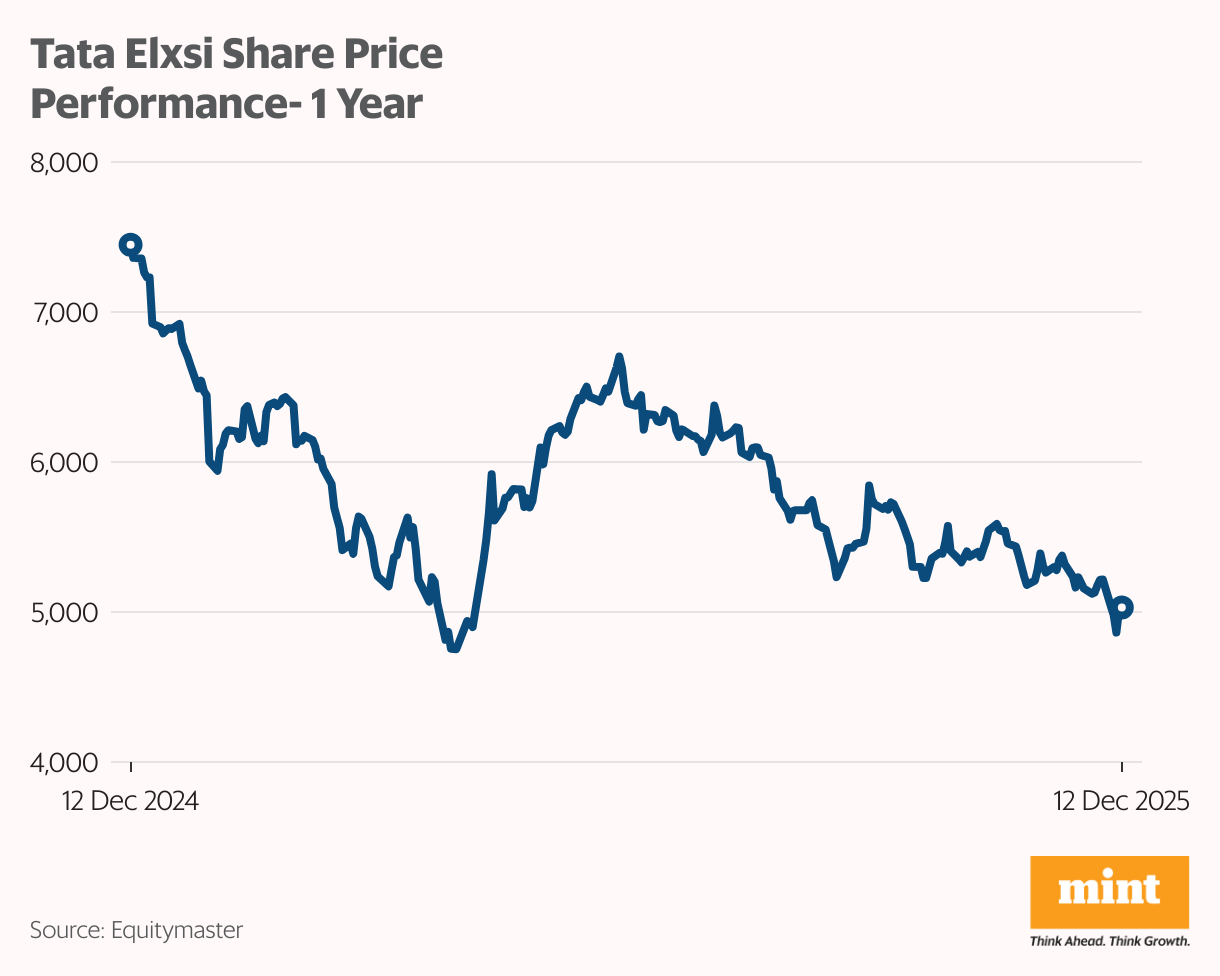
This could be attributed to stake reductions by both FIIs and promoters during the September 2025 quarter. Promoter shareholding edged down in the September 2025 quarter, while FII holding declined from 12.7% to 12.5% over the same period.
In addition, revenue from operations fell to ₹920 crore from ₹960 crore a year earlier. Net profit also declined sharply, dropping 32.5% year-on-year to ₹150 crore.
Moving ahead, the company says that it will continue to invest in differentiated AI-first offerings and services.
Conclusion
Investing in AI-linked stocks that are down up to 40% from their 52-week highs may appear attractive as the technology continues to reshape industries and fuel a new wave of digital transformation.
India’s AI ecosystem is expanding at a rapid pace, with the country’s $264 billion IT sector projected to cross $400 bn by 2030, driven by increasing AI adoption across global outsourcing, according to Bessemer Venture Partners.
That said, investors should remain mindful that AI-themed opportunities can be volatile, and stock selection should be backed by a careful assessment of underlying fundamentals and long-term business strength.
Investors should evaluate the company’s fundamentals, corporate governance, and valuations of the stock as key factors when conducting due diligence before making investment decisions.
Happy investing.
Disclaimer: This article is for information purposes only. It is not a stock recommendation and should not be treated as such.
This article is syndicated from Equitymaster.com.

