


Paytm had corrected by almost 80% in less than 3 years since its public market listing in November 2021. But the stock is taking a turn for the better. The company has managed to reclaim its licences from regulators, and turned profitable in the latest quarter.
The stock has broken out above the critical support level of ₹1,000 per share. But is the recovery here to stay, or is it yet another sucker’s rally?
Run-ins with the regulator
Paytm, which started as a mobile connectivity top-up platform in 2010, began operations as a payments bank in 2017. Over the years, it grew to claim more than a quarter of India’s payments bank industry. It had bigger ambitions, including securing a small finance bank licence. But its plans went for a toss following repeated run-ins with the regulator.
Within a year of commencing operations, the Reserve Bank of India found lapses in Paytm payment bank’s process for customer acquisition and adherence to the regulator’s customer verification or know-your-customer (KYC) rules. As a result, Paytm was barred from onboarding new clients.
In 2022, barely a few months after its stock market listing, Paytm popped up on the regulator’s radar again. This time, RBI mandated a comprehensive technology audit, with a focus on Paytm’s data-storage, data-privacy, and cybersecurity processes. Yet again, following unsatisfactory findings, new customer onboarding was banned, and monetary penalties followed.

View Full Image
RBI’s death blow
In January 2024, RBI directed Paytm to cease almost all banking operations. Following raids by the Enforcement Directorate and a telling audit report, Paytm was no longer allowed to accept top-ups or fresh deposits in any of its products. All nodal accounts were directed to be closed.
Withdrawals were allowed, which effectively meant a regulatory death sentence on Paytm payment bank as customers emptied their account balances. Paytm’s lending partner backed off, and the National Highways Authority of India banned the company from selling FASTags.
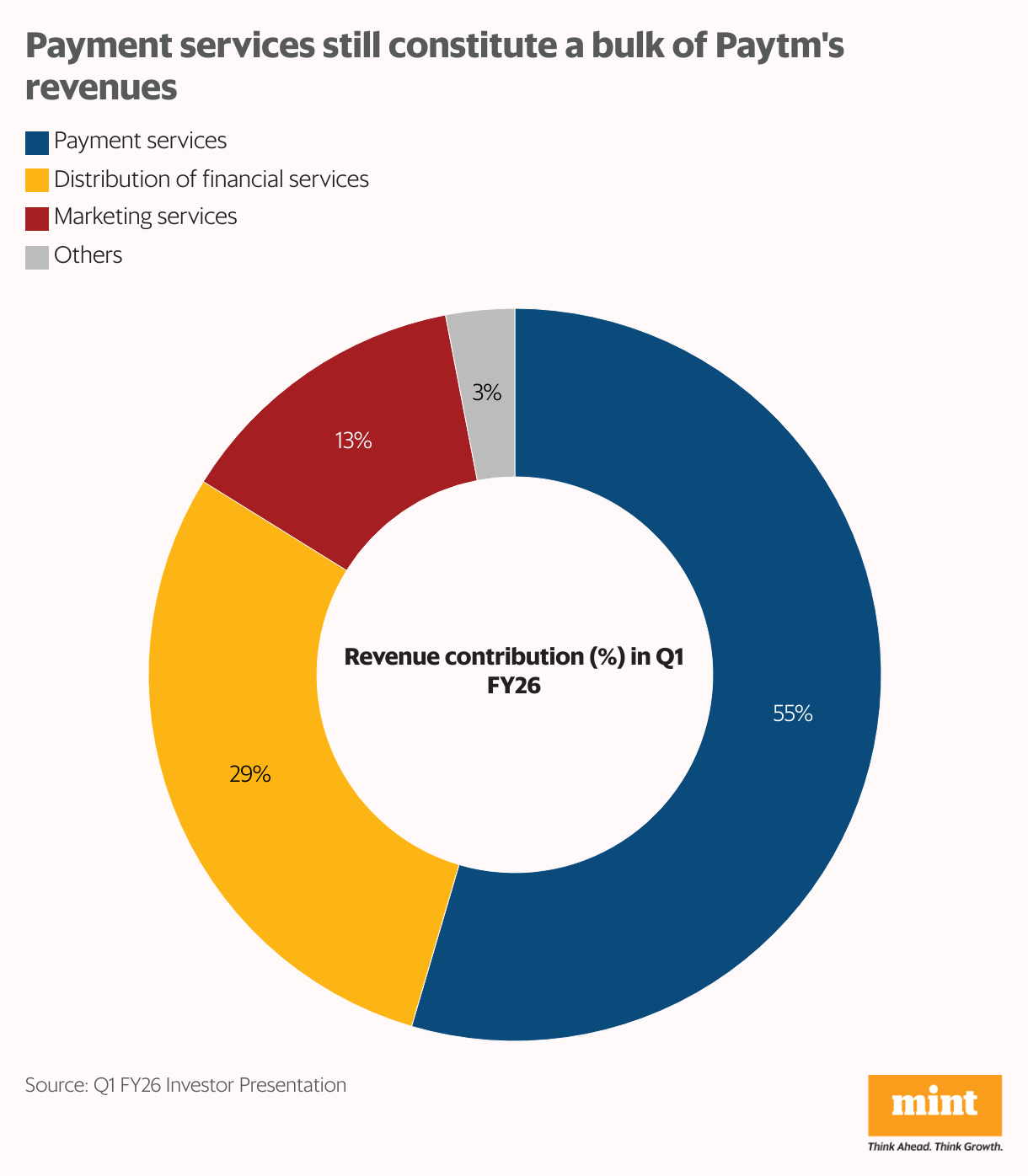
Payment services constitute a bulk of Paytm’s business. While the company retained its wallet licence, UPI was disrupted because Paytm’s realtime money transfer facility was operated through its payment bank.
With major operations hit, cross-selling opportunities went out the window. Paytm was practically written off by the industry as well as investors. The stock lost a massive 50% of its value in just a few days.
Behind RBI’s worries
The regulator’s concerns primarily stemmed from Paytm payment bank’s intertwined finances and operations with China-backed One97 Communications, its parent company.
The Paytm app was integral to the payment bank’s operations. Customer acquisition, marketing, and distribution were channelled through the Paytm app, while access to all banking services were provided exclusively through the app.
This was problematic, considering that the app was controlled by Paytm, not Paytm Payments Bank. This is to say that customers’ data and funds flowed freely between Paytm and its Chinese parent.
RBI’s worries were exacerbated following clashes between Indian and Chinese troops along Ladakh’s Galwan valley in 2020.
Due to operational codependence with its parent, Paytm Payments Bank could not bring up a Chinese wall despite repeated warnings from the regulator. And that’s what brought about its eventual downfall.
A retained client base
Unlike Google Pay and PhonePe, which act as third-party application providers (TPAP), or user interfaces for digital payments for other banks, Paytm had been using Paytm Payments Bank to provide its UPI services.
With its payment bank operations suspended, Paytm secured a TPAP licence in March 2024. This helped it resume UPI services. Since then, despite a fall in government incentives for UPI transactions, Paytm has managed to retain its edge in the industry.
For wallets, FASTags, and merchant accounts, Paytm partnered with other banks to ensure service continuity. Paytm also doubled down on acquiring merchants, resulting in its merchant base expanding from 39 million in December 2023 to 45 million in June 2025. The interventions helped Paytm retain a bulk of its customers.
Back to basics, and profits
After containing the immediate threat of losing customers, Paytm got down to the basics. It downsized non-core businesses such as ticketing and e-commerce to cut costs.
Paytm also implemented sharp cuts in marketing, customer-acquisition, and employee costs, and employed artificial intelligence to improve operational efficiencies and derive significant cost-savings.
The sale of Paytm Insider to Zomato, now Eternal, delivered a large exceptional gain in the second quarter of 2024-25 (July-September 2024). But employee stock options held back profitability in the fourth quarter (January-March 2025).
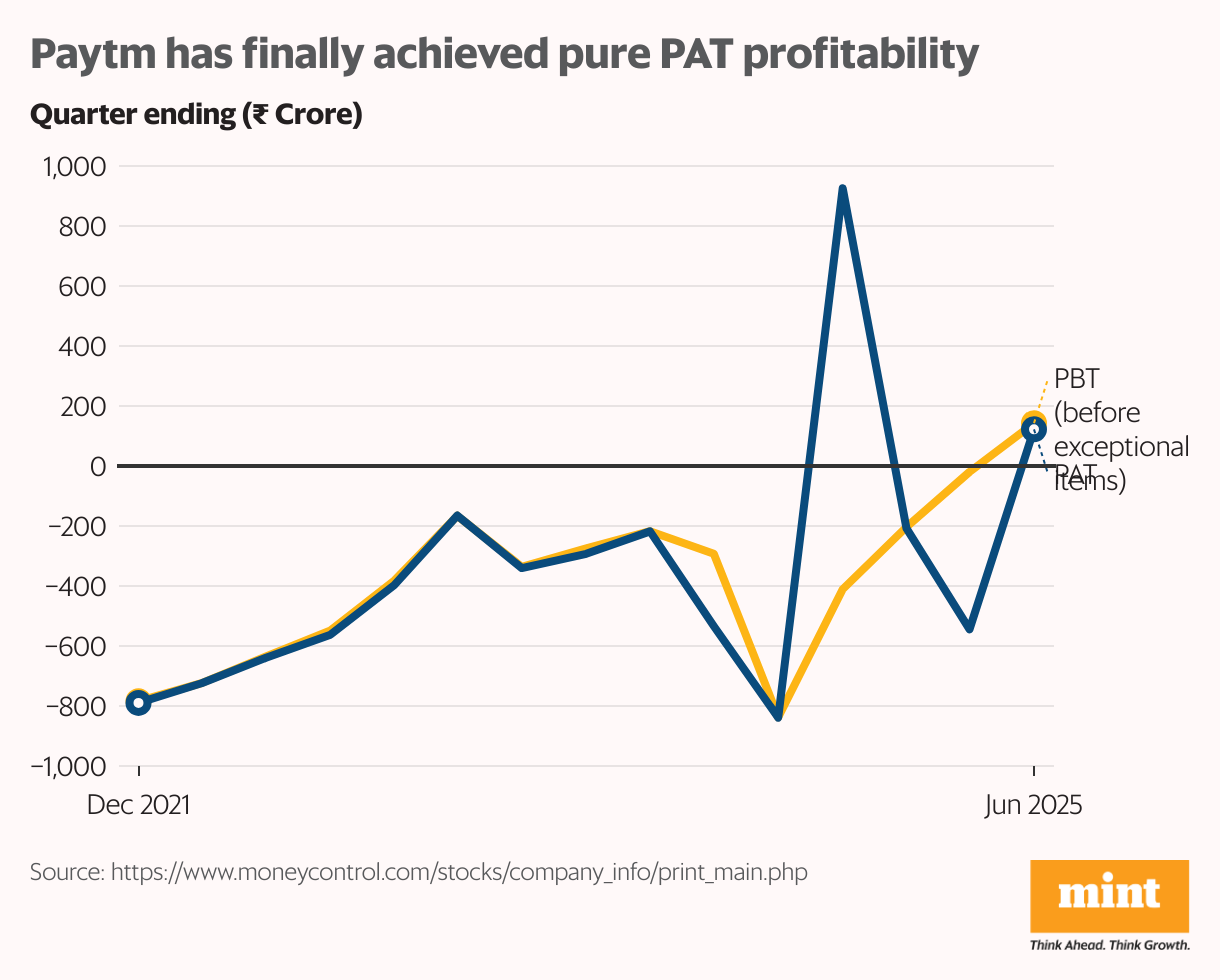
Paytm finally achieved pure profit after tax in the first quarter of FY26. With ESOP expenses sharply lowered, Paytm reported PAT of ₹123 crore for the April-June quarter.
Importantly, the regulatory overhang may be behind Paytm. In October, the National Payments Corporation of India allowed Paytm to onboard UPI customers. Earlier this month, Ant Financial, an affiliate of China-based Alibaba Group, completely exited One97 Communications.
This leaves founder Vijay Shekhar Sharma and his family (through Resilient Asset Management) as the largest shareholders in Paytm. On cue, RBI granted Paytm a payment aggregator licence last week. Investors celebrated the news, with the stock rallying 9% in a week.
Where does Paytm go from here?
Paytm is yet to regain its customer base. The company’s monthly transacting users dropped from 100 million in the quarter ended December 2023 to 74 million in the latest June quarter.
Its credit business has suffered as well. But that has more to do with Paytm holding back on small-ticket lending due to industry-wide stress rather than the regulator’s crackdown.
But regulatory risks are rumored to persist. Some reports claim Ant Financial continues to exert indirect influence over Paytm, and that Ant may have “parked” its stake in Paytm at Resilient Asset Management through optionally convertible debentures.
Also, a 100% year-on-year growth in Paytm’s financial products distribution business in the June quarter was countered by a modest 18% growth in its payment services business.
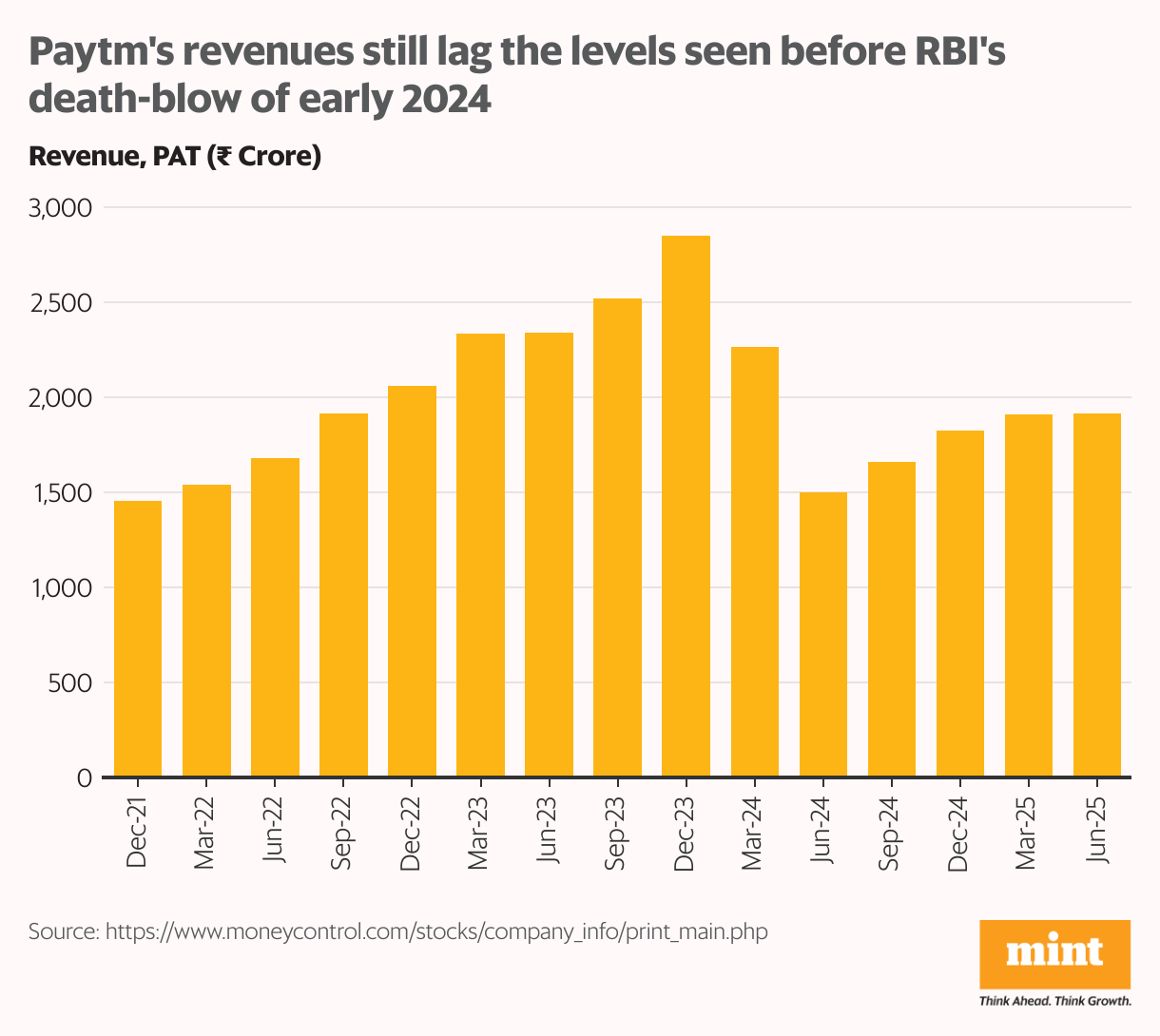
Paytm’s first-quarter revenue grew 28% year-on-year to ₹2,000 crore, but that’s lower than the nearly ₹2,900 crore recorded for the quarter ended December 2023.
Paytm’s diversification initiatives including international expansion and its wealthtech business are years from fruition.
So while cost-cutting has fuelled Paytm’s profitability, the company still has a long way to go for redemption on the revenue front.
That said, with licences now in place, steady progress in onboarding merchants, the ESOP weight shed-off, and some major banking partnerships under its belt, Paytm’s prospects appear promising.
Ananya Roy is the founder ofCredibull Capital, a Sebi-registered investment adviser. X: @ananyaroycfa
Disclosure: The author holds shares of some of the companies discussed. The views expressed are for informational purposes only and should not be considered investment advice. Readers are encouraged to conduct their own research and consult a financial professional before making any investment decisions.

