


Traditionally linked to chopda pujan (worship of account books), it has evolved into a valid trading window with settlements and deliveries. It’s an hour where investors aren’t just trading—they’re seeking the blessings of Goddess Lakshmi, believing that trades executed during this auspicious time will bring luck, prosperity, and positive returns. A historic shift marks the 2025 Muhurat trading session: the customary evening timing has been moved to an afternoon window.
But does this belief in auspicious timing actually translate into positive market returns?
A Mint analysis of the last 28 Samvat years (1997–2024) shows that the Sensex closed higher in 22 Muhurat sessions, reflecting the customary Diwali optimism. However, volumes are often lower, with a median return over these years of -0.42%.
But the post-Diwali glow fades quickly. In the very next session, markets have turned red approximately two-thirds of the time. The pattern highlights that while Muhurat trading boosts sentiment, it dissipates the next day.
Gains may sometimes reverse shortly after Muhurat trading, but retail investors typically approach this day with a long-term mindset, said Sachin Jasuja, head of equities and founding partner at broking firm Centricity WealthTech.
“Muhurat trading is largely symbolic — it does not define market fundamentals. The broader market is driven by corporate earnings, their quality, and growth trajectory, rather than short-term buying or selling by retail investors or FIIs.”
Muhurat trading has become a barometer of investor sentiment. “The spirit of Muhurat is not meant for speculative flurry,” highlighted a note by broking firm Samco Securities. “Ideally, trades placed during this session should be held for weeks or months to benefit from compounding and positive sentiment over time.”
To make the most of the Muhurat session, investors should pick stocks with strong fundamentals and adopt a long-term approach, it recommended.
“Favour large-cap or blue-chip names with adequate liquidity, stable earnings histories, and reasonable valuations. Avoid hyper-volatile, illiquid mid/small caps unless you have conviction and risk appetite,” Samco noted.
To truly capitalise on the auspicious spirit of Muhurat trading, experts stress that the session is more about strategic entry, and not speculative exit.
While FII and IPO activities and promoter stake sales have remained elevated, long-term investors are steadily absorbing this supply, Jasuja added. “This reflects a structural shift toward financialisation of household savings. For such investors, Muhurat trading remains a meaningful tradition focused on long-term wealth creation, whereas any near-term reversals often arise from short-term participants, including FIIs, booking quick profits.”
Dhananjay Sinha, CEO & co-head of institutional equities at broking firm Systematix Corporate Services feels that the Diwali trading event has become a customary tradition. “However, markets are driven by numerous variables, including fundamental factors, capital flows, and the interplay of global and domestic policies. These factors have a simultaneous impact, diminishing the relevance of the Diwali event.”
Long-term shine
This brings back the ultimate debate. As India enters Samvat 2082, the year-to-date outperformance of precious metals over equities has reignited the familiar Dalal Street question: Should investors prioritize bullion or stocks? Gold and silver are shining brighter than equities this Diwali.
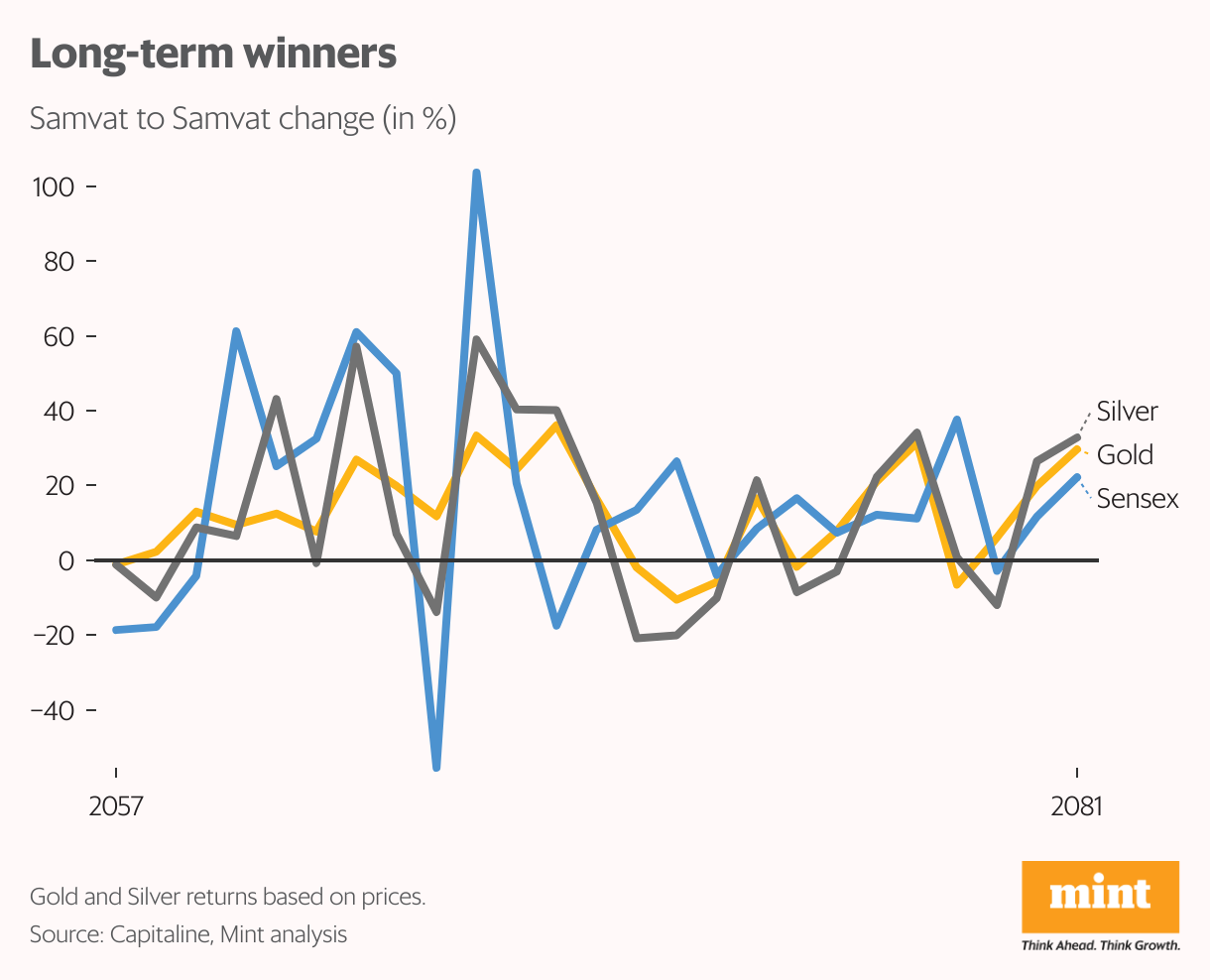
A deep analysis of 25 Samvat years by Mint confirms that while equities remain the dominant long-term wealth creator, gold and silver often tend to outperform during volatile or uncertain years — a pattern clearly visible this year.
Across these 25 years, the 30-scrip blue-chip index, Sensex, has only managed to outperform both gold and silver in nine Samvat periods. Individually, the Sensex was eclipsed by gold and silver a total of 14 times each. Within the metals, gold was outperformed by silver 11 times.
The current divergence is stark: gold has surged 52% year-on-year and silver 55%, dramatically dwarfing the frontline index’s modest 5% gain so far. While gold’s exceptional rally this year was supported by strong central bank buying, rising geopolitical tensions, and economic uncertainty driven by tariffs and rate cut expectations, silver turns white hot amid global supply crunch.
“Money flow has definitely shifted from riskier to safe-haven assets amidst the move and volatility,” said Manav Modi, analyst – precious metals at Motilal Oswal Financial Services.
“On a year-on-year basis, gold and silver have outperformed most asset classes. However, diversification remains key — investors should ideally allocate at least 10% of their portfolio to these metals, depending on risk appetite and investment horizon.”
Meanwhile, experts also caution against taking exposure to bullion at current high prices and suggest entering on dips.

