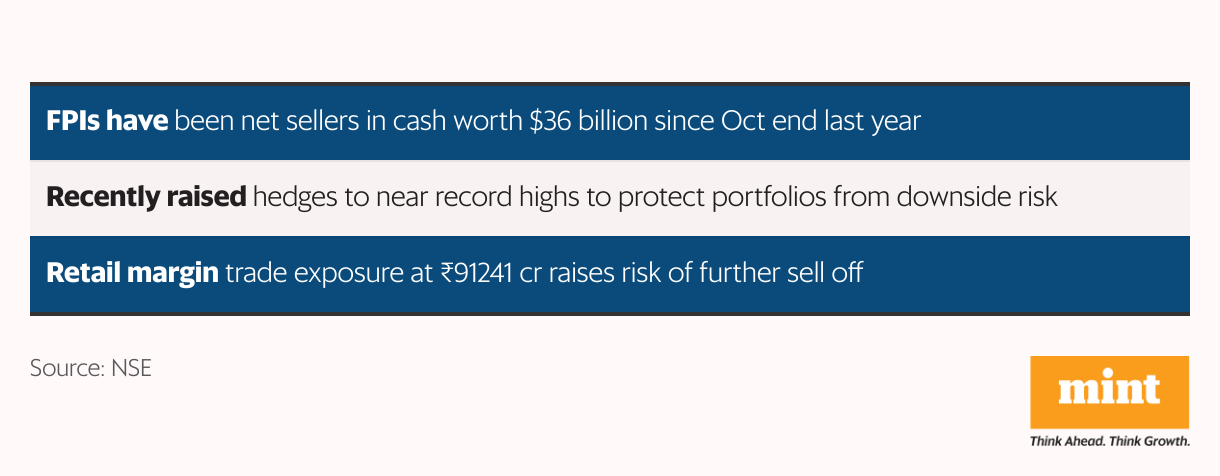
Foreign portfolio investors (FPIs) have raised their bearish bets on Nifty and Bank Nifty derivatives to near record highs, signalling that a market rebound may yet be hard to come by or might peter out quickly.
They have also been selling in the cash market, which analysts said reflects caution amid muted earnings growth and rising tariff tensions between India and the US.
The FPI long-short ratio on index futures fell to 8.28% on Friday, down from 8.58% last Wednesday and close to the 7.75% low seen on 22 March 2023.
FPIs also stepped up selling of index call options and buying of index puts on Friday, a sign they expect markets to stay flat or fall, which will enable them to pocket the premiums paid by call buyers. Puts are purchased as protection against a correction, with their values rising as markets fall.
Net outstanding positions stood at a record negative 90,813 contracts for index calls and 283,135 for puts on Friday. Such positions help protect their $822-billion equity holdings as of July-end, National Securities Depository Ltd (NSDL) data showed.
While FPIs were net buyers of ₹1,932.81 crore in cash shares on Friday, breaking a selling streak of ₹51,391 crore since July, per NSDL and BSE data, market sources linked the inflow to their likely participation in a Bharti Airtel Ltd block deal where the telco’s promoters pared their stake by almost 1%.
“The excessive shorting could be to protect their cash portfolios from an anticipated rise in volatility amid the trade tensions and relatively muted earnings growth,” said Nirmal Jain, founder of the IIFL group. “It’s not easy for either FPIs or domestic investors to figure out what to do in the present time. Best to wait and see how the issue plays out.”
FPI sentiment towards India has soured since June-end due to tariff tensions and muted earnings growth, with the Nifty 50 falling 4.5% to 24,363.3 by Friday, breaching the 24,400-24,500 support zone.
S.K. Joshi, a consultant at Khambatta Securities and a former director (finance) at Bharat Petroleum Corp. Ltd, said that if there’s a bounce back, it will likely be short-lived.
Nitin Jain, chief executive officer at Kotak Mahindra Asset Management (Singapore), agreed, but added that sentiment could quickly flip if India and the US reach a deal before 27 August, when 50% tariffs are due to kick in. He added that earnings growth is set to take off from the second half amid a benign inflationary environment, “which can also aid the currency and bring India back to favour as a potential partner in the US value chain.”
The US, under the Donald Trump administration, imposed an additional 25% tariff on Thursday on top of the one levied on 31 July, citing India’s Russian energy imports. India called the move “unfair and unjustified.”
Rating agency Moody’s estimates the impact on India’s gross domestic product (GDP) growth this fiscal at 30 basis points (it had forecast 6.3% growth). Meanwhile, the Reserve Bank of India (RBI) has retained its 6.5% forecast but held back from cutting a key interest rate.
A basis point is one-hundredth of a percentage point.
Earnings growth remains subdued, with Nifty 50 profits up in single digits for four straight quarters and expected to stay in the mid-single digits this quarter, too, according to market experts. Nifty 50 earnings tend to grow 200-300 basis points above nominal GDP growth (real growth plus inflation).
However, valuations have crept higher—the trailing price-earnings (P/E) multiple rose from 21.05 on 1 April to 21.48 on Friday—making them look stretched.
“FPIs don’t seem interested in our markets for now,” said A. Balasubramanian, managing director and CEO of Aditya Birla Sun Life Mutual Fund. “While earnings are okay, they aren’t good enough for a P/E re-rating.”