


With taxes slashed on medicines, medical equipment, and insurance, GST 2.0 will cover India’s entire healthcare sector. But investors do not seem enthused. Since Modi’s speech on 15 August, pharma, healthcare, and insurance indices have corrected by as much as 2.4%. Even when the GST details came out on 4 September, the indices closed in the red.
What gives? Nuances have overpowered broader optimism.
What got cheaper?
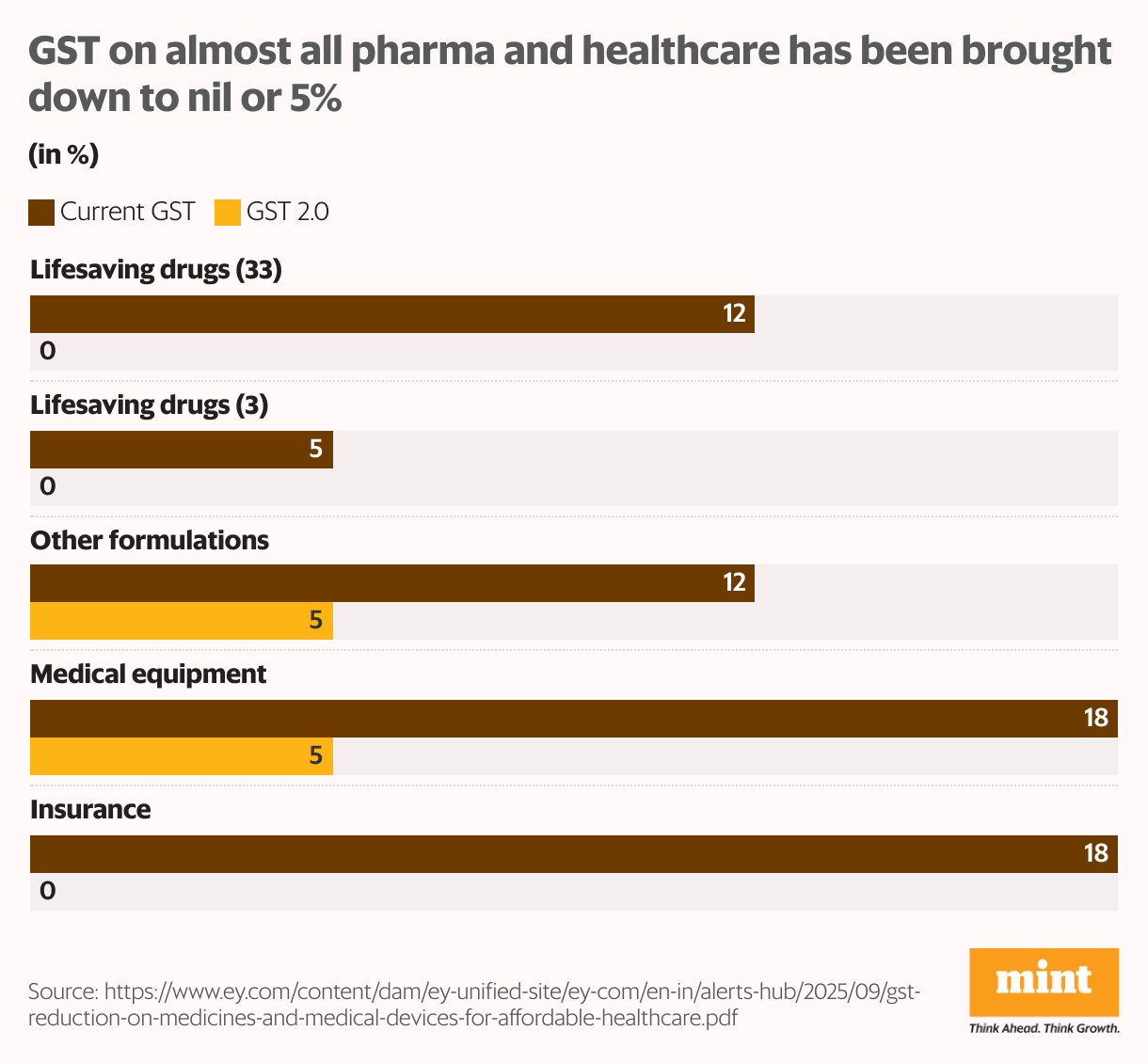
Almost everything related to pharmaceuticals and healthcare has been deemed for mass consumption, thus attracting nil or 5% GST. GST on 36 lifesaving drugs has been reduced to nil, thus ensuring affordable access to drugs for the treatment of rare and chronic diseases.
Other formulations have also been brought down to the 5% GST slab, furthering the cause of equitable access to healthcare. GST on medical devices has also been slashed from 12% or 18% down to 5%, and that on insurance has been cut from 18% to nil. This should benefit hospitals and diagnostic centres, as well as patients, as some of the benefits are passed on.
With higher affordability, quality healthcare would find deeper penetration in semi-urban and rural markets. This should enhance top-line growth for pharma and healthcare providers.
According to Grant Thornton Bharat, the GST rationalization will also end long-term ambiguity, thus freeing up litigation costs and enabling better market planning.
Lifesaving drugs could not save sentiment
Among the 36 lifesaving drugs, which are now exempt from GST, 10 are manufactured by pharmaceutical companies whose Indian arms are listed.
For instance, Novartis manufactures Zolgensma, Scemblix, and Leqvio for spinal muscular atrophy, leukaemia, and hypercholesterolaemia, respectively. Drugs manufactured by Sanofi treat Pompe, Fabry, and Gaucher diseases, among others. These lifesaving drugs are now exempt from GST.
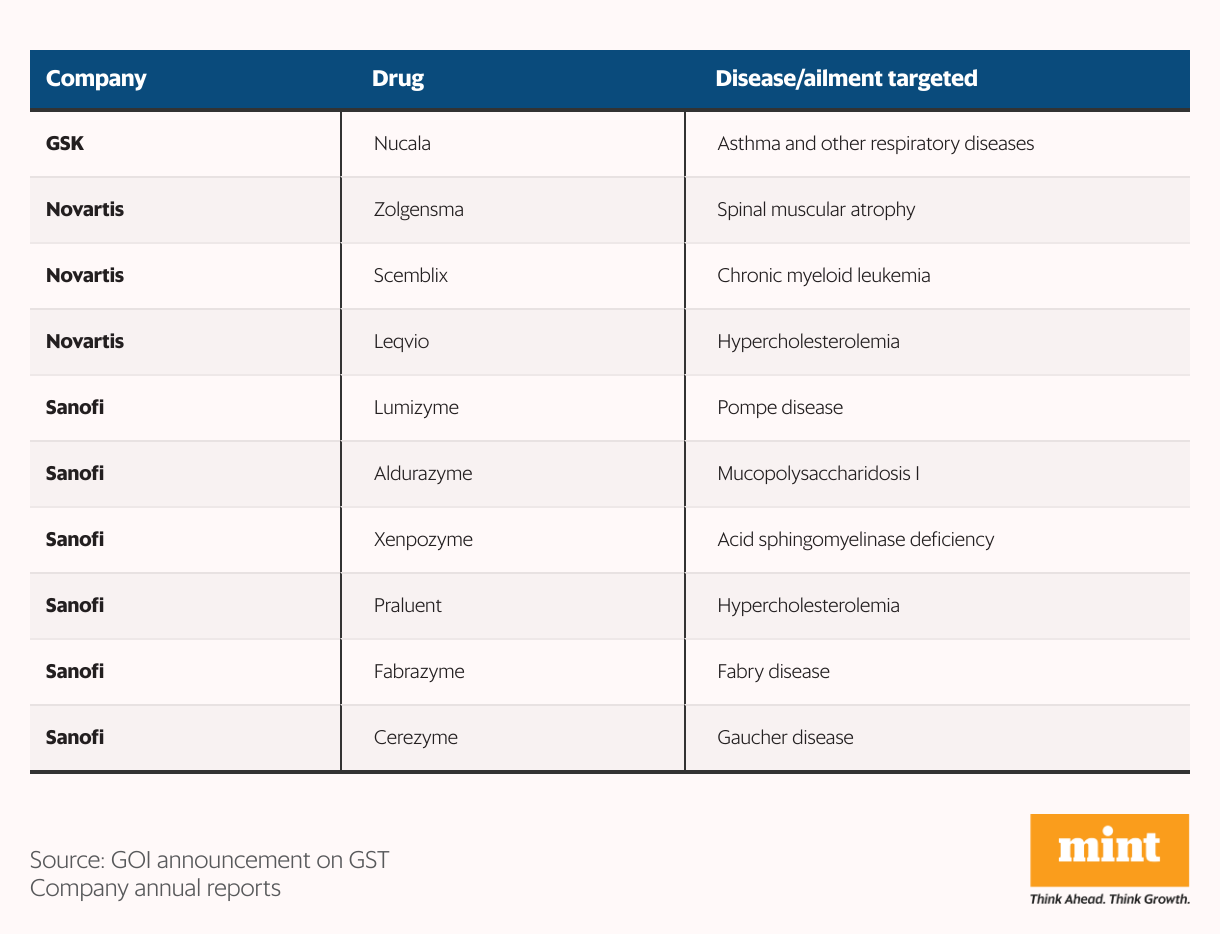
But there are caveats. Some of these drugs are manufactured overseas and imported into India, at times requiring government approval. The imported drugs’ revenue contribution to global sales is fractional. Even when the drugs are manufactured in India, their revenue contribution to the businesses is not significant. The demand for these medicines is not particularly elastic either. Novartis and Sanofi remained flat following the GST announcement.
Mepolizumab, sold under the brand name Nucala by GSK, appears to be an exception. Used to treat severe eosinophilic asthma and other respiratory diseases, Nucala saw 22% revenue growth in 2024-25. Backed by extensive scientific engagement and clinical advocacy initiatives, GSK’s respiratory portfolio is one of the fastest-growing segments in speciality medicines for the company.
Now that GST on Nucala has been slashed from 12% to nil, the medicine should drive even faster top-line growth at GSK. The stock appreciated by almost 3% following the announcement of GST details last week.
Consumer healthcare promises potential
Considering the inelasticity of demand for lifesaving drugs, the impact of GST cuts on their sales is ambiguous. But on the other side of the coin, we have over-the-counter (OTC) medicines. These include analgesics, cough and cold remedies, digestive remedies, wound care, skin treatment, and vitamins, to name a few. Commonly referred to as consumer healthcare, the demand for such medicines has been found to be responsive to price cuts.
According to a report by the Business Research Company, other tailwinds for the segment include an ageing population, an increasing focus on wellness and prevention, and an expansion of e-commerce and online pharmacies. The global consumer healthcare market is expected to expand from just about $0.5 trillion in 2023 to $1.5 trillion by 2028, registering a compound annual growth rate (CAGR) of more than 22%.
In India, the OTC Pharma market has lagged behind. It is estimated at less than $8 billion as of 2025, and is expected to grow at a modest CAGR of 5.6% to $10.3 billion by 2030. This could receive a much-needed push from the GST reforms.
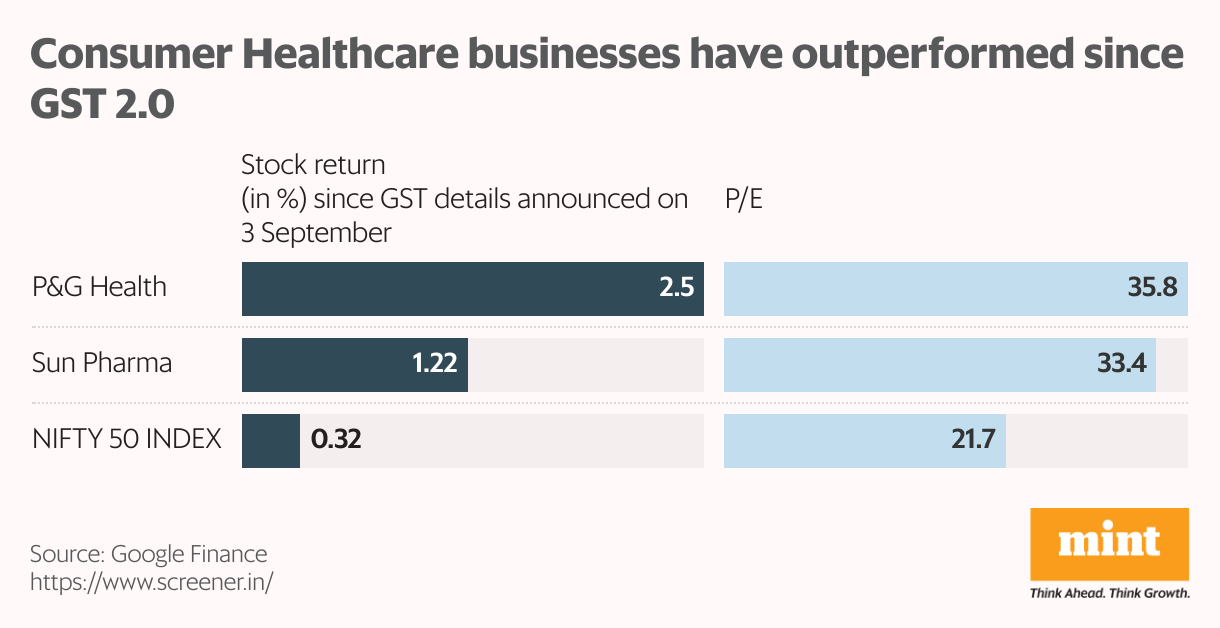
Key beneficiaries include pharmaceutical companies, which are known to have exposure to consumer healthcare. For instance, P&G Health specializes in vitamins, minerals, and supplements. Similarly, with household brands like Revital and Volini, Sun Pharma ranks among the top 10 consumer healthcare companies in India. The stocks have outperformed the broad market since the GST 2.0 announcement on 3 September.
Closely tied insurance and hospital businesses
Insurers and hospitals have recently been in the news over the handling of cashless payments. Apparently, hospitals have been handed the short end of the stick with lower-than-billed and delayed payments from insurers.
GST 2.0 is expected to make it easier for both, insurers, and hospitals. As policy premiums have moved from 18% GST to being exempt, deeper insurance penetration can be expected. For hospitals, the cost of procuring drugs as well as medical equipment is going to moderate.
Drug and other medical consumable procurement accounts for about a third of a hospital’s costs. The reduction in GST on medical equipment is expected to particularly benefit hospitals planning large greenfield capex. Deeper insurance penetration is also expected to benefit hospitals, subject to the successful resolution of their recent disagreements.
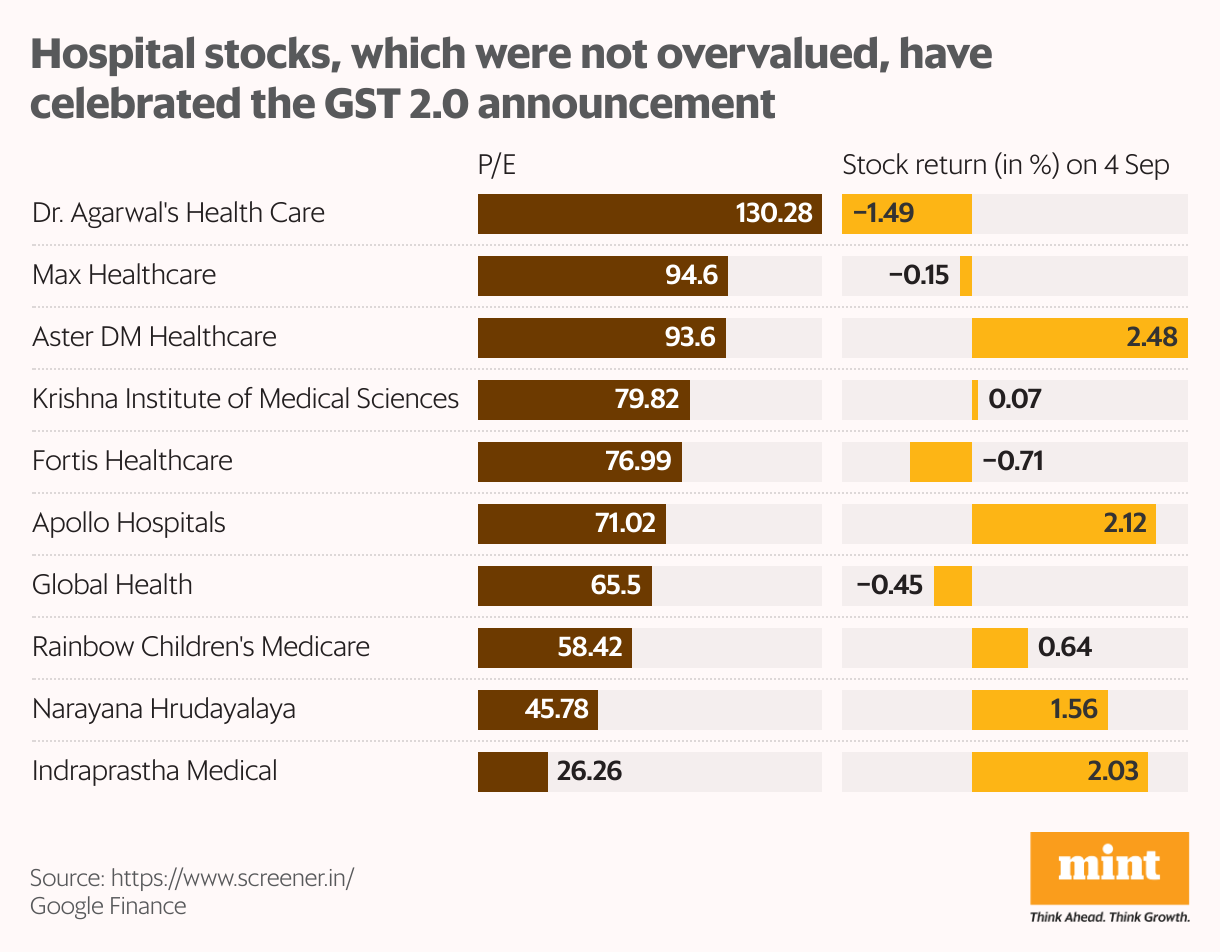
Dr. Agarwal’s stocks have been struggling with the news of the merger, and a few others are priced to perfection. Others have celebrated the GST announcement. Insurance stocks, as we shall see in the next section, have been spooked by near-term margin pressures.
Near-term pressure possible
For life and health insurance policies, as premiums are now exempt from GST, insurers will no longer be able to claim input tax credit on their expenses like reinsurance, claims processing, and commissions. While reinsurance is itself GST-exempt now, it constitutes only about 30% of an insurer’s costs. As a result, experts estimate about 5-7% impact on margins, if insurers were to absorb the entire additional costs.
For pharma companies, too, over the near term, there could be some margin pressure as older (pricier) inventory gets sold at lower GST rates effective from 22 September. Of course, such kinks would iron themselves out over the medium term. And over the longer term, an uptick in volumes is expected to more than make up for any near-term hit to margins.
Still some way to go
Active pharmaceutical ingredients (APIs) and key starting materials are still under the 18% GST slab, thus exaggerating the inverted duty structure (finished goods fall under a lower slab than the raw materials). According to a report by EY India, this would lead to the accumulation of input tax credits and consequent working capital strain despite the provision for a 90% provisional refund of input tax credits.
Another counterproductive outcome would be for pharma companies to avail of state-level incentives and budgetary support schemes calculated on the basis of GST paid. They would lose out on incentives as the tax outgo shrinks. Finally, if GST reforms are to result in long-term competitive advantage, pharma companies will need to use the savings to step up their R&D game.
For more such analyses, read Profit Pulse.
Ananya Roy is the founder of Credibull Capital, a Sebi-registered investment adviser.
Disclosure: The author holds shares of some of the companies discussed. The views expressed are for informational purposes only and should not be considered investment advice. Readers are encouraged to conduct their own research and consult a financial professional before making any investment decisions.

