


The flood of new shares–from mega maiden offers, government divestments and selling by promoters and private equity firms–has some market experts worried about whether institutional investors shifting attention to new shares will trigger a market correction.
“Sure, there is an abundant supply of equity,” says Pranav Haldea, managing director of Prime Database Group. Just in initial public offerings (IPOs), 75 companies with valid approvals plan to raise ₹1.16 lakh crore, while another 95 companies awaiting approval are eyeing ₹1.64 lakh crore. Several large ones are yet to file their papers. “However, I believe that there is no dearth of demand for good-quality paper and attractive valuations.”
Rising mutual fund and retail inflows have bolstered Indian markets. That has given confidence to the likes of Tata Capital Ltd to LG Electronics India Pvt. Ltd to line up mega IPOs. There has also been a surge in block deals and qualified institutional placements (QIPs) as promoters and large investors seek to sell at high valuations.
Smart vs dumb money
Siddhartha Bhaiya, Managing Director and chief investment officer (CIO) of Aequitas Investment Consultancy, however, warns that the markets are headed for a fall and expects suboptimal returns over the next 3–5 years, citing rampant mis-selling as a key red flag. Too many investors are being mis-sold products at inflated valuations, with risks downplayed.
“The smart money is selling, the dumb money is buying. What we’re witnessing is a transfer of wealth from the middle class to the rich,” he said.
While bouts of buying may keep sentiment alive in the short term, Bhaiya says an eventual decline could trigger a consumption slowdown, squeezing household incomes and dampening demand.
When stacked against other countries in the MSCI World index, India has been one of the biggest laggards by one-year returns. The Philippines’ PSEi Composite slumped 11.5%, earning the tag of the worst performer, just below India, where benchmarks Nifty 50 and S&P BSE Sensex slipped 2.4% and 2.5%, respectively, over the past year up to 29 August.
The damage was deeper in the broader markets, with the Nifty Smallcap 250 tumbling 9% and the Nifty Midcap 100 losing more than 5% during the period.
Nifty 50 is staring at a flat spell over the next 3–5 years, according to Shankar Sharma, founder of GQuant. There may be the odd bounce or a fleeting technical rally, but structurally, he sees India lagging global peers. “We’re in the last lap of a bull run that has stretched nearly five years.”
Sharma, however, is bullish on China, calling it the standout market. Stocks from Chile, Peru, Greece, Italy, Germany, and Europe have also delivered good returns, he said.
According to Sharma, India’s underperformance risk stems from a supply glut of equity. Vast promoter and private equity exits, a pipeline of big IPOs, and surging domestic mutual fund and retail flows have created a pool of liquidity that’s being fully tapped.
IPO, block deal rush
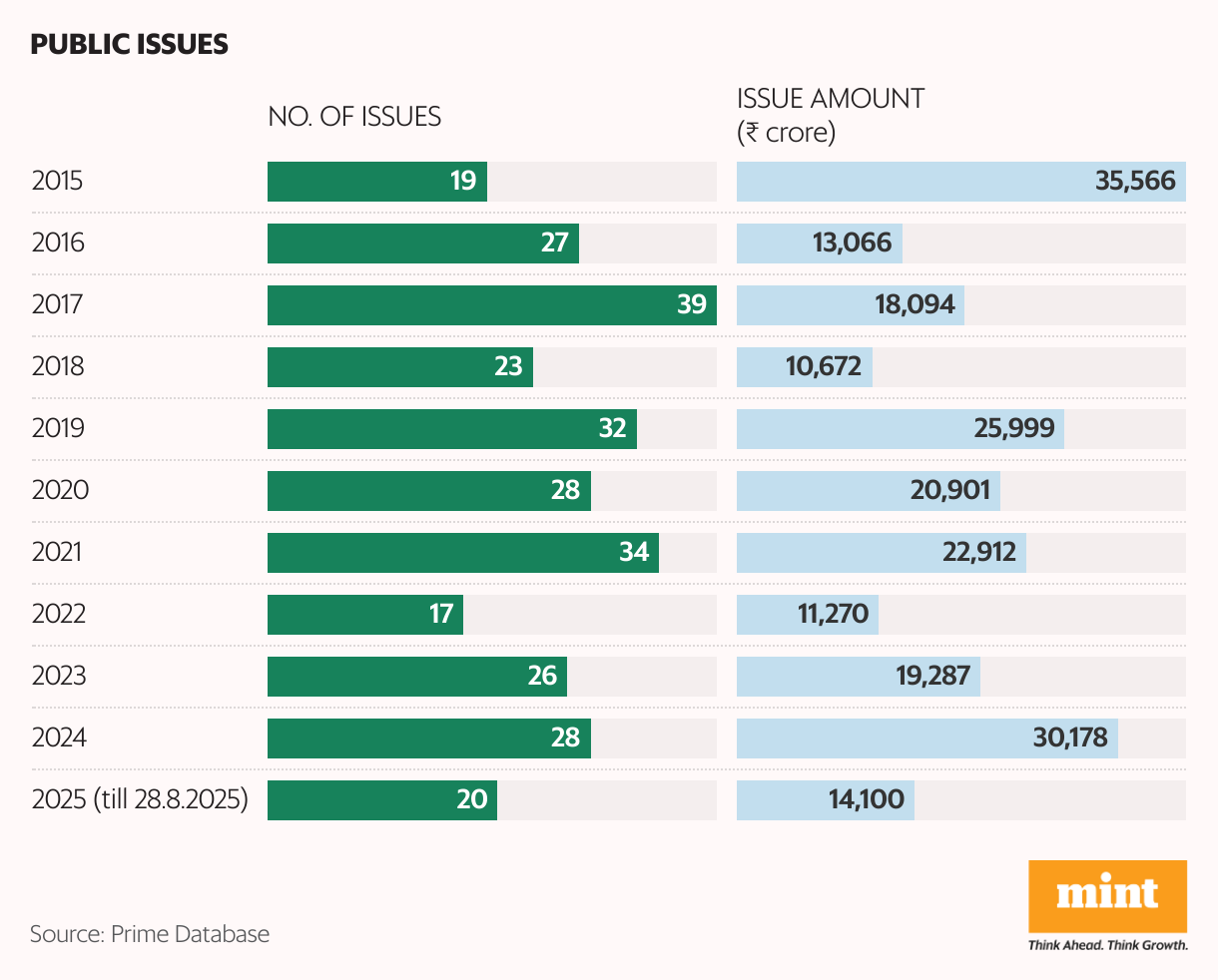
According to Prime Database, several big-ticket IPOs already have Sebi’s nod with approvals still valid—among them LG Electronics ( ₹15,000 crore), Credila Financial Services ( ₹5,000 crore), Dorf Ketal Chemicals India ( ₹5,000 crore), and PhysicsWallah ( ₹4,600 crore). Firms that have filed but await the regulator’s green light include Tata Capital ( ₹17,200 crore), ICICI Prudential Asset Management Co. ( ₹10,200 crore), Lenskart Solutions ( ₹8,000 crore), BillionBrains Garage Ventures ( ₹5,950 crore), Clean Max Enviro Energy Solutions ( ₹5,200 crore), and Inox Clean Energy ( ₹5,000 crore).
Earlier, promoter wealth was just “paper money,” but now, thanks to this liquidity, promoters and private equity players are cashing out at absurd valuations, Sharma said.
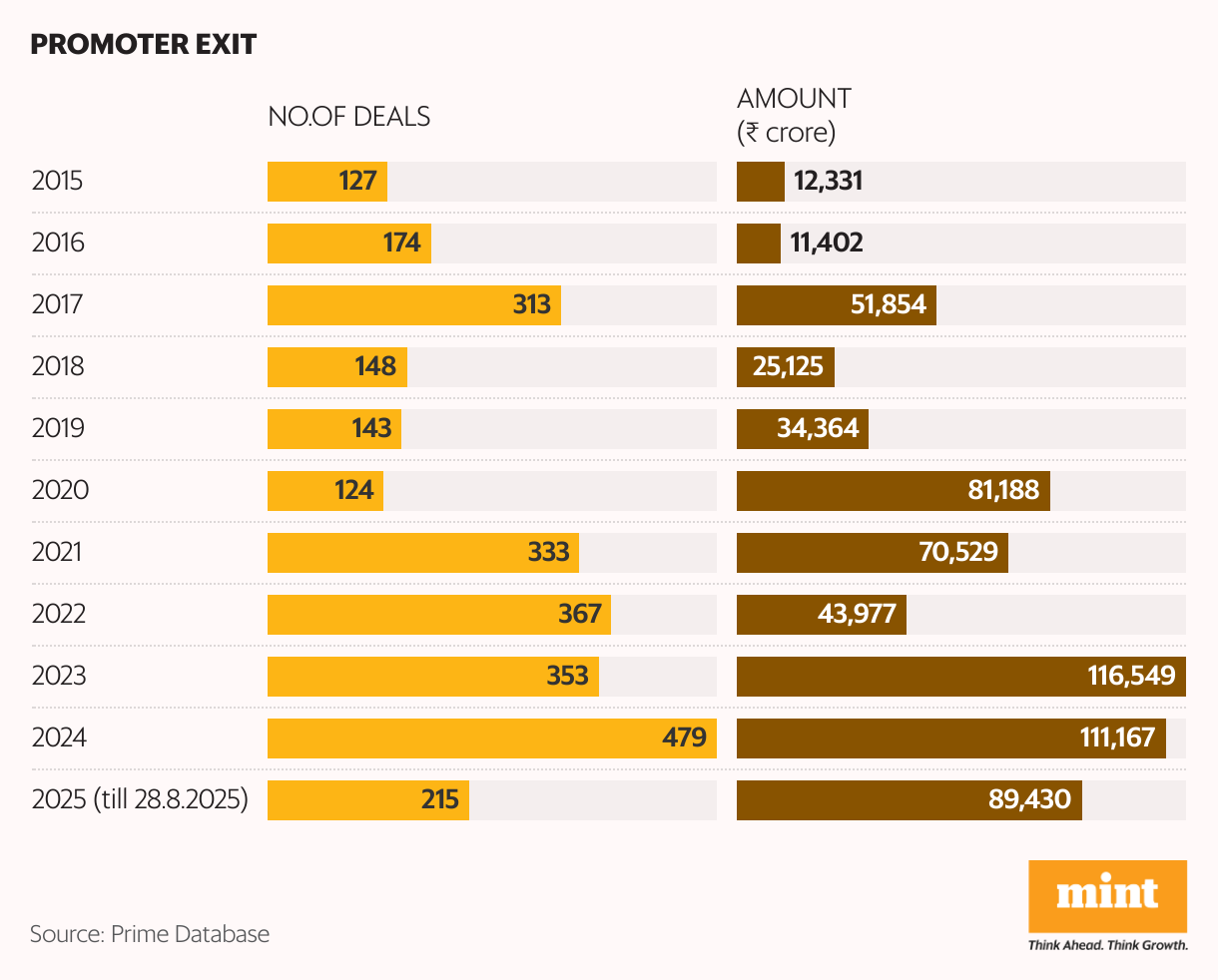
Some of the biggest promoter exits of 2025 have been chunky. At Bharti Airtel, Pastel offloaded shares worth ₹12,879.97 crore, while Indian Continent Investment exited with ₹11,227.05 crore. The Chinkerpoo Family Trust sold its stake in InterGlobe Aviation for ₹10,407.68 crore, and Samayat Services LLP cashed out ₹10,220.40 crore from Vishal Mega Mart. Vedanta Ltd sold shares worth ₹3,028.51 crore in Hindustan Zinc Ltd, while Sunil Vachani offloaded ₹2,221.35 crore worth in Dixon Technologies Ltd, showed Prime Database data.
Private equity and venture capital players, too, have also been busy cashing in. The biggest deal came from ANTFIN (Netherlands) Holding BV, which sold its stake in One 97 Communications Ltd for ₹3,980.76 crore. TPG Asia VII SF Pte sold ₹2,675.64 crore worth of shares in Sai Life Sciences, WestBridge Crossover Fund sold ₹1,905.91 crore in Aptus Value Housing Finance India, while General Atlantic Singapore Fund sold ₹1,790.41 crore worth of shares in KFin Technologies.
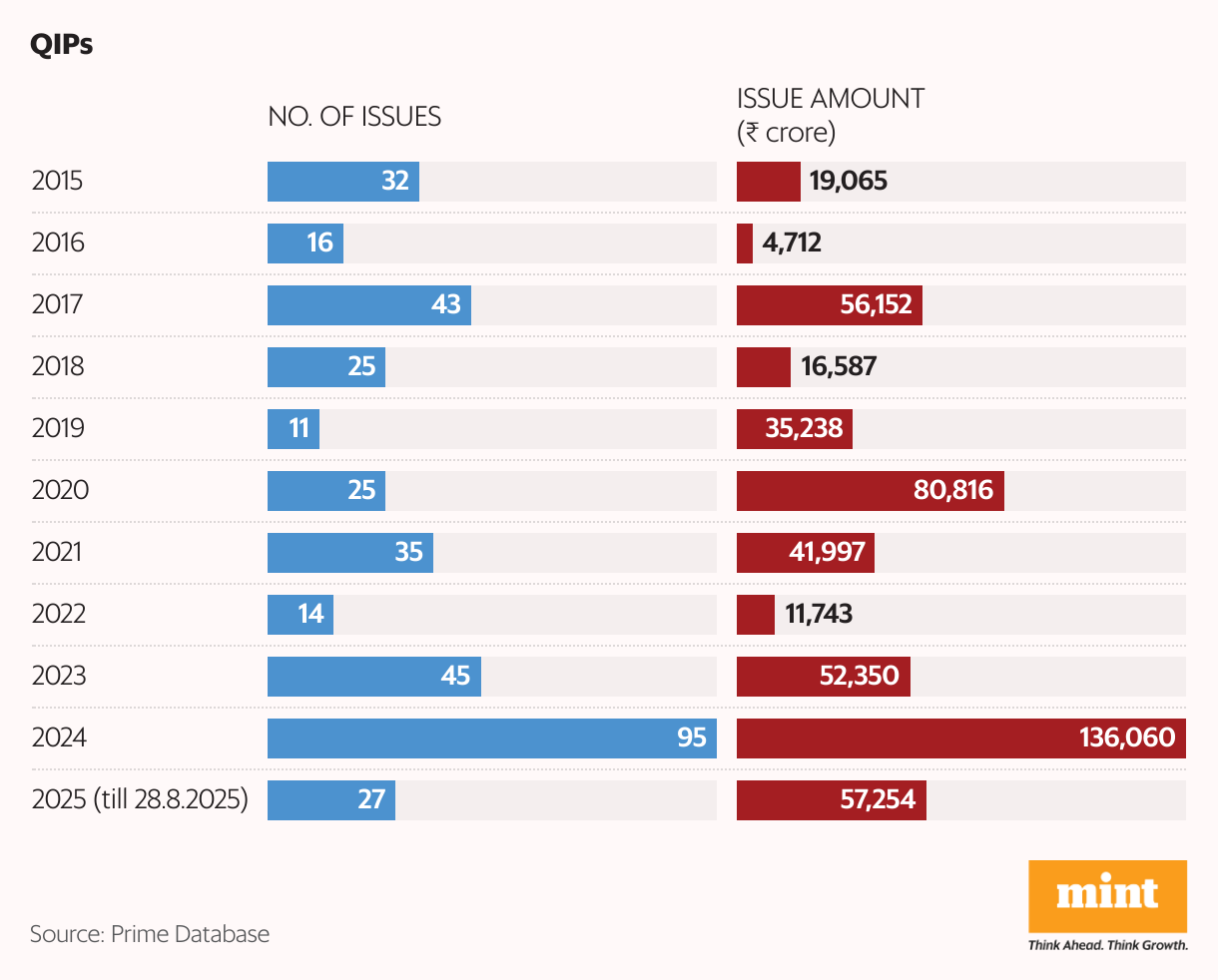
Prime Database data shows that promoter, PE, and VC stake sales have gathered pace post-Covid. Both offer-for-sale (OFS) and QIP issuances have surged since 2023.
The irony, Sharma says, is that while everyone else is making money, retail investors are left shortchanged: SIP returns over the past two years have barely matched fixed deposits at 7–8%, that too with volatility. Capital gains taxes have also lessened the appeal of equities overall.
Domestic investors to the rescue
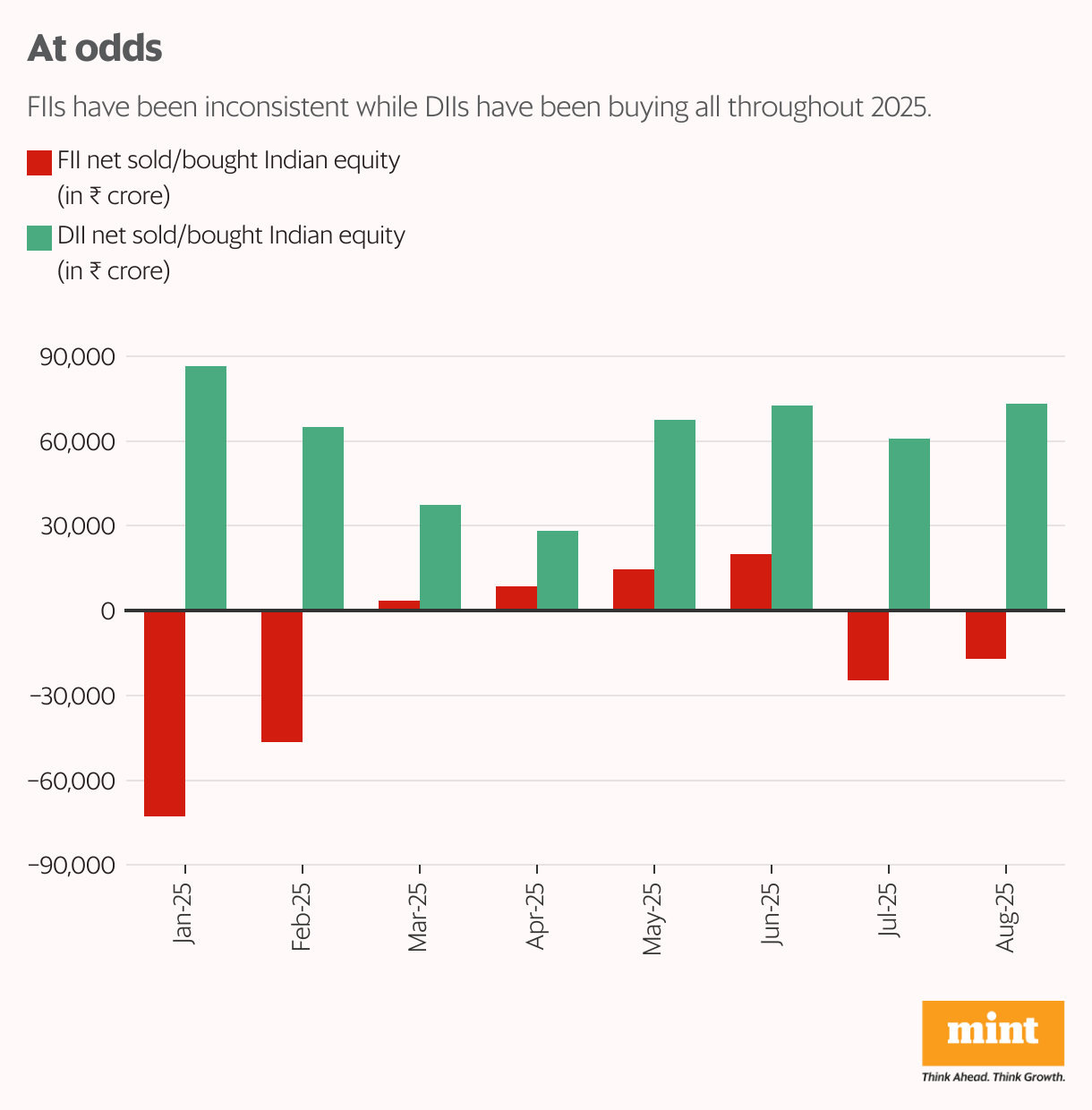
Meanwhile, foreign investors have been blowing hot and cold—selling in January and February, turning buyers for four straight months, only to offload again in July and August. Domestic institutions, on the other hand, have kept the throttle steady, buying every single month this year.
Mutual fund assets under management have been on a steady climb, rising from about ₹33.16 trillion in April–June 2021 to around ₹72.1 trillion in April–June 2025. Meanwhile, new SIP registrations have surged from about 18.6 million in 2022 to 68.3 million in 2024, with about 37.7 million already added in 2025 so far.
Haldea of Prime Database Group highlighted that while domestic institutional investors (DIIs), largely led by mutual funds, have been consistently pumping in money and supporting the market, individuals—including retail and high-net-worth clients—took advantage of the upswing in prices to book profits and turned net sellers to the tune of ₹24,000 crore and ₹9,000 crore in the June and March quarters, respectively. This came after pumping in ₹49,000 crore in the December quarter.
Despite equity oversupply, a major correction is unlikely, according to Haldea. The last five years have shown that both primary and secondary markets can deliver in parallel, he said.
Tax cuts to counter tariff woes?
Tariffs imposed by the US on India have been an overhang for the Indian market.
The tariff issue is all the more important because growth has already slowed, particularly nominal GDP growth, which is so important for equity markets, said Christopher Wood in a 28 August Jefferies note. Jefferies projects India’s nominal GDP growth to slow from 10% in FY25 to 8.5–9% in FY26 — the lowest rate in the past two decades, barring the Covid years–FY20 and FY21.
“Still, if this is the backdrop, the reason the stock market has not yet reacted more negatively of late to the 50% tariff threat, particularly consumption-related stocks, is the escalating policy response of the government,” Wood said.
The February budget already delivered income tax cuts. But the bigger positive now is the proposed overhaul of GST — reducing the current four slabs (5%, 12%, 18%, 28%) to just two (5% and 18%). GREED & fear learnt from senior Delhi officials that while this rationalisation had been in the works for a while, the Trump-triggered tariff tussle has fast-tracked its rollout, Wood said. The aim is to implement the new GST rates by September-end, he said.
Divestment overhang
Another factor adding to the potential equity glut is the government’s own divestment push.
Mint reported in August that the Centre plans to cut its stake in Life Insurance Corp. and several public sector banks (PSBs) beyond Sebi’s mandated levels. Five PSBs—Indian Overseas Bank (94.61% state stake),UCO Bank (90.95%), Punjab & Sind Bank (93.85%),Central Bank of India (89.27%) andBank of Maharashtra (79.60%)—are required to bring government holding below 75% by August 2026. Of these, only Bank of Maharashtra is on track to meet the deadline, Mint had reported.
Haldea, however, says the proof lies in the pudding—there have been several announcements on disinvestments and stake sales, but little action.

