


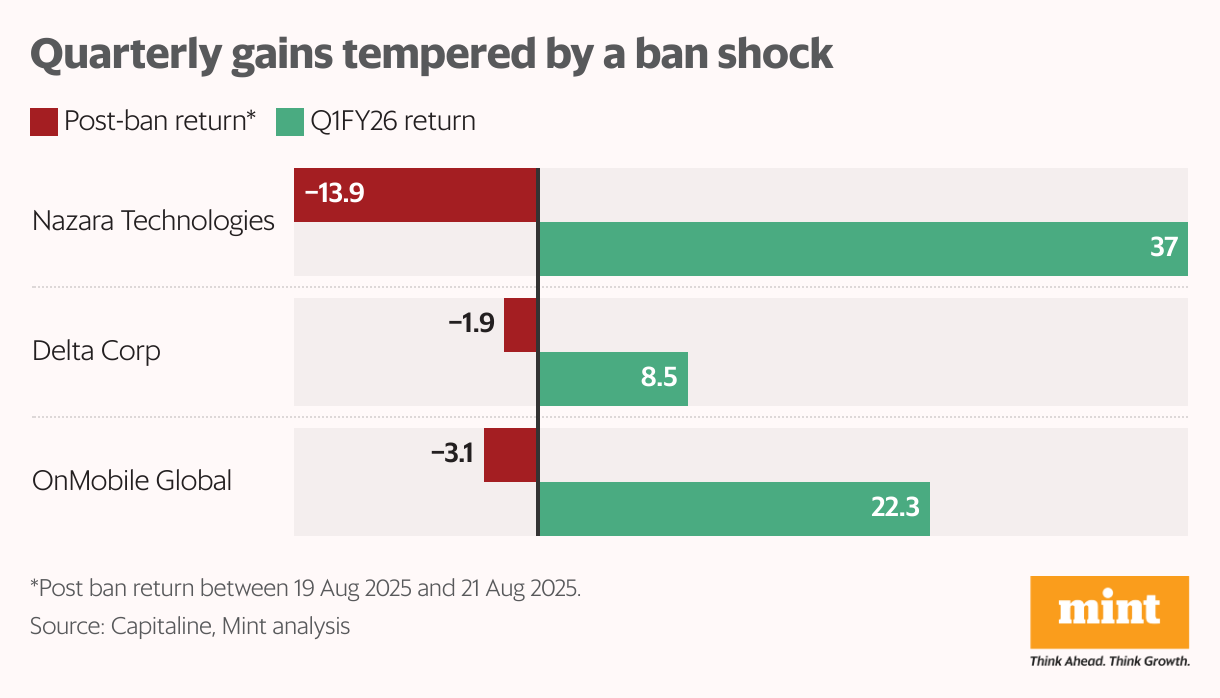
Shares of Nazara Technologies plunged 14% in two sessions—13% on Wednesday and another 1.2% on Thursday. Delta Corp and OnMobile Global slipped 2% and 3%, respectively, in two sessions.
“The passage of the online gaming bill has created an immediate overhang for gaming stocks, and the near-term impact looks sharply negative. Since the bill effectively bans real-money gaming (RMG), which currently contributes nearly 86% to India’s online gaming revenues, investor sentiment has turned cautious,” said Hariprasad K., a Sebi-registered research analyst and founder, Livelong Wealth.
Yet, amid the carnage, thousands of small investors who had been steadily trimming their stakes in gaming stocks over the past year appear to have walked away just in time.
Did investors see it coming?
A Mint analysis of shareholding data reveals a striking trend: retail investors (those holding up to ₹2 lakh in equity) have been gradually trimming their stakes in gaming stocks for a year before the ban.
To be sure, retail investors pared exposure in Nazara Technologies for four straight quarters. In the June quarter alone, 11,272 retail investors exited the stock, reducing the base to 114,420 from 125,692 in March.
These investors have seen their wealth erode by around ₹200 crore in two trading sessions following the ban, but the ones who exited the stock during the June quarter would have walked away with hefty gains of nearly 37%.
These exits weren’t new, as their retail shareholders’ base saw a sequential reduction. Besides, their ownership steadily declined to 10.94% in June, down from 15.79% a year ago. Institutional investors also pared stakes: FPIs cut by 0.3 points to 25.95%, and mutual funds by 0.64 points to 8.95% in the June quarter, on a sequential basis.
Underlying resilience
Nazara has been quick to reassure investors. It clarified that the Promotion and Regulation of Online Gaming Bill, 2025, has no direct bearing on its consolidated revenues or Ebitda. “The company’s only indirect exposure to RMG is through its 46.07% stake in Moonshine Technologies Private Limited (PokerBaazi),” the company clarified in a release.
Consider Moonshine Technologies—Nazara’s associate company and the operator of PokerBaazi. Its net revenue surged 54% year-on-year in Q1FY26 to ₹191.8 crore, marking its best-ever quarter. PokerBaazi’s gross gaming revenue (GGR) grew 46% to ₹434 crore, driven by higher user engagement and improved products, according to the company’s presentation.
But the concern is perception. “While Nazara’s core businesses in e-sports, adtech, and gamified learning remain strong, the stock is under pressure due to perception. Despite company assurances, investors fear a potential regulatory crackdown could force a significant write-down of its 46% stake in Moonshine Games, valued at over ₹1,000 crore,” said Harshal Dasani, business head at Invasset PMS.
He concluded that long-term investors may be comforted by its diversified revenue and strong balance sheet, but traders are awaiting regulatory clarity.
“The market reaction has been swift, with fears around its ₹800+ crore investment in PokerBaazi potentially getting written off. While diversified revenue streams buffer the hit, the stock will likely remain volatile until clarity emerges,” Hariprasad added.
OnMobile Global: limited exposure, mixed flow
For OnMobile Global, the story was more uneven. In Q1FY26, 1,395 investors exited, cutting the retail base to 86,546. Earlier quarters showed a mixed trend of net additions and a reduction in the retail investor base. Though, retail ownership slipped just 0.01 points to 33.29% in June.
On the other hand, FPIs marginally increased holdings to 1.48%, while mutual funds stayed away. Despite investor churn, the stock delivered 22.3% gains in the June quarter.
“OnMobile’s exposure is relatively indirect—focused on mobile entertainment and gaming subscriptions rather than RMG. Still, as part of the gaming basket, it may see collateral selling. Fundamentally, its risk from the ban is lower than Nazara or Delta,” Hariprasad said.
A regulatory jolt
Parliament has passed the Promotion and Regulation of Online Gaming Act, 2025 that draws a clear line: e-sports, educational games, and social play are permitted; all real-money online games—whether skill- or chance-based—are banned outright.
The bill bars companies from offering or advertising RMG, and prohibits banks from processing related payments. Violators face up to three years’ jail and fines up to ₹1 crore, with harsher penalties for repeat offences. The government also has the power to block offending platforms.
The broad definition covering both games of skill and chance puts popular formats like fantasy cricket, rummy and poker at risk and raises serious questions for both domestic and overseas investors.
“Because of this scope, companies offering such games may be prohibited from operating… ‘Real Money Games’ like fantasy cricket, rummy, and poker are extremely popular with millions of players. Overseas companies have also invested in these formats, putting business models and investments at risk,” said Vikram Jeet Singh, partner at BTG Advaya, a disputes and transactional law firm.

