


The US Federal Reserve, chaired by Jerome Powell, trimmed its benchmark rate by 25 basis points (bps) on Wednesday, lowering the federal funds rate to a range of 4.00–4.25%.
This marks the first rate cut since December 2024 and signals mounting concerns over employment even as inflation pressures linger. Policymakers project another 50 bps of easing by year-end, followed by measured cuts of 25 bps each in the next two years, underscoring the Fed’s tightrope walk between growth and price stability.
While the Indian markets saw only modest gains with headline indices gaining just 0.4%, the real question is whether this initial ripple will become a wave and whether it will be enough to inject the optimism needed to reverse the recent FPI flows, a puzzle Mint decodes.
Is the Fed rate cut enough to trigger a sustained bullish trend in Indian markets?
Global investors often treat Fed actions as turning points for risk appetite. Yet, past cycles show India’s equity markets respond more to domestic earnings and global fundamentals than to US monetary shifts.
History suggests that rate cuts in the US do not guarantee a bull run on Dalal Street. In 2019, the Fed cut rates three times, but the Nifty gained meaningfully only after the October cut—rising 2.5% over six months. Earlier decisions barely moved the needle.
In March 2020, when the Fed slashed rates by 150 bps in two rapid steps, Indian equities still reeled under the pandemic shock, with the Nifty down 1% six months later.
More recently, three cuts delivered between September and December 2024 coincided with a 12% drop in the Nifty over the next six months, dragged down by recession fears, tariff tensions, and weak global demand.
“Investors often assume that a Fed rate cut automatically sparks a bull run in India, but history doesn’t support that view. The last cycle of cuts actually coincided with a 17% correction in Indian equities, driven not by Fed policy but by overvaluation and weak earnings growth,” said Anand K. Rathi, co-founder of Mira Money, a digital-first investment platform.
Also read: Indian, Japanese firms lead corporate turnarounds
Will India’s premium valuation be a deterrent in attracting fresh foreign capital?
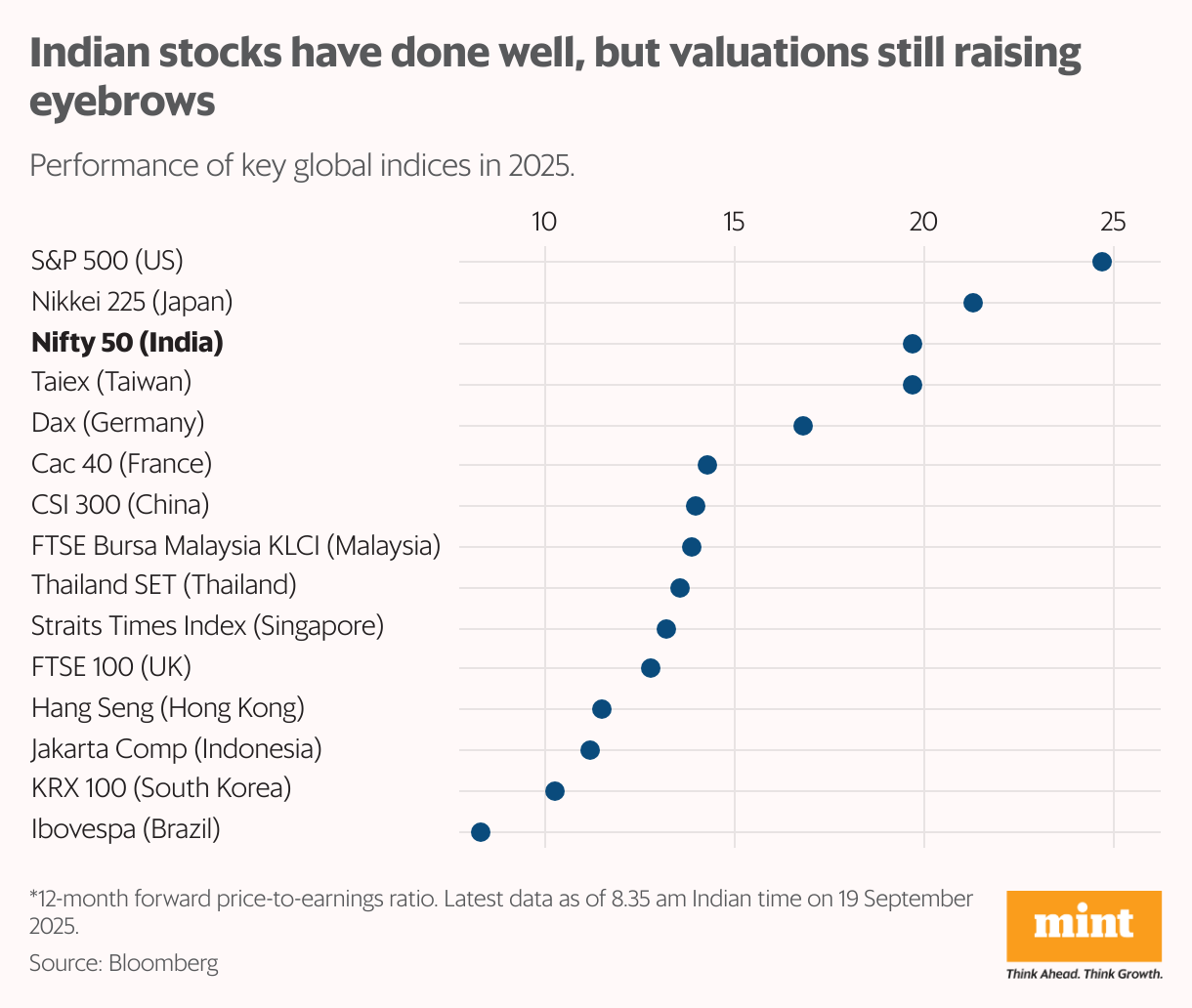
The Federal Reserve’s rate cut has reignited hopes of fresh liquidity flowing into emerging markets. But for India, the bigger hurdle may not be global liquidity—it may be whether investors are willing to pay up for already stretched valuations.
In the covid trough on 23 March 2020, nearly two-thirds of listed companies traded at less than 10 times earnings, while half of market wealth sat in the 10–25x band. Only 5% of stocks commanded valuations above 60x.
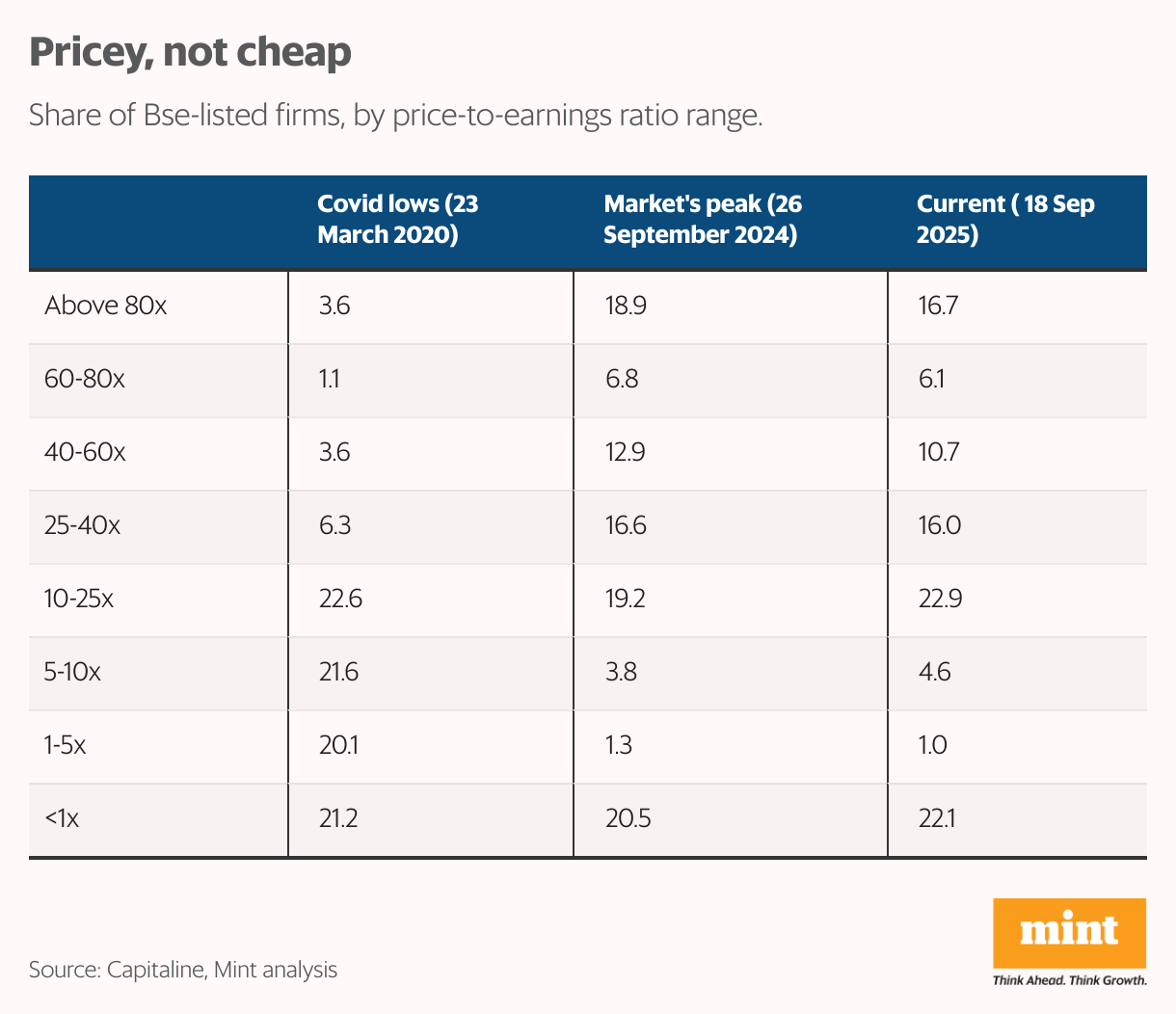
By 26 September 2024, when the Sensex scaled record highs, 26% of companies were priced above 60x, while nearly 30% fell in the 25–60x range. The share of firms trading below 10x shrank to just 5%.
Even after a recent 3% correction, valuations remain stretched: 23% of stocks still trade above 60x earnings and another 27% in 25–60x range. Deep discounts have virtually disappeared, raising questions about whether earnings growth can justify such multiples.
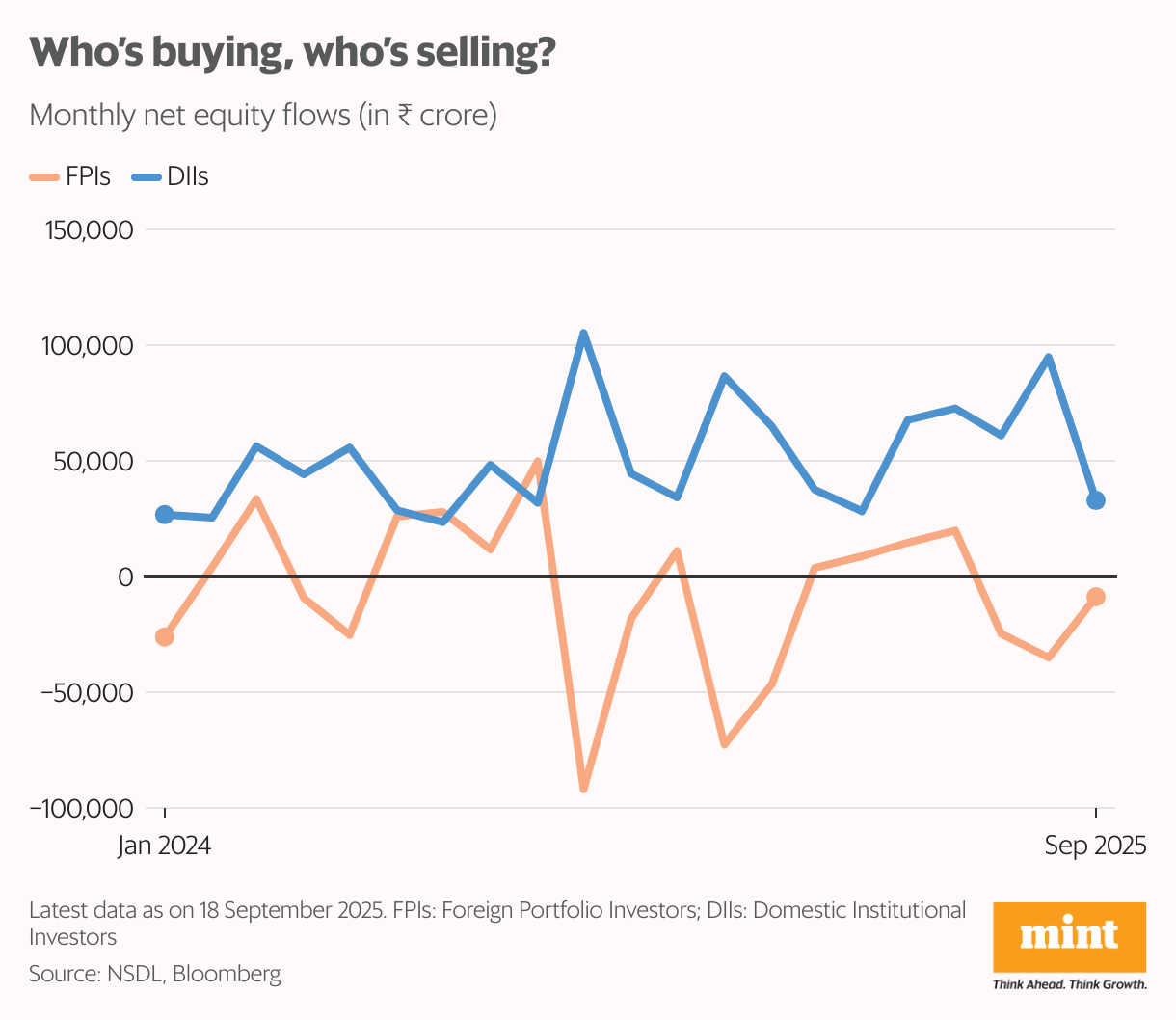
Against the backdrop, flows show a tug-of-war. In September so far, FPIs have sold ₹8,730 crore worth of shares. Domestic institutional investors (DIIs), however, offset the exodus with robust inflows of ₹32,893 crore. This counter-balance has become routine: every month since January 2024, DIIs have offset foreign selling.
The scale of divergence is striking. Between March 2024 and September 2025, FPIs recorded multiple months of withdrawals above ₹25,000 crore. Yet, DIIs consistently stepped up, often with inflows above ₹50,000 crore. In October 2024, while FPIs offloaded ₹91,933.64 crore, DIIs invested ₹1.05 trillion—their strongest monthly commitment on record. This domestic defence has been crucial in steadying Indian equities amid volatile global flows.
Where are FPIs currently directing their investments across other emerging economies?
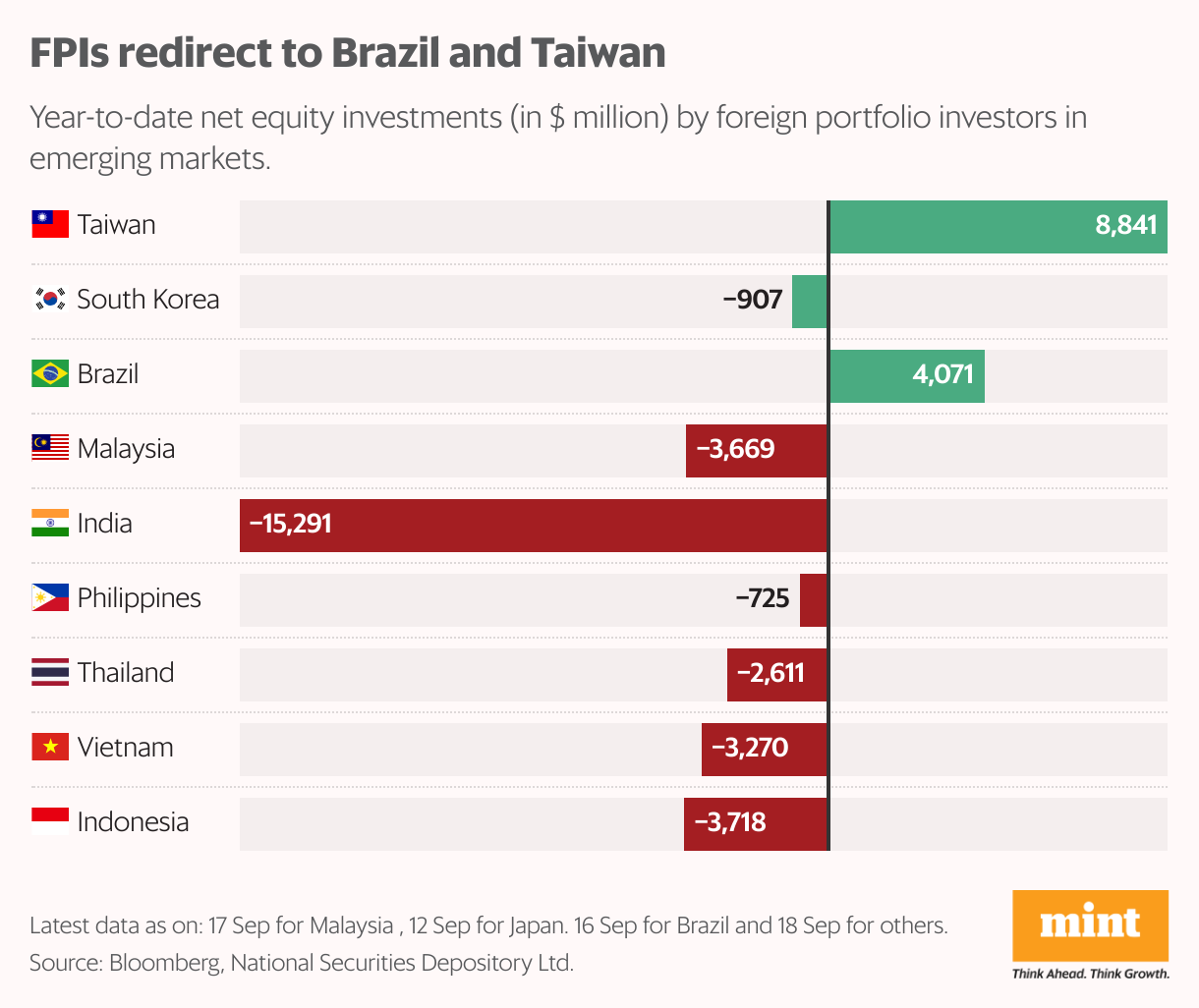
Global reallocation trends have hurt India’s relative appeal in 2025. Year-to-date, FPIs have pulled out $15.3 billion from Indian equities—the sharpest outflows among major emerging markets.
Brazil and Taiwan have been the biggest winners. FPIs pumped $8.8 billion into the Taiex and $4.1 billion into Brazil’s Ibovespa, lured by relative value and commodity-linked growth prospects.
Elsewhere in Asia, outflows continue: South Korea saw outflows of $907 million, while Malaysia, Indonesia, Thailand and Vietnam each saw $2.6–3.7 billion of exits. The Philippines was relatively spared, with modest withdrawals of $725 million.
“These outflows have hit India hard, largely because of heightened risks around tariffs, which investors assumed would persist,” said Abhishek Bisen, senior EVP & fund manager, fixed income, Kotak Mutual Fund.
“But negotiations are underway, and indications suggest reversals are likely soon. Equities have also run ahead of fundamentals, with earnings growth lagging amid signs of a slowdown, making a correction inevitable. At the same time, a depreciated currency and improving policy signals make Indian markets attractive again. Once the dust settles, we expect foreign investors to return in a meaningful way,” he added.
Also read Countdown to market cap rejig: New guards book the upper berth
What is the fear gauge indicating? Calm or warning of complacency?
Volatility in Indian equities has collapsed to historic lows amid these shifts, v. On Thursday, the India VIX made its lifetime low at 9.89. While currently the market is navigating global uncertainty, the fear gauge had spiked during past crises: it jumped to an all-time high on 17 November 2008 during the global financial meltdown, and again surged to 83.6 on 24 March 2020 at the peak of the covid sell-off.
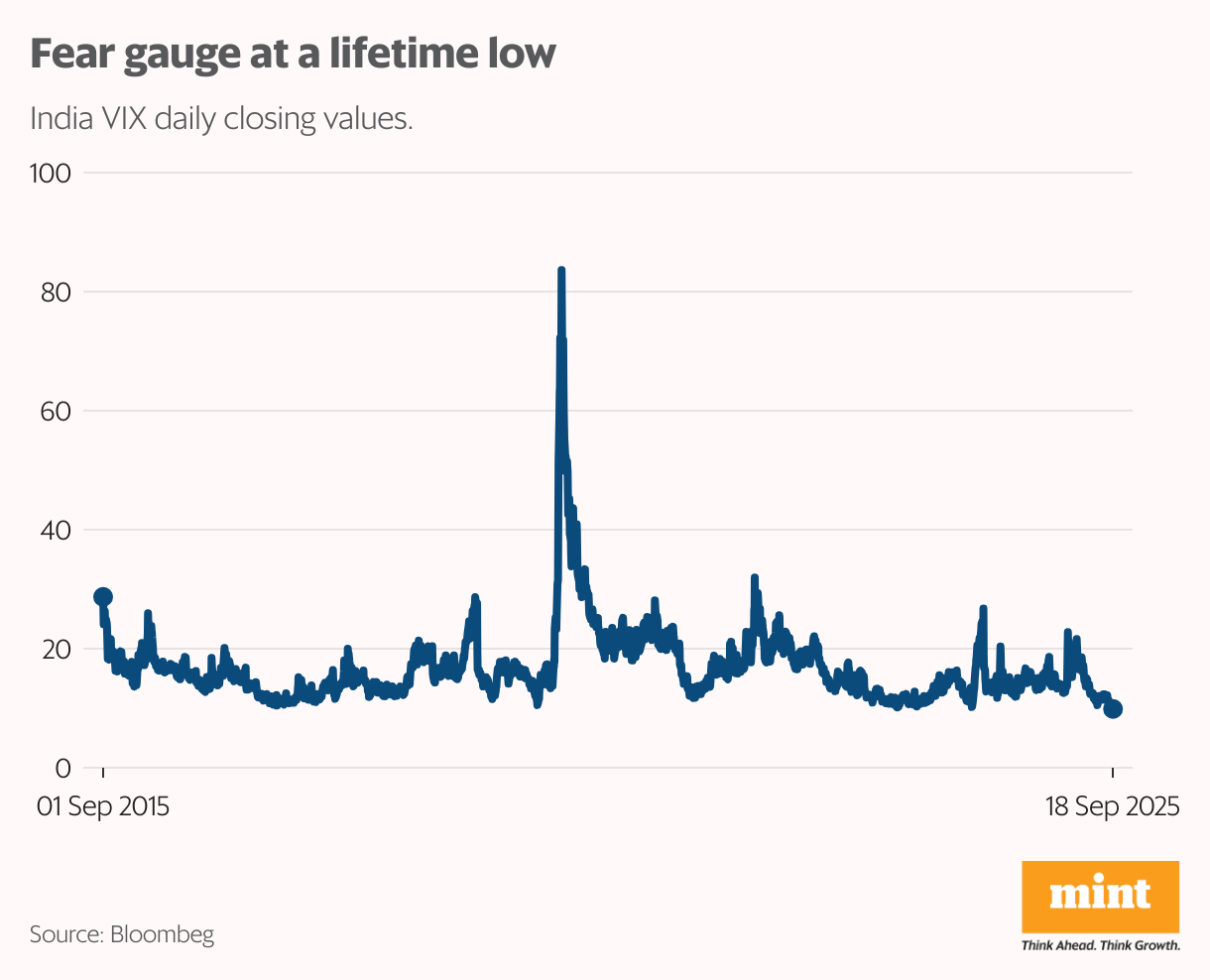
By design, VIX rises when uncertainty climbs and falls as risk perceptions ease. While today’s subdued levels suggest calm waters and muted demand for hedging, they also carry the risk of complacency.
“A low fear gauge simply means the market feels comfortable and doesn’t expect much volatility. But history shows sudden news—good or bad—can jolt markets sharply. At present, the only visible positive trigger appears to be a potential shift in Trump’s tariff stance,” cautioned Rathi of Mira Money.

