


But this expansion comes as the group faces fresh scrutiny in the US: just months after Gautam Adani was accused by the US SEC and the Department of Justice of bribery, Mundra Solar PV Ltd (MSPVL), a subsidiary of Adani Enterprises, is being sued by the country’s largest solar cell manufacturer for alleged patent theft—a case that, along with the group’s heavy reliance on export markets, could temper its momentum.
Adani Enterprises’ stock has fallen nearly 25% in the past year, undoing the outperformance of the previous year. But the company has big plans for its renewable energy businesses, boosted by the government’s persistent push for clean energy.
Can this help it tide over its latest legal hurdles and carry the stock back to its former glory?
Solar could power Adani’s next leg of growth
The Adani group spans everything from energy, airports, and roads to cement, metals, mining, and media. It categorizes airports, roads, and green hydrogen as “incubating businesses” and the rest as “established.”
The incubating businesses are now outpacing the established ones, contributing 60% of the group’s Ebitda in FY25—nearly half of it from green hydrogen. These initiatives sit under Adani New Industries Ltd (ANIL), which, until recently, made wind turbine generators. Late last year, it absorbed Mundra Solar Technology, a manufacturer of solar wafers and ingots.
Two sister companies—Mundra Solar PV Ltd (MSPVL) and Mundra Solar Energy Ltd (MSEL), which make solar cells and modules—will also be folded into ANIL, creating an integrated supply chain for its green hydrogen ambitions.
MSPVL doubled its revenue in FY25 to ₹6,353 crore, powered by about ₹3,000 crore in exports to the US. That made it responsible for nearly half of ANIL’s ₹14,236 crore revenue in a year when the Adani group posted close to ₹1 trillion in revenue overall.
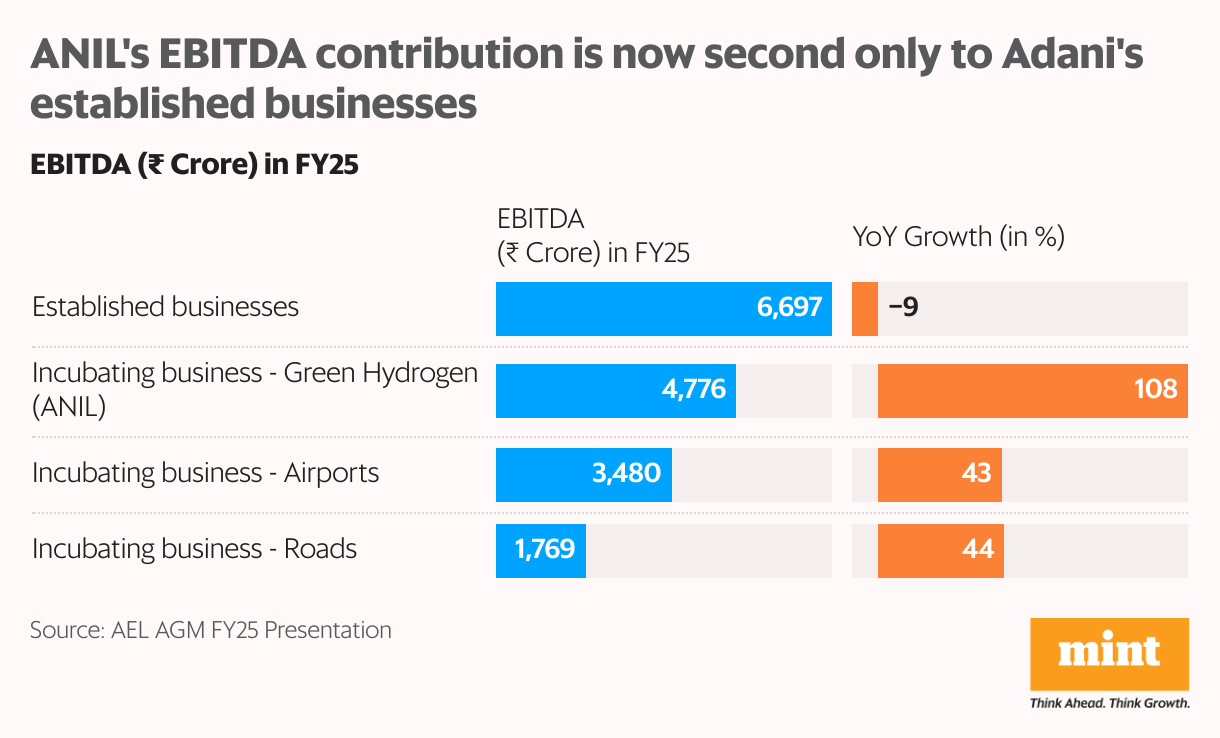
Crucially, ANIL has been Ebitda-accretive. Its earnings more than doubled to ₹4,776 crore in FY25, making it the group’s second-largest Ebitda contributor after the established businesses and accounting for nearly 30% of the total. MSPVL’s profit surged five-fold to ₹1,085 crore, driven by high-margin exports—an outlier in a year when the established portfolio saw Ebitda shrink 9%.
Big plans for solar
Adani is betting big on green hydrogen, with solar manufacturing at the heart of that strategy.
At Mundra in Gujarat, the group is building a fully integrated green hydrogen ecosystem powered largely by solar energy. The facility will produce green hydrogen and downstream products, with manufacturing and consumption tightly linked. The goal: minimal wastage, quick turnaround, low inventory costs, and reduced overheads—driving superior cost efficiency.
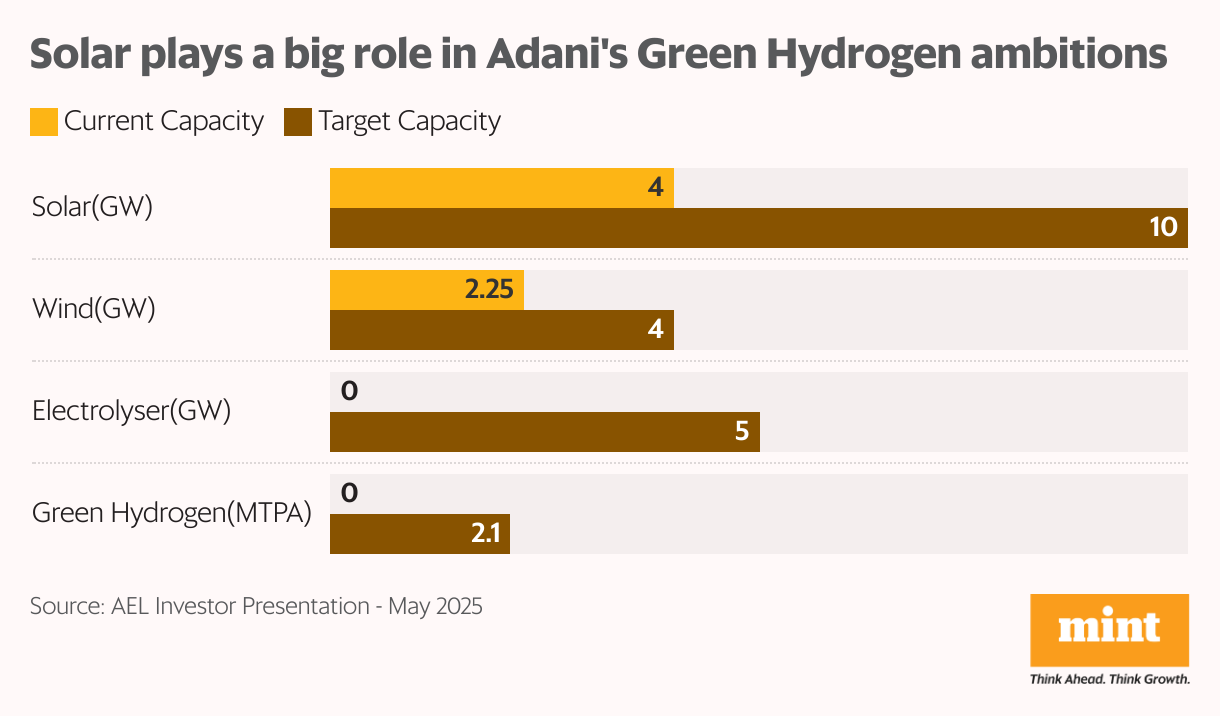
To support this, Adani has set up a backward-integrated solar manufacturing chain. Mundra Solar Technology produces silicon wafers and ingots, which feed into MSPVL and MSEL for the production of solar cells and modules using high-efficiency TOPCon and mono-PERC technologies. Together, the two units have an annual capacity of 4 GW, slated to rise to 10 GW in the next two years. The group has already secured ₹5,500 crore in funding for this expansion.
ANIL has also secured production-linked incentives for 300 MW of electrolyser manufacturing capacity, which will help subsidize its planned 5 GW electrolyser plant. Alongside its 2.25 GW of wind generation, targeted to double to 4 GW, ANIL aims to create a 2.1 million tonnes per annum (MTPA) integrated green hydrogen value chain.
Well-placed to capitalize on industry tailwinds
India is targeting 500 GW of renewable energy capacity by 2030, with solar expected to contribute 300 GW. To accelerate this, the government has rolled out production-linked incentive (PLI) schemes, central and state capex subsidies, domestic procurement mandates, and steep import duties on solar cells (27.5%) and modules (44%).
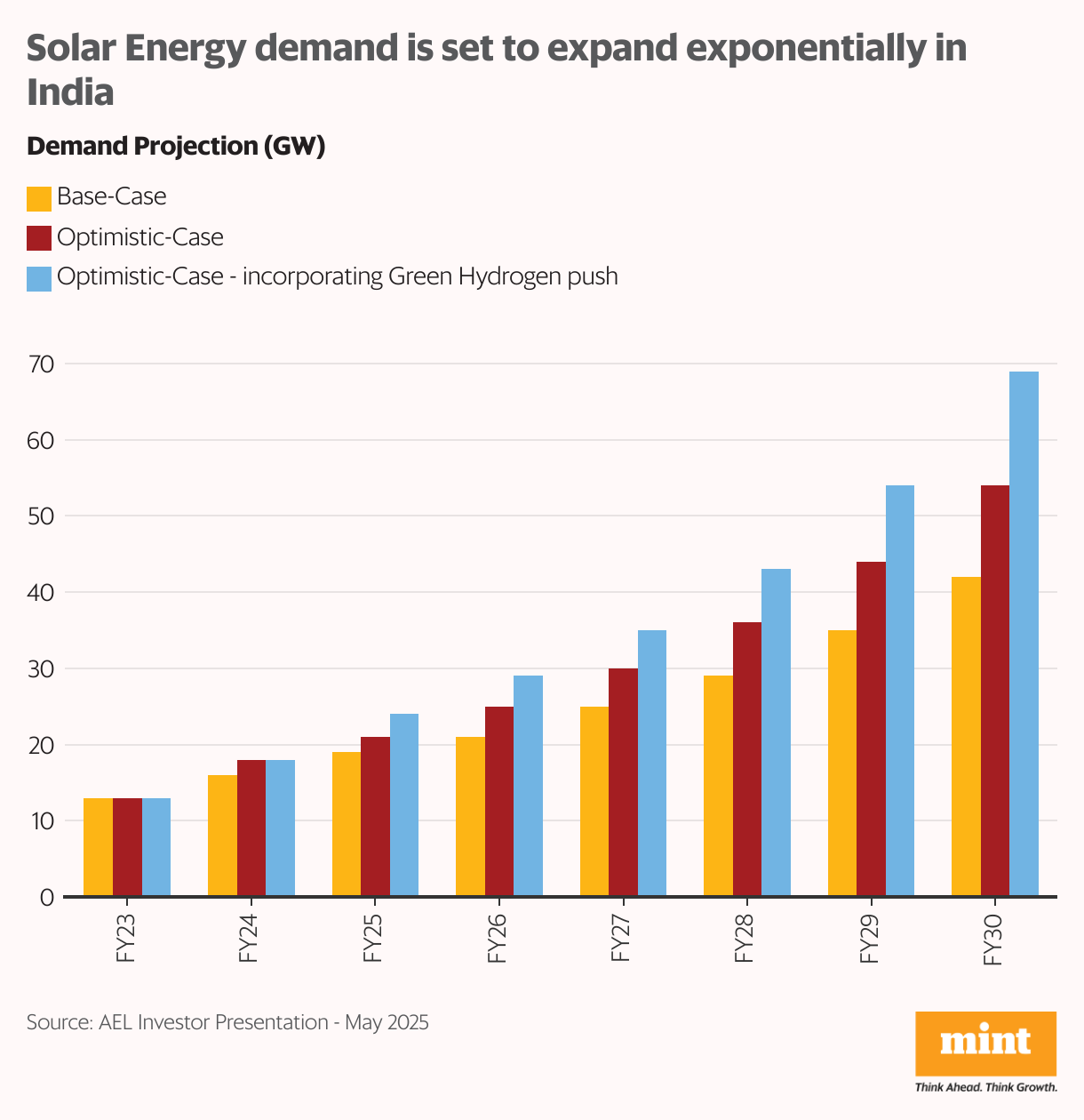
These measures, along with assured offtake through central PSUs, the Kisan Urja Suraksha evam Utthan Mahaabhiyan (KUSUM) programme, and rooftop solar initiatives, are expected to lift domestic solar demand to 42 GW annually by FY30.
Green hydrogen, with its zero emissions, high energy density, scalability, and ability to decarbonize hard-to-abate sectors such as heavy industry and long-haul transport, is seen as a cornerstone of the net-zero transition. Factoring in demand from green hydrogen projects under optimistic scenarios, annual solar demand could reach 69 GW.
ANIL is positioned to benefit from this policy push and industry momentum as the only hydrogen hub being developed by a player with deep expertise in both renewable energy and port infrastructure. Its fully developed, utility-scale grid-connected site at Mundra SEZ is designed to produce green hydrogen at costs competitive with fossil fuels.
In FY25, the company sold 4.3 GW of solar capacity, up from 2.7 GW the previous year, and has already secured export orders of 1.9 GW for FY26. Proximity to end-users, along with substantial captive demand from Adani’s fertiliser, steel, cement, power, and petrochemical businesses, should further support growth.
Can the patent-theft allegation play spoilsport?
Nasdaq-listed First Solar, the largest US solar manufacturer, has accused MSPVL of patent infringement in a Delaware court. The company is seeking unspecified damages. First Solar has also sued China-based JinkoSolar on similar grounds and sent warning letters to others, including Canadian Solar.
Adani is contesting the charge. In fact, the group had pre-emptively approached the Delaware court, claiming innocence after receiving an accusatory letter from First Solar.
Its defence rests on key differences in manufacturing methods, most notably, Adani’s process skips the heat-treatment step central to First Solar’s patented technology. Experts say this distinction could be enough to disprove equivalence and potentially tilt the case in Adani’s favour.
Exports are a crucial revenue stream. ANIL earns about ₹3,000 crore annually from solar panel shipments to the US. While India’s estimated 6.55 MTPA domestic hydrogen demand could, over time, reduce reliance on exports as the market shifts from grey to green hydrogen, overseas sales remain critical for now. An unfavourable court ruling could therefore slow growth.
For more such analysis, read Profit Pulse.
Another risk looms on the trade front. Indian solar exports currently enjoy an edge in the US, as they are exempt from tariffs that hit Chinese solar cells and polysilicon at 50%. If Trump were to change the policy, it could further squeeze Adani’s US business.
Ananya Roy is the founder of Credibull Capital, a SEBI-registered investment adviser. X: @ananyaroycfa
Disclosure: The author does not hold shares of the companies discussed. The views expressed are for informational purposes only and should not be considered investment advice. Readers are encouraged to conduct their own research and consult a financial professional before making any investment decisions.

