


A colourful veteran of World War II, he also served in US military campaigns in Korea, Nicaragua and Haiti. A famous incident during the Korean War offered a glimpse into his mode of thinking.One day, in the midst of battle, a breathless soldier ran up to him with some grim news. “Sir, we’re surrounded by enemy soldiers from all sides!”
Puller’s eyes lit up instantaneously. “Good,” he replied, “This makes it the perfect time to go on the offensive, because now we can shoot in any direction.”
View Full Image
This mindset of seeing opportunity where others see only danger is a hallmark not just of great military leaders but also outstanding investors.
The most successful investors, both globally and in India, have made their fortunes not when times were good, but when fear was at its peak and their backs were against the wall.
‘Buy the dip’ is a well-worn investing maxim. It is also the hardest thing to do in practice. Just ask the millions of investors in India’s embattled IT sector.
Peak pessimism
To say that India’s $280-billion IT industry is facing trouble would be flirting shamelessly with understatement.
Global macroeconomic headwinds, tariff-induced uncertainties in multiple sectors, delayed decision-making by clients and subdued discretionary tech spends across geographies have coalesced into the roughest seas the industry has faced in recent years.
Adding to this is the tidal wave of generative artificial intelligence (GenAI), which threatens to wash away the entire business model the IT services outsourcing industry has been built on.
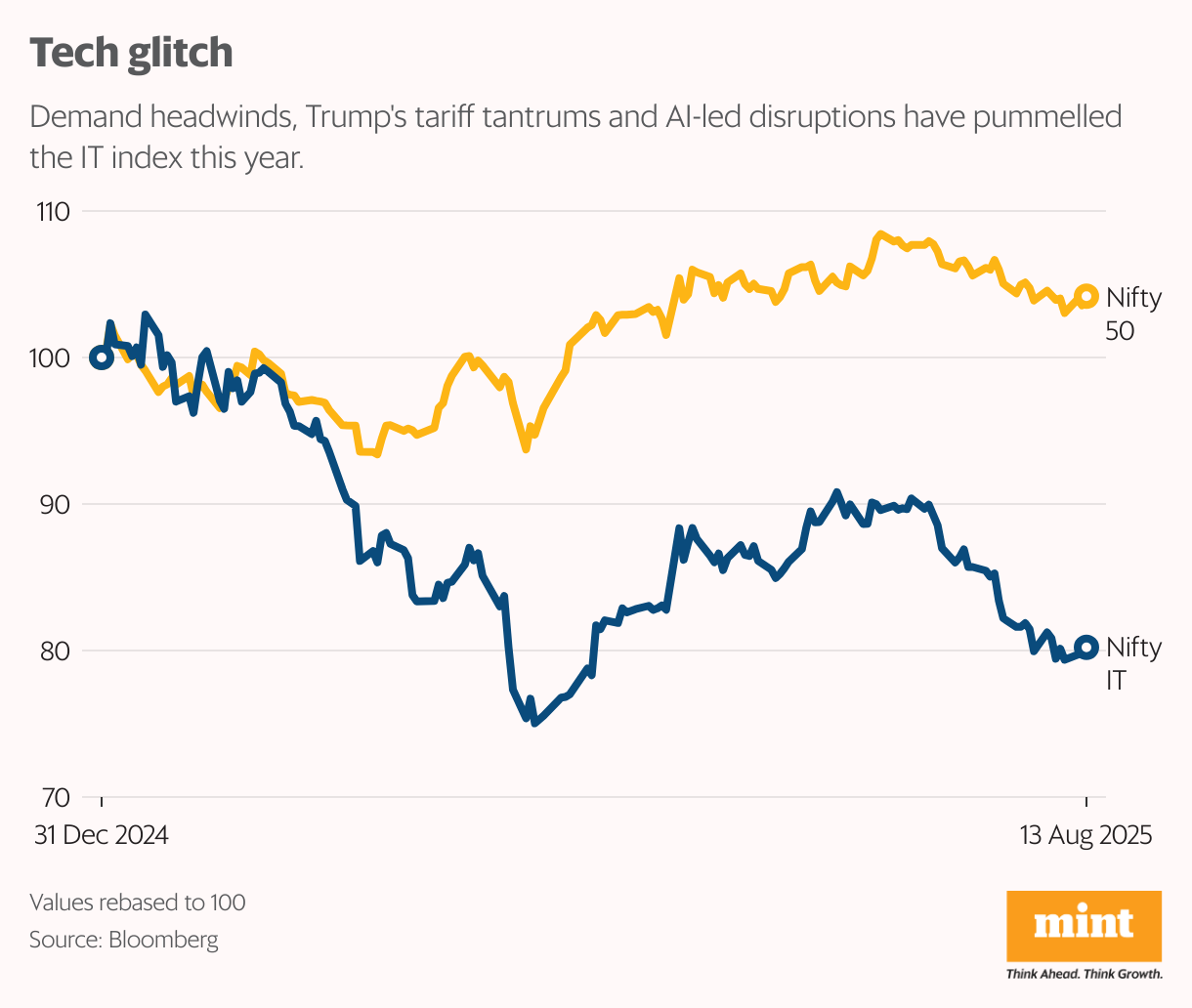
GenAI is driving unprecedented efficiency across software development and maintenance, automating vast chunks of coding, testing and debugging. Tasks that once required teams of engineers can now be handled by a fraction of the headcount, upending traditional staffing models and shaking the foundations of IT services pricing.
“With 35-45% of industry revenues tied to ADM (application development and maintenance services), even partial automation poses a meaningful headwind. We estimated that up to 10-15% of current revenue could come under pressure as clients start getting more for less, making productivity a structural challenge,” domestic brokerage Motilal Oswal stated in a note last month.
It is not as if the Indian IT sector has not faced massive industry-altering shifts in the past. But GenAI is turning out to be a whole different beast in terms of both speed of adoption and scope of deployment.
“Indian IT sector’s legacy business deflation is nothing new: what is biting is the absence of a new technology cycle to replace the old,” analysts at the brokerage house noted.
During earlier transitions (e.g. to the cloud, or from legacy app development to digital), vendors were quick to scale up new offerings that more than compensated for the decline in older lines of business.
“This time, GenAI is exacerbating the deflationary pain, but there is no budgetary expansion from a new tech cycle in sight,” the analysts noted. “Clients are experimenting, but large scale rollouts are limited, and traditional programmes continue to get rationalized or delayed.”
Report card
IT firms’ June quarter (Q1 FY26) numbers amply demonstrated the pain coursing through the sector.
While deal wins were robust across the board, four of the five largest IT companies posted a sequential decline in revenue on a constant currency basis—TCS, HCL Technologies, Wipro and Tech Mahindra. Only Infosys logged a 2.6% growth.
Compared to the same quarter last year, only two of the top five players managed to clock revenue growth (constant currency)—Infosys and HCL Tech.
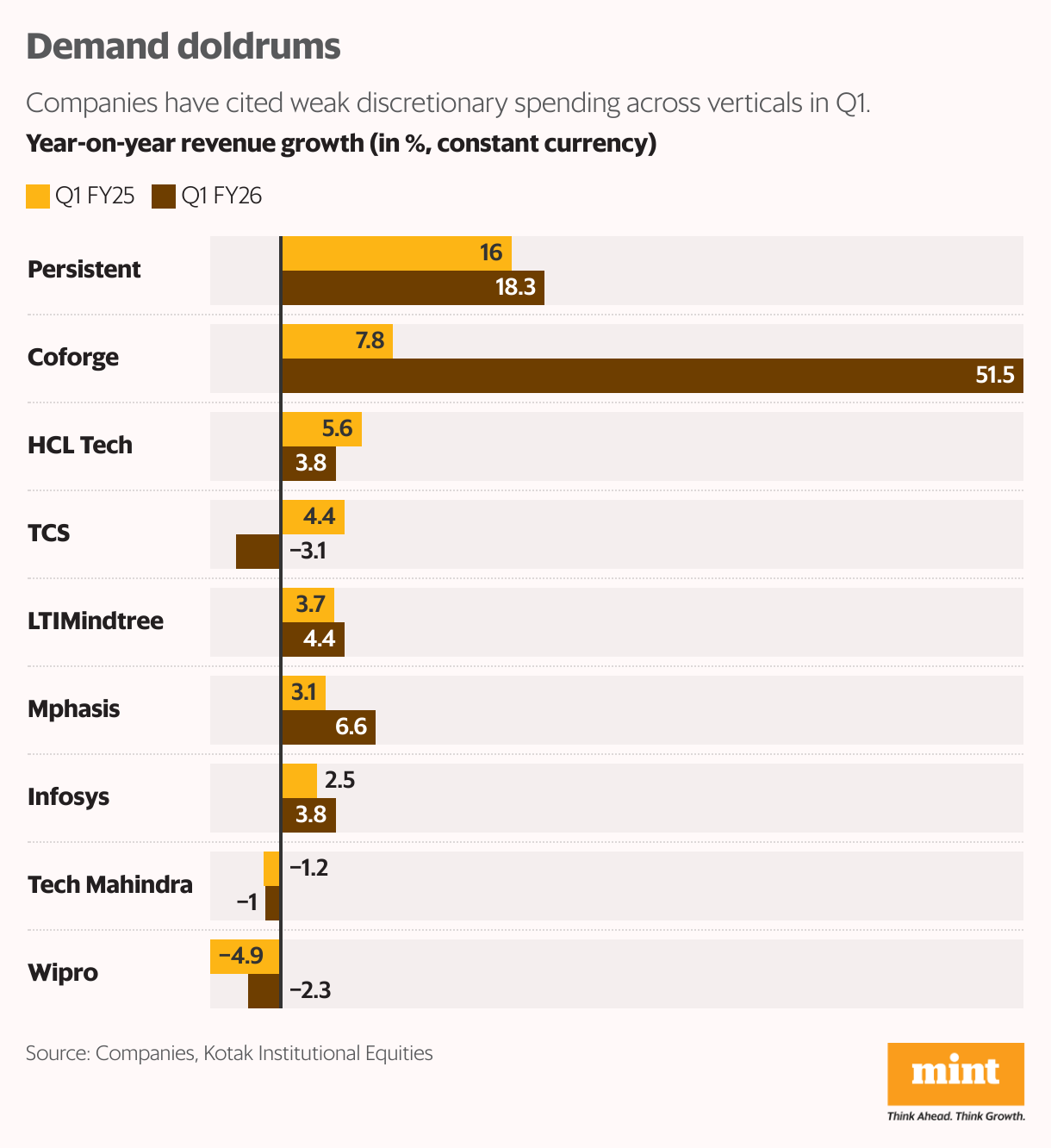
Even mid-tier firms, which have outperformed their larger peers in recent times, are beginning to see signs of strain, with revenue growth slowing in Q1 FY26 compared to the past few quarters.
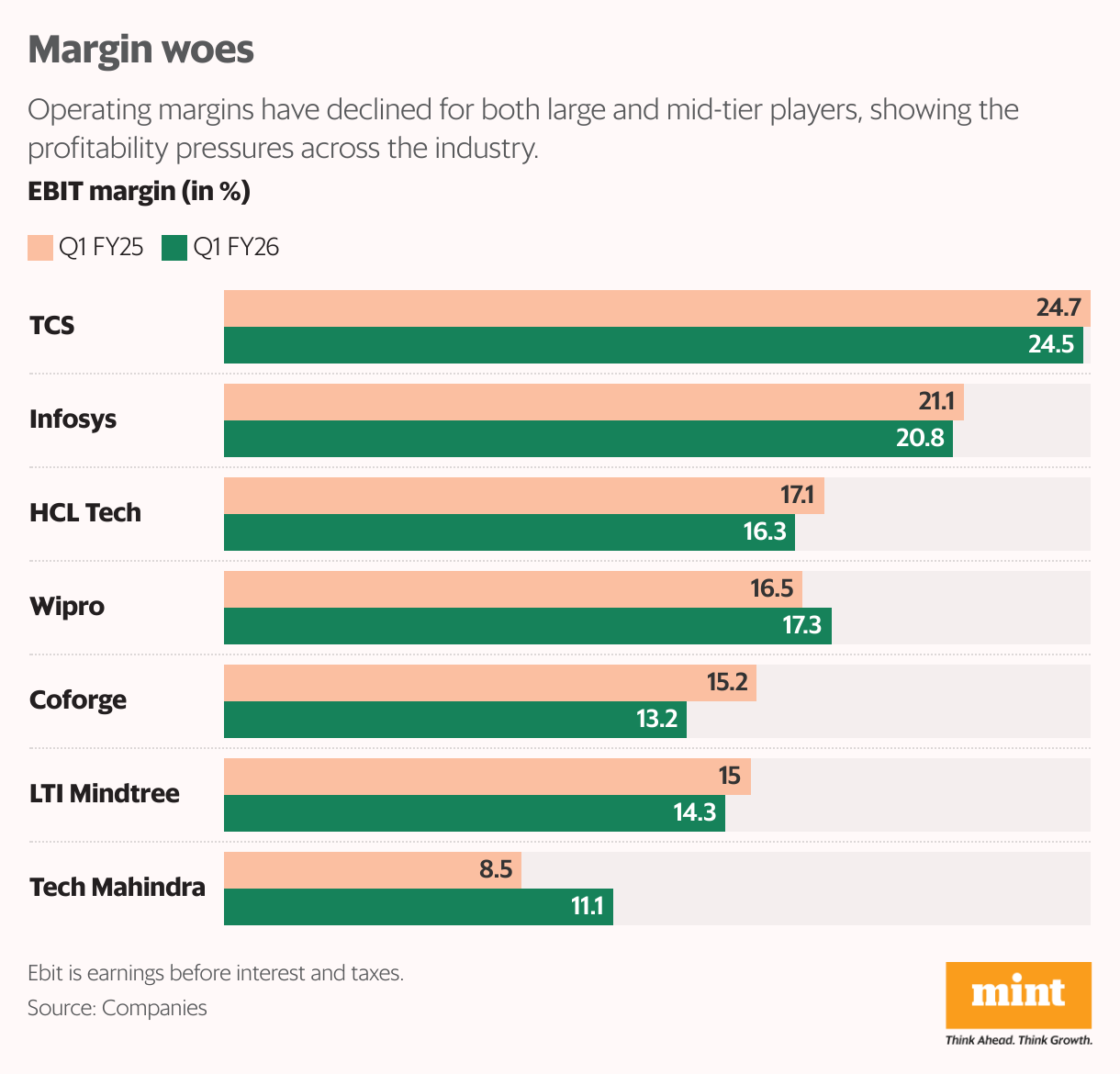
A lacklustre demand environment and intense competition among companies to bag contracts is also weighing on margins. Out of the top five firms, only two saw a sequential increase in Ebit margins, while the rest suffered declines of 0.2% to 1.6%. Even on a y-o-y basis, the three largest IT companies reported margin compression.
“The higher mix of cost take-outs in deals and intense competition, together with below-normal revenue growth over an extended period of time, is pressuring the margin profile of companies,” Kotak Institutional Equities noted. “A few margin levers are exhausted—such as utilization and subcontractor usage.”
Companies are leaning more on direct employee costs as a result, leading to lower variable payouts, wage hike deferrals, stricter performance management and layoffs/restructuring, the brokerage further noted.
GenAI is also leading to uncomfortable questions around pricing, further clouding the outlook for IT firms. If fewer hands are needed on the job, clients are wondering why should they continue paying according to the legacy headcount-heavy model?
Infosys chief executive officer (CEO) Salil Parekh noted that while AI is leading to productivity benefits, a part of that is being shared with clients. The trend is noticeable even for mid-tier IT firms. Venu Lambu, CEO and managing director of LTIMindtree, acknowledged that clients are having discussions on pricing at the time of contract renewals and even otherwise.
Darwin’s darlings
When TCS, India’s largest private-sector employer, announced last month that it would lay off 2% of its global workforce—or over 12,000 employees—this financial year, it sent seismic shocks throughout the industry. To many doomsayers, it was the first concrete sign that AI’s moment of reckoning had arrived, and IT sector jobs, the building blocks of India’s middle-class aspirations, were on the road to extinction.

View Full Image
Experts, however, say such fears are overblown.
“AI is undeniably a major technological shift, but for India’s IT outsourcing sector, it’s more of a deep transition than a sudden existential rupture,” Aniruddha C., partner, Grant Thornton Bharat, told Mint. “The sector’s traditional model, built on cost efficiency and scale, is giving way to one driven by intelligence, automation, and measurable outcomes. This change is not just technological, it spans the entire business ecosystem.”
The emerging model focuses on AI-led automation, digital platform integration, and hybrid human-AI workflows. Companies are moving beyond service delivery to become strategic partners, offering end-to-end digital transformation and outcome-based engagements, he pointed out.
This, consequently, is altering the nature of employment in the IT sector.
Firms are investing in comprehensive AI up-skilling across the organization. Training now extends beyond engineering to include HR, finance, sales, marketing, and operations. Roles are being redefined — software engineers are becoming AI engineers, cyber professionals are transitioning into AI security specialists, and business analysts are evolving into AI-driven decision-makers, he added.
Most analysts maintain that AI is less an existential death sentence and more an electric shock jolting IT companies out of their comfort zones and forcing them to move up the value chain. The message for incumbents is clear—adapt and thrive, or cling to the status quo and go extinct.
Most analysts maintain that AI is less an existential death sentence and more an electric shock jolting IT companies out of their comfort zones and forcing them to move up the value chain.
The market is willing to pay a premium for companies which exhibit agility at this critical time.
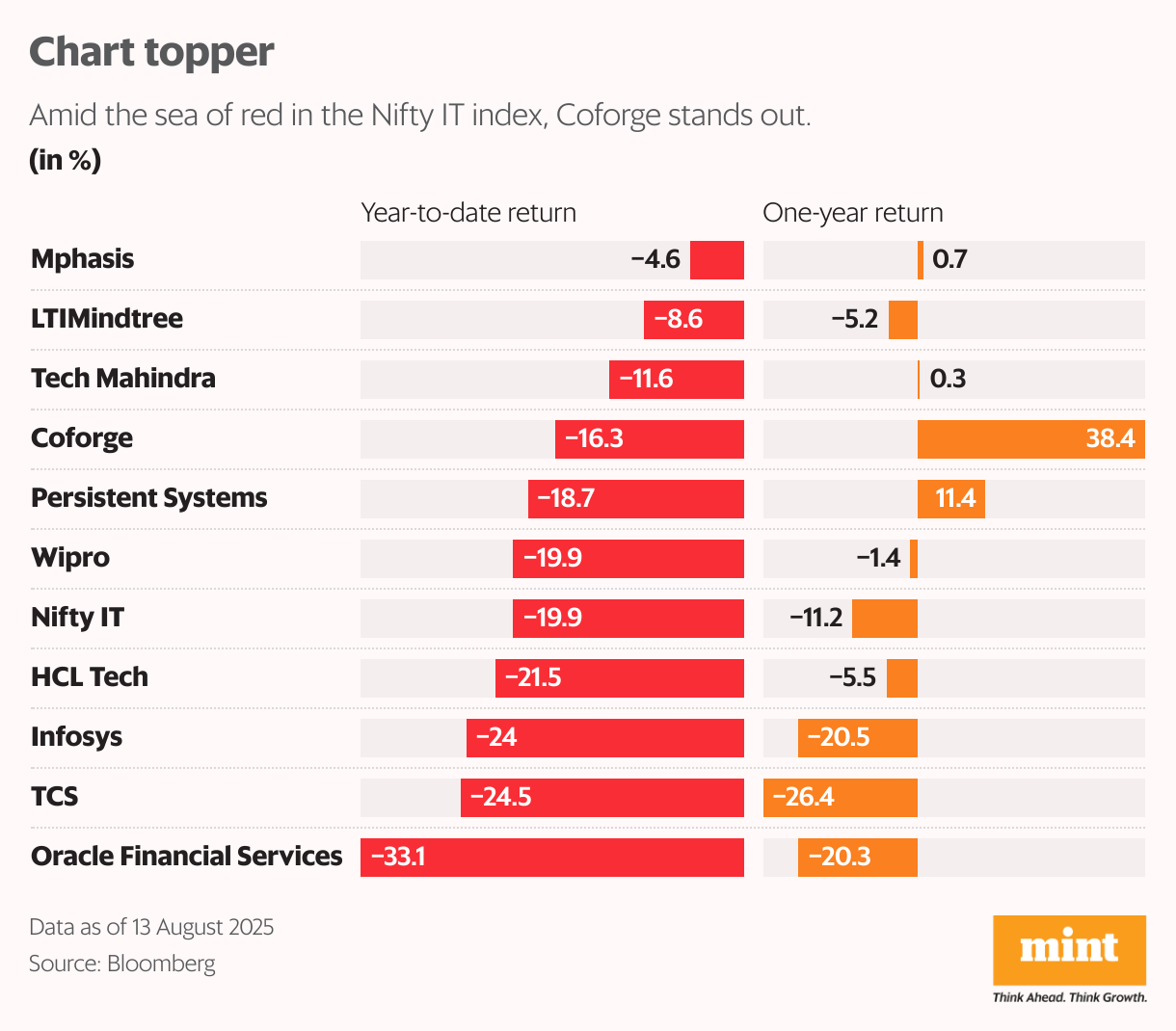
The clearest example of this at this juncture is Coforge, which is not only the top performing stock on the Nifty IT index on a one-year basis by a wide margin, but also commands the highest price-to-earnings multiple among the top-10 IT companies in India.
As against the anaemic revenue growth of most IT companies, Coforge posted a 51.5% topline expansion in Q1, in constant currency terms, over the year-ago quarter. This was not a one-off. Its revenue growth stood at 42.4% in the preceding quarter and 40.3% in the three months to December 2024.
Earlier this year, Coforge signed a $1.6 billion, multi-year agreement with global travel technology company Sabre Corporation to enhance product delivery and develop AI-enabled solutions. This was the largest deal signed by any mid-cap software services provider in the country.
“The previous downcycle showed that mid-tier firms can thrive in cost-focused environments. Coforge’s recent deal with Sabre is a strong indicator that mid-tiers now have both the scale and the solution maturity to win cost-saving deals,” Motilal Oswal noted.
Noting that the company is well-set on an industry-leading growth path, analysts at Kotak Institutional Equities highlighted that Coforge views AI not merely as an efficiency play but as a catalyst for business model transformation. The company believes that many clients currently lack AI fluency, particularly in understanding the revenue-generating potential of AI beyond cost optimization. To bridge this gap, Coforge engages its solution experts to co-ideate with clients through iterative workshops, fostering a collaborative environment for innovation, it said.
“In most large deals, AI is embedded by design, not as an add-on, but as a core component of the solution architecture. This proactive approach enables net new revenue streams from AI, shifting the narrative away from AI as a deflationary force and toward its role as a growth enabler,” they added.
Marked to market
The current performance of the IT pack is the market equivalent of a Shakespearean tragedy. This year, so far, not a single component of the Nifty IT index has managed to post gains. Over the past 12 months, only two companies have logged meaningful returns.

View Full Image
While a bout of profit-taking was inevitable after the post-pandemic boom in IT stocks, the sheer scale and persistence of the current downturn suggest this is no mere cooling-off phase.
While there are stray rays of hope for the sector, even the staunchest supporters of India’s IT story agree that the road to recovery is likely to be a long, and perhaps painful one.
“Some indicators suggest peak pessimism for Indian IT, and a potential buying opportunity, but it’s not a clear-cut. Historically, Indian IT stocks have delivered strong returns when bought during periods of extreme pessimism—provided earnings recover within 12–18 months.
“However, Trump’s tariff rhetoric adds uncertainty, and the “unknown” around post-AI business models may delay growth in the companies. It may be an opportune time to invest for the long term, but one should follow a staggered accumulation strategy,” Pranay Aggarwal, director and CEO of discount brokerage platform Stoxkart, told Mint.
It may be an opportune time to invest, but one should follow a staggered accumulation strategy.
—Pranay Aggarwal
Market watchers also point out that while the valuations of IT stocks have eased from their post-pandemic peaks, it is not as if the companies are priced for extinction, suggesting the ‘doom-and-gloom’ narratives are overdone.
“Valuations have already corrected to levels below long-term averages, offering potential entry points for investors with a multi-year horizon. However, the transition to AI-driven delivery models is still in its early stages, and the pace of monetization remains unclear, keeping near-term earnings visibility muted,” said Anil Rego, founder and fund manager at Right Horizons PMS.
While this could prove to be a classic contrarian opportunity for those willing to endure short-term volatility, the path to recovery will likely be gradual, he added.
From an investing perspective, when an entire sector is gripped by crisis, it becomes an extreme case of a stock-picker’s market.
“Investors should be selective within the IT sector, driven by the strength of client verticals, geographic exposure, and execution capability rather than purely by company size,” Rego said.
Large players offer scale, diversified revenue streams, and relative resilience, while select mid-tier firms can deliver faster growth by capitalizing on niche capabilities, domain expertise, and quicker client decision-making cycles, he added.
“The winners will be those who invest early in AI partnerships, platforms, and talent, not those who simply add AI buzzwords to sales pitches,” Stoxkart’s Aggarwal said.

