


The expansion will require substantial capital expenditure and is projected to drive demand across allied sectors, including fibres and cables, cooling systems, and power infrastructure.
Most of this expansion will be driven by hyperscalers such as Alphabet, Amazon, Microsoft, and Meta. In fact, they have announced cumulative capex of $640 billion in 2026 to date, up from $430 billion in 2025.
This acceleration in AI-led infrastructure spending is creating a structural demand tailwind for companies embedded deep within the digital connectivity value chain.
However, not all fibre manufacturers will benefit equally. The key differentiator will be technological capability, geographic positioning, and the ability to supply high-fibre-density solutions required in GPU-intensive AI clusters.
In this context, Sterlite Technologies’ positioning in optical fibre preforms and its localised North American manufacturing align it structurally with the AI infrastructure cycle. The company’s share price has also surged 63% over the past month following announcements by hyperscalers of capex plans and tariff reductions.
Sterlite’s share in global optical fibre cable market
Sterlite Technologies Ltd (STL), part of the Vedanta Group, is a global optical and digital connectivity company. It designs and deploys high-capacity converged fibre and wireless networks, positioning itself as a key enabler of digital infrastructure. The company describes itself as one of the few players globally to master the entire value chain from “glass to gigabit,” spanning silicon, glass preforms, optical fibers, cables, and connectivity solutions.
As of FY26, STL holds approximately 8% market share in the global optical fibre cable market (excluding China). It is also the number one end-to-end optical manufacturer in India. STL operates primarily through two main business divisions: optical networking business (ONB) and digital & technology solutions (STL Digital).
ONB is the company’s core manufacturing and product division, accounting for around 94% of revenue in 9MFY26. It includes manufacturing optical fibre & cables, optical interconnect (end-to-end connectivity kits, enclosures, and pre-connectorized solutions for telecom operators and data centres), and speciality cables for industrial applications.
STL is highly export-oriented, with the majority of its revenue coming from international markets. Europe remains the largest market, accounting for 40% of total revenue, while North America accounts for 36%. The remaining 24% comes from India and other global markets. This geographic mix is increasingly relevant as AI-led demand accelerates in developed markets.
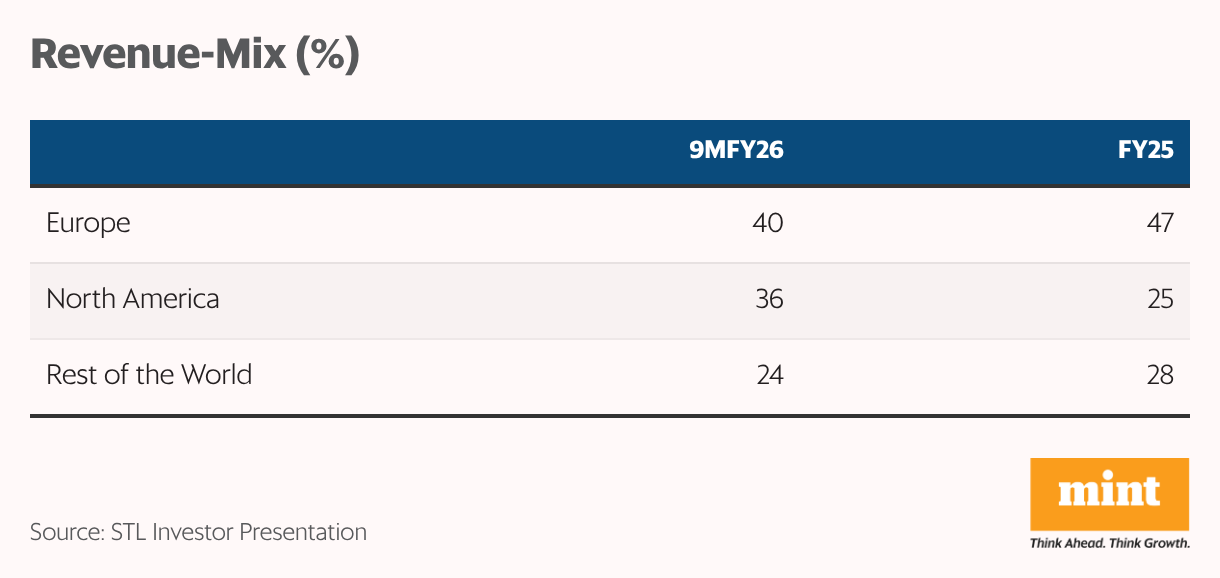
North America has emerged as the primary growth engine, with demand consistently outpacing domestic supply. Independent projections (CRU) estimate the region’s optical demand will grow at a 13.7% CAGR through 2030, the strongest regional growth globally. This is expected to be driven by hyperscalers investing in data centres, which require high-density fibre cables.
Tracking the growth, the region’s revenue share increased to 36% in 9MFY26 (up from 25% in FY25), despite US tariffs affecting Indian imports. The rapid expansion of AI infrastructure has been a key driver of demand, given that AI data centres are significantly more fibre-intensive than traditional facilities.
Demand shift in AI data centres
STL views the AI cycle as a once-in-a-generation opportunity for the optical industry. AI data centres differ structurally from traditional data centres, driving a surge in demand for specialised fibre solutions. GPU-dense racks require up to 36 times as much fibre as traditional CPU setups, according to the company. Overall fibre density in AI data centres is nearly 70% higher than in legacy centres. This fundamentally alters the demand intensity per facility.
Beyond internal wiring, demand is also increasing to connect data centres. Sterlite states this “interconnect market” is expected to more than double by 2030. Major technology companies are increasing investments to build out this infrastructure, pushing global data centre IT spending toward multi-trillion-dollar levels.
For instance, to date in FY26, hyperscalers such as Amazon have announced $200 billion in AI investments, followed by Alphabet ($185 billion), Meta ($115-135 billion), and Microsoft ($120 billion). Such capital allocation signals long-term infrastructure build-out rather than short-term experimentation. This increased AI spending is expected to drive sustained demand for data centres and, in turn, benefit players like STL, which holds an 8% global market share.
Beyond telecom: the pivot to data centre revenue mix
STL is pivoting its portfolio to capitalise on this shift, moving from a telecom-heavy mix to a more balanced exposure across the enterprise and data centre segments. The enterprise and data centre segment accounted for 20% of total revenue in 9MFY26. The company targets scaling this segment to 30% of revenue within the next 12-18 months, indicating a structural shift in revenue composition.
AI data centre portfolio
STL has developed an end-to-end “Make in India for the World” AI data centre portfolio tailored for high-bandwidth, low-latency, GPU-dense environments. To address space constraints in crowded facilities, STL has launched high-density solutions, expanding its portfolio to include 1,728- and 3,456-fibre counts. These configurations enable faster deployment and large-scale fusion splicing, improving execution efficiency for hyperscalers.
The company is also developing advanced fibre technologies to address latency and capacity challenges. Multicore fibre technology allows 4-7x higher capacity within the same physical footprint, making it critical for space-constrained AI data centres and future-ready networks. STL has successfully conducted trials with Colt in the UK.
Hollow-core fibre is another area of innovation in which light travels through an air-filled core rather than glass. This reduces latency by 30-47%, which is relevant for high-frequency trading and real-time AI workloads. STL notes that hyperscalers such as Microsoft and Amazon are evaluating large-scale deployment, with potential commercial rollouts over the next two to three years.
Beyond data centres, continued expansion of fibre-to-the-x networks could provide incremental support. The broadband equity, access, and deployment (BEAD) program is supporting broadband expansion across the US. This has resulted in demand outstripping supply in North America, keeping lead times tight and creating opportunities for players with local manufacturing capabilities.
Sterlite’s hedge against global trade wars
STL has invested more than $50 million to construct a facility in Lugoff, South Carolina. The company is increasing utilization to meet local demand and mitigate the impact of elevated U.S. tariffs on Indian imports. As a result, reported Ebitda in Q3FY26 declined by 760 bps. Margins are expected to normalize as tariff rates have been reduced to 18% and local capacity scales up.
The company is building the STL Digital division, which currently accounts for the remaining 6% of revenue in 9MFY26. This segment focuses on engineering digital experiences for customers in telecom, technology, and healthcare, offering services in cloud computing, cybersecurity, AI, data analytics, and enterprise SaaS. The active customer base increased to 34 in Q3FY26.
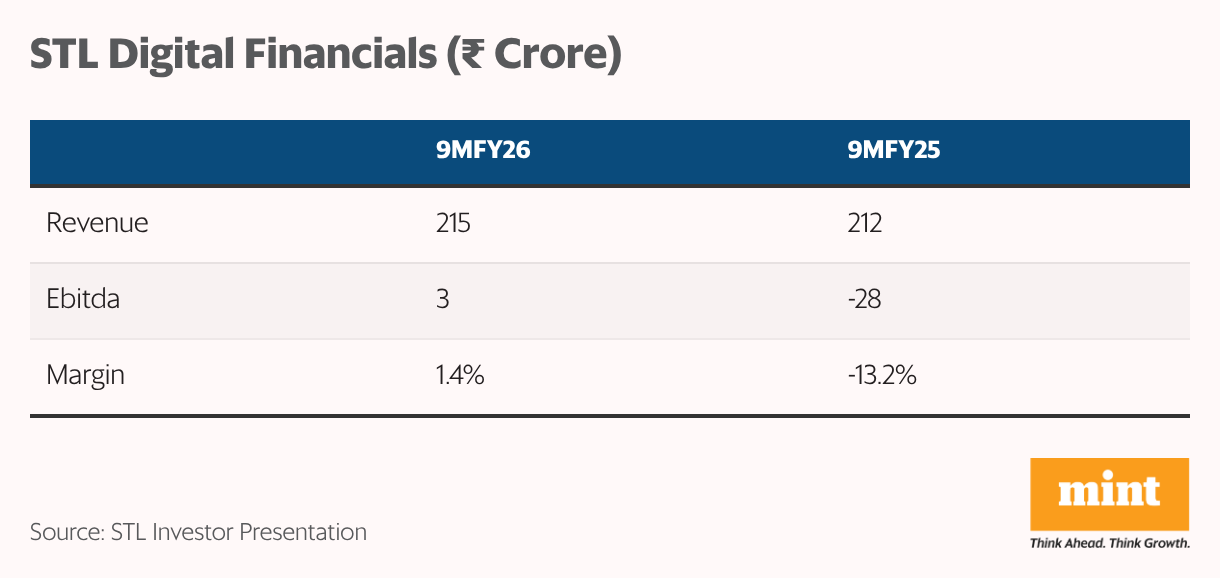
Management’s priority for this division is to drive profitable growth through disciplined execution and scalable platforms. The segment reported revenue of ₹215 crore in 9MFY26, flat year-on-year, but turned operationally profitable, with Ebitda of ₹3 crore, compared with a loss of ₹28 crore in the same period last year. While still small in scale, the division has crossed the breakeven threshold.
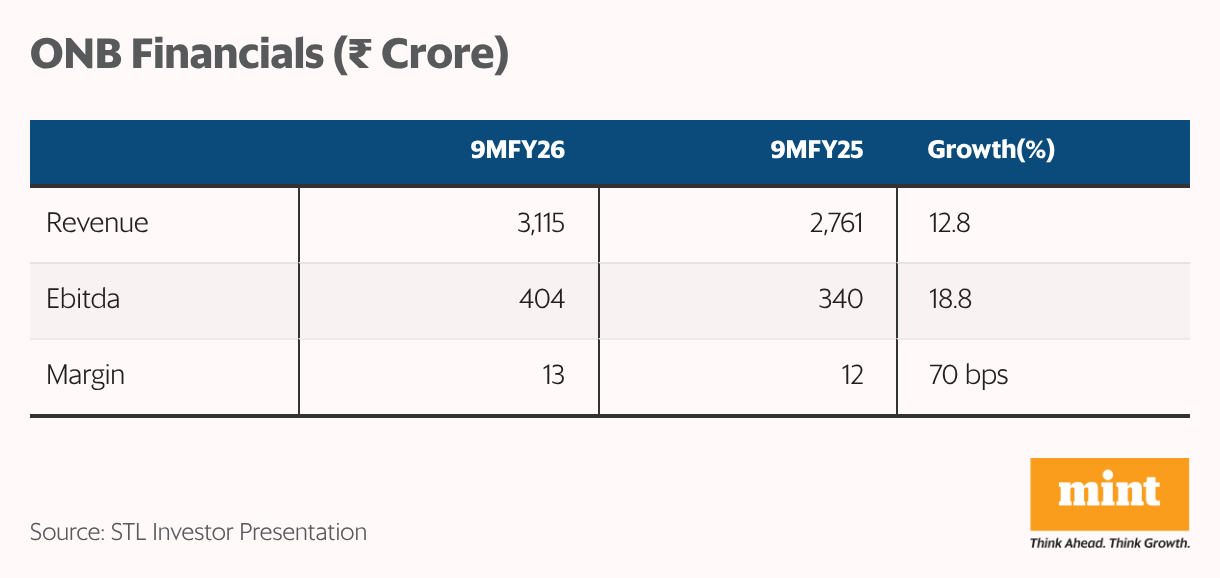
At the same time, core ONB revenue increased 12.8% year-on-year to ₹3,115 crore in 9M FY26. Ebitda rose 18.8% to ₹404 crore, with margins expanding 70 bps to 13%. Revenue quality improved due to a shift toward value-added products such as high-fibre-count Intermittently Bonded Ribbon cables, which are critical for rapid deployment in AI data centres.
The 20% margin threshold
Management asserts that this is fundamentally a 20% Ebitda margin business when operating at optimal utilization levels (70%+). If demand driven by AI is sustained, the recent tariff reduction could lead to margin expansion. This growth would be driven by product premiumization rather than by relying solely on increased capacity utilization, even as revenue rises.
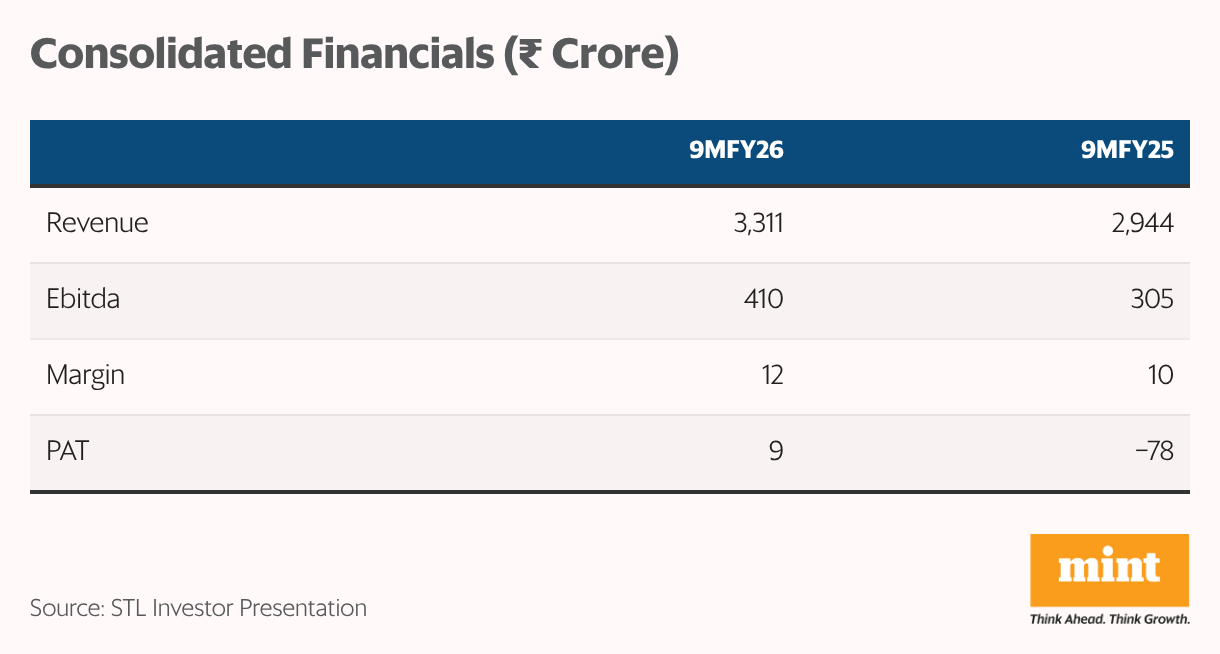
On a consolidated basis, revenue increased 12.5% year-on-year to ₹3,311 crore in 9MFY26, driven primarily by ONB. Despite margin compression in Q3, Ebitda for 9MFY26 increased 34.4% to ₹410 crore, with margins expanding 200 bps to 12.4%. STL reported a net profit of ₹9 crore, compared to a loss of ₹78 crore in the same period last year, reflecting operational recovery.
The company’s order book stood at ₹5,325 crore as of Q3FY26, providing revenue visibility of over one year based on FY25 revenue of ₹3,996 crore. Order intake grew 40.3% to ₹4,263 crore in 9MFY26, driven by large-scale data center wins and a breakthrough order from a Tier-1 North American telecom customer. Net debt stands at ₹1,331 crore, with manageable leverage at 2.6x net debt to Ebitda.
A discount to peers?
At ₹154 per share, Sterlite trades at an EV/Ebitda multiple of 16.2x, above its 10-year median of 10.6x. However, it trades at a discount compared to peers such as HFCL (25.3x). The valuation suggests that the market is pricing in margin recovery and sustained AI-driven demand, though execution and capacity utilization will remain key monitorables.
Three risks to watch
A lawsuit, geographical concentration, and supply chain are key risks to the business. The company is also navigating a substantial legal risk following a $96.5 million jury verdict against its US subsidiary in a trade secrets lawsuit filed by Prysmian. While STL has appealed, the ultimate financial implication is currently not determinable.
The supply chain is exposed to geopolitical tensions, particularly regarding the availability of Germanium, a key raw material for optical fibre that is tightly controlled by China. STL also remains susceptible to commodity price volatility (particularly copper) and foreign exchange fluctuations.
For more such analysis, read Profit Pulse.
Madhvendra has over seven years of experience in equity markets and writes detailed research articles on listed Indian companies, sectoral trends, and macroeconomic developments.
The writer does not hold the stocks discussed in this article.
The purpose of this article is only to share interesting charts, data points, and thought-provoking opinions. It is NOT a recommendation. If you wish to consider an investment, you are strongly advised to consult your advisor. This article is strictly for educational purposes only.

