


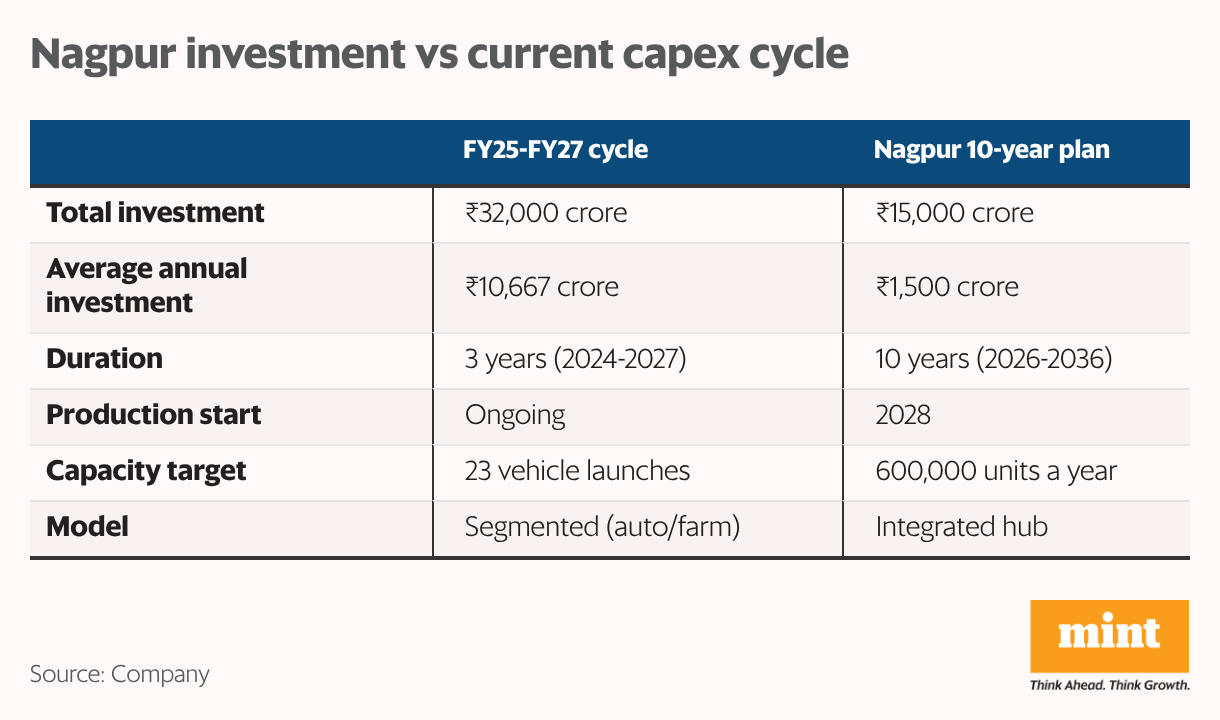
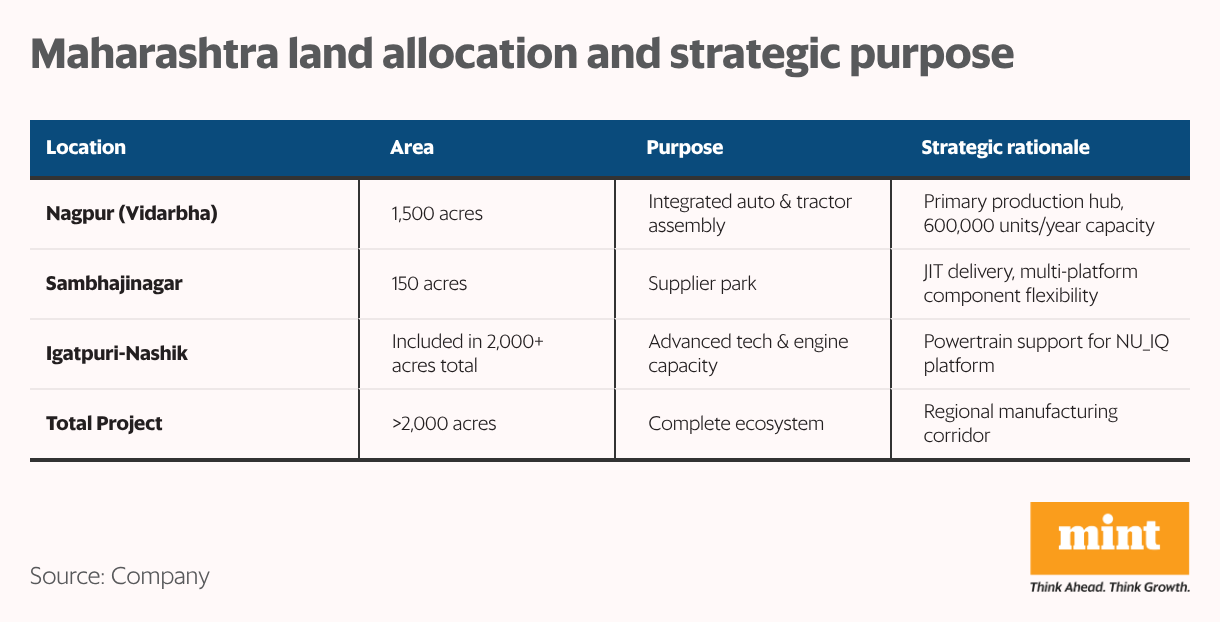
The 10-year commitment includes a 1,500-acre Nagpur plant, a 150-acre supplier park in Sambhajinagar (formerly Aurangabad), and engine-capacity expansion near Nashik. It represents roughly 14% of the company’s average annual capital expenditure during its current three-year investment cycle. But this modest percentage belies the company’s ambitious recalibration to compete on scale, flexibility and capital efficiency.
Scale imperative
Mahindra’s challenge is straightforward: launch 23 new vehicles by 2030 while simultaneously defending its 41.6% market share in tractors and clawing back EV leadership from Tata Motors. The ₹32,000 crore allocated for FY25-FY27 is to fund product development: ₹8,500 crore for SUV internal combustion engine (ICE) platforms, ₹4,000 crore for commercial vehicles, and ₹12,000 crore for electric subsidiary MEAL. The Nagpur facility aims to have an annual capacity of 500,000 vehicles and 100,000 tractors starting in 2028.
Beyond this expansion, Mahindra is fundamentally rethinking its manufacturing economics. Rather than dedicating separate capex buckets to auto ( ₹27,000 crore in the current cycle) and farm ( ₹5,000 crore), Nagpur integrates both under one roof, enabling shared infrastructure, pooled logistics, and fungible capacity allocation based on market demand. Executive director Rajesh Jejurikar’s emphasis on “scale, flexibility, and advanced technology” reflects management’s assessment of India’s automotive future.
Volume players such as Maruti Suzuki and Hyundai enjoy structural cost advantages through amortization of fixed investments across millions of units. Mahindra has struggled with this math. The Nagpur hub attempts to bridge that gap by achieving tractor-like production volumes for passenger vehicles while maintaining platform flexibility.
Architecture advantage
The facility’s design around Mahindra’s NU_IQ architecture aims to solve a critical challenge. Mahindra claims this modular platform can accommodate internal combustion engines, battery-electric powertrains, and undefined “future technologies” – presumably hydrogen fuel cells or range-extended hybrids. Building such multi-energy capability into greenfield infrastructure costs far less than retrofitting existing plants, a lesson European automakers learned at great cost during their EV transitions.
For Mahindra, this flexibility hedges against India’s uncertain regulatory timeline. While the government pushes electric mobility, rural tractor buyers and commercial vehicle operators remain wedded to diesel. The platform aims to overcome this problem by allowing production to shift between powertrains without leaving assets stranded. A 500,000-unit EV line can become a 400,000-unit EV and 100,000-unit ICE facility within the same physical footprint.
The ₹12,000-crore MEAL investment for electric vehicles makes this flexibility operationally critical. Unlike Tata Motors, which bet heavily on dedicated EV platforms, Mahindra’s multi-energy approach reduces existential risk if adoption curves disappoint.
Supplier park gambit
The 150-acre Sambhajinagar supplier park represents a strategic commitment. While automakers routinely develop vendor ecosystems, dedicating to suppliers a significant part of the over 2,000 acres being acquired across three locations indicates a shift toward vertical integration – a fully integrated value chain with geographic proximity.
This matters because Mahindra’s product complexity far exceeds that of typical passenger-vehicle manufacturers, as producing turbocharged petrol SUVs, electric crossovers and diesel tractors requires drastically different component sets. Coordinating this with distant suppliers inflates inventory costs and extends lead times.
By co-locating suppliers, just-in-time delivery for high-value, low-volume components becomes possible while maintaining buffer stocks for commodity parts. The model mimics Toyota’s renowned supplier city strategy in Toyota City, Japan, which delivers exceptional inventory turnover ratios. For a company launching 23 products across multiple powertrains, the initiative makes eminent operational sense.
The regional clustering could also mitigate a uniquely Indian challenge. Despite improvements, Indian highways still impose meaningful time and cost penalties for long-distance freight. Positioning final assembly, suppliers and engine production within Maharashtra creates a self-contained ecosystem less vulnerable to infrastructure bottlenecks that plague supply chains within India.
Margin question
Mahindra’s has not provided specific FY27 margin guidance, even as it has committed ₹37,000 crore across existing and new programs. This may frustrate analysts, but it reflects operational realities. The ₹1,500 crore allocated for regulatory and sustenance in the farm sector, including a contingent ₹600 crore for potential Trem V emissions compliance, exemplifies the challenge.
With ₹37,000 crore in operating cash generated in the previous cycle and a net surplus of nearly ₹20,000 crore, Mahindra enters the FY25-FY27 investment cycle with a strong balance sheet, negating the immediate need for significant external debt to fund its ₹32,000 crore aggregate capex. This financial flexibility allows management to prioritise long-term positioning over near-term margin commitments.
Unlike software businesses with predictable margin trajectories, automotive profitability swings wildly based on commodity prices, regulatory changes, and competitive intensity. Mahindra’s farm division achieved impressive margins through cost reduction and market dominance, but that performance required benign steel and rubber prices. Locking into margin commitments during an investment-heavy period, particularly with electrification uncertainties, would constrain management’s flexibility to prioritize volume over near-term profitability.
The strategic priority appears clear. Use the FY25-FY27 period to establish product leadership and platform dominance, then leverage Nagpur’s scale economics post-2028 to drive margin expansion. The ₹15,000 crore investment annualizes to ₹1,500 crore, manageable against current run-rate capex, but delivers outsized returns if capacity utilization reaches 80-90% by 2030.
The Nagpur announcement will also cause depreciation and amortization to increase over the medium to long term. The investment will lead to the creation of massive tangible and intangible assets. D&A is a ‘front-loaded’ cost in automotive manufacturing; thus, large greenfield investments like Nagpur inevitably increase the D&A line item once assets are commissioned. Once production begins in 2028, these assets will be capitalized on the balance sheet, triggering significant annual depreciation charges.
While absolute D&A will increase, this could be mitigated through operating leverage. The Nagpur facility will manufacture vehicles across ICE, EV, and future technologies, allowing the company to spread fixed costs (including D&A) over a much larger production volume of 600,000 units per year.
Can Mahindra pull it off?
Mahindra’s track record on mega-projects, however, is mixed. The company successfully scaled its SUV business from niche off-roaders to mainstream contenders, but stumbled in luxury segments with SsangYong and first-generation EVs. The three-year implementation window provides breathing room, but also extends the period before returns materialize.
More fundamentally, the integrated hub strategy assumes Mahindra can achieve Toyota-like manufacturing excellence. That’s no small feat for a company whose production systems have historically emphasised ruggedness over precision. The NU_IQ platform’s multi-energy flexibility offers theoretical advantages but demands extraordinary shopfloor discipline to prevent quality issues when switching between vastly different powertrain assemblies.
The farm-auto integration poses cultural challenges, too. Tractor manufacturing operates on different cycles, quality standards, and customer expectations than premium SUVs. Whether Mahindra’s management can harmonize these businesses under one manufacturing roof without compromising either remains unproven.
Mahindra’s Maharashtra investment represents a coherent response to India’s automotive evolution. By committing capital to integrated infrastructure rather than fragmented capacity additions, the company positions itself for a future where operational excellence and economies of scale determine industry leadership. The supplier park addresses real logistics constraints, while NU_IQ architecture hedges electrification uncertainties.
Yet success hinges on execution across multiple dimensions. Ramping 23 product launches, achieving planned capacity utilization, extracting supplier park efficiencies, and maintaining quality across radically different vehicle types.
For investors, the announcement signals management confidence in India’s long-term automotive growth story and Mahindra’s ability to capture disproportionate share. Whether that confidence proves justified depends on capabilities the balance sheet can’t capture – manufacturing excellence, supplier coordination, and platform execution.
Dev Chandrasekhar advises corporations and think tanks on big picture narratives relating to strategy, governance, markets, and policy.
Disclaimer: The author owns shares of Mahindra and Mahindra Ltd (M&M). He is not associated in any pecuniary or advisory capacity with M&M, its owners, its employees, or its competitors. The article is the author’s own interpretation of publicly available information on M&M’s strategy, operations and financials; it does not offer any investment advice related to any company or, for that matter, any asset class. Any factual error, if pointed out, shall be corrected. No liability accepted.

