


The global tech equity markets are currently witnessing a structural realignment of sorts, one that is being deemed as the “SaaSpocalypse”. The US markets overnight witnessed a $285 billion erosion in major tech IT stocks, a ‘flash crash’ that signalled the changing dynamics of the tech services space, shifting away from assistive chatbots and human capabilities to autonomous digital workforces.
Here, at NDTV Profit, we will take you through a series of charts that will help you understand the ongoing ‘SaaSpoclaypse’ and how it promises to rapidly change how the markets view the IT services sector.
The Onset of the SaaSpocalypse
Photo Credit: Notebook LM
The “SaaSpocalypse” represents a strategic autopsy of a market that suddenly realised AI is no longer just a feature but a full-scale competitor.
This chart illustrates the sharp erosion of valuations as investors began pricing in the transition from human-intensive labor to autonomous agentic execution.
The $285 Billion Flash Crash
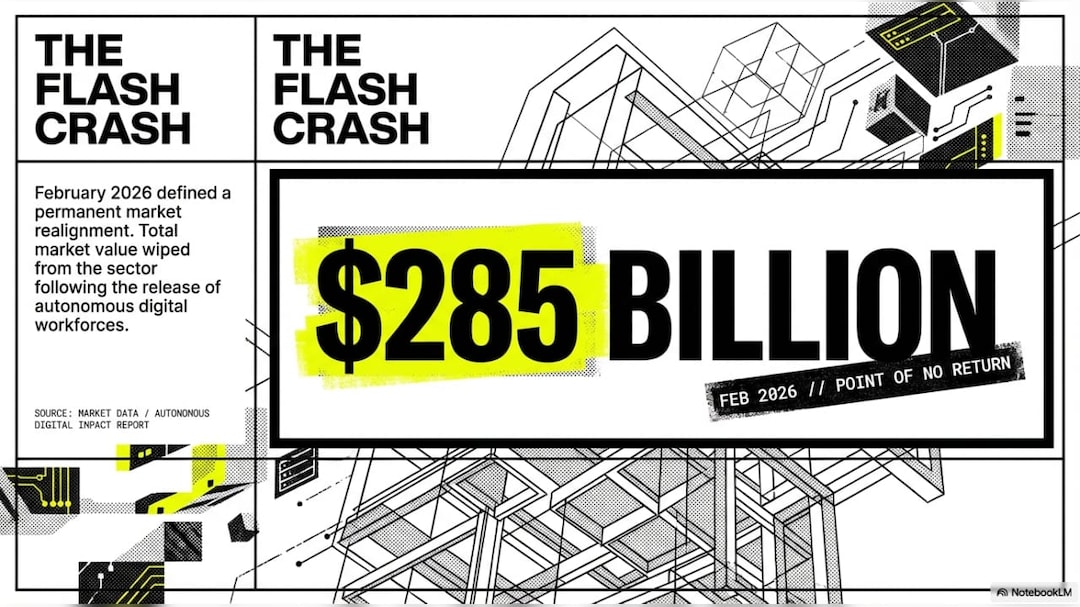
Photo Credit: Notebook LM
On February 3, 2026, the global tech sector hit a “point of no return” as a staggering $285 billion was wiped from market capitalisations following the release of autonomous digital workforces.
The crash originated in Western markets before spreading like a contagion to Indian IT behemoths, marking a permanent realignment of how value is perceived in the age of AI.
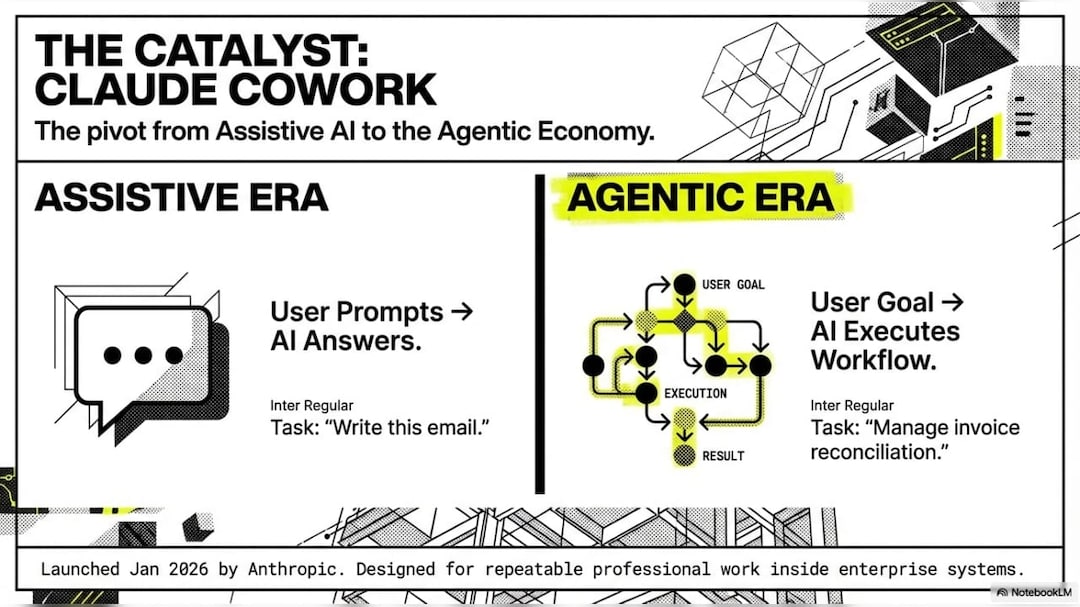
The Catalyst: Claude Cowork
dasdasd
Photo Credit: Notebook LM
What was the genesis of this rout? Technically, it was Claude Cowork, which was announced in late January. While previous AI tools required manual prompts to give answers, Cowork is designed to execute entire professional workflows inside enterprise systems, transforming Claude from a chat assistant into an active coworker.
What handed the final blow, however, was the announcement of Claude’s new AI legal advisor plugin, added within the Claude ecosystem, which could handle tasks such as reviewing complex documents, flagging risks, NDA triage, and tracking compliance. The sheer capabilities by these products is the one that caused the market meltdown.
The 11 Open-Source Plugins
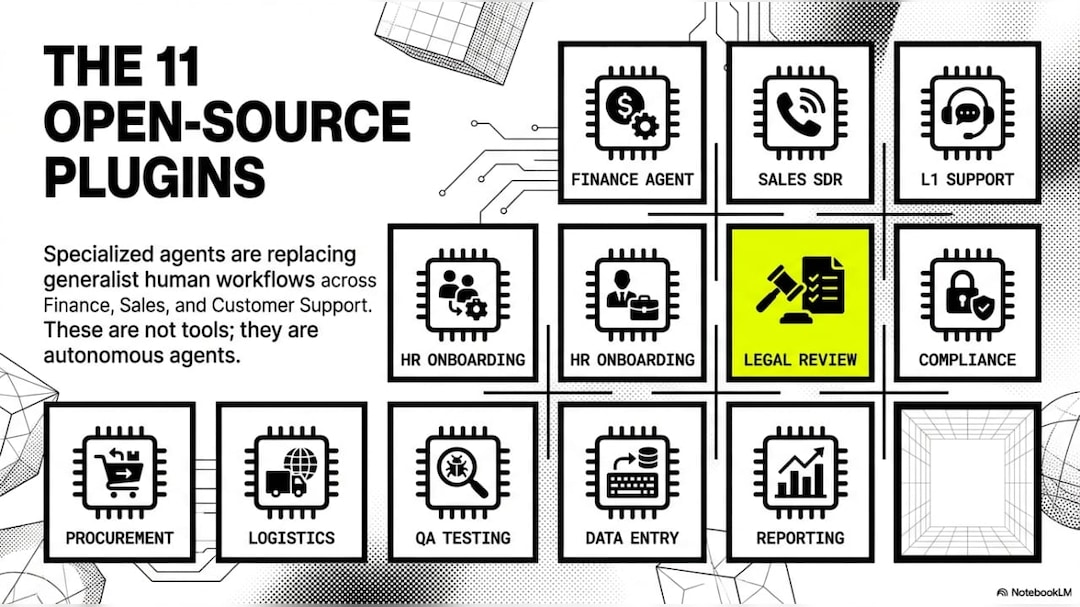
Photo Credit: Notebook LM
The true power of this shift was revealed when Anthropic released 11 open-source plugins, creating specialised autonomous agents for roles spanning Legal, Finance, Sales, and Customer Support.
These are not merely tools; they are pre-configured “digital employees” that handle complex, repeatable tasks that were previously the domain of human white-collar professionals.
The End of the Data Moat
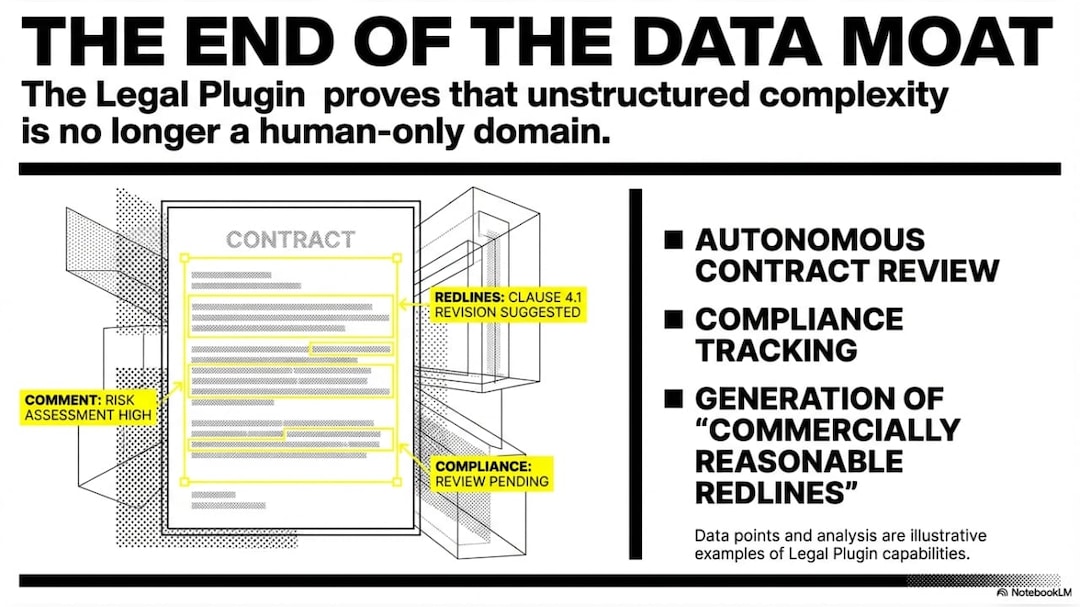
Photo Credit: Notebook LM
The Legal Plugin served as a warning shot, proving that unstructured complexity is no longer a human-only domain. By automating contract review, compliance tracking, and redline generation,
Anthropic has challenged the “data moats” of legal-tech giants who previously relied on proprietary databases to ward off competition.
The Body Shop Breakdown
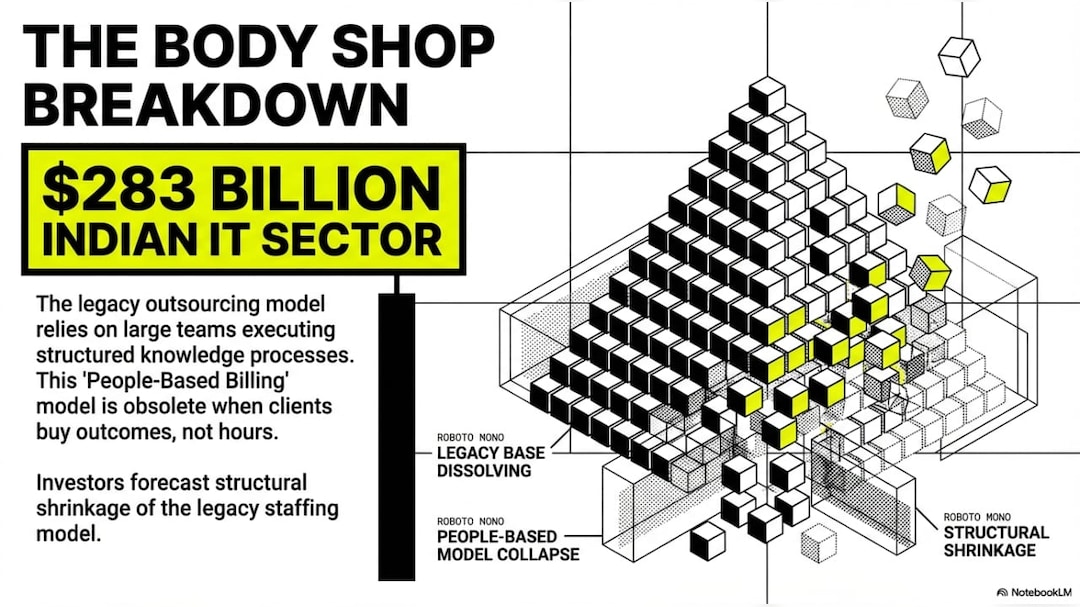
Photo Credit: Notebook LM
The $283-billion Indian IT sector found itself at the epicentre of the crisis as its legacy “people-based billing” model faced obsolescence.
Investors began forecasting a structural shrinkage of the traditional outsourcing model, as clients started prioritising business outcomes over billable human hours.
The Vulnerability Matrix
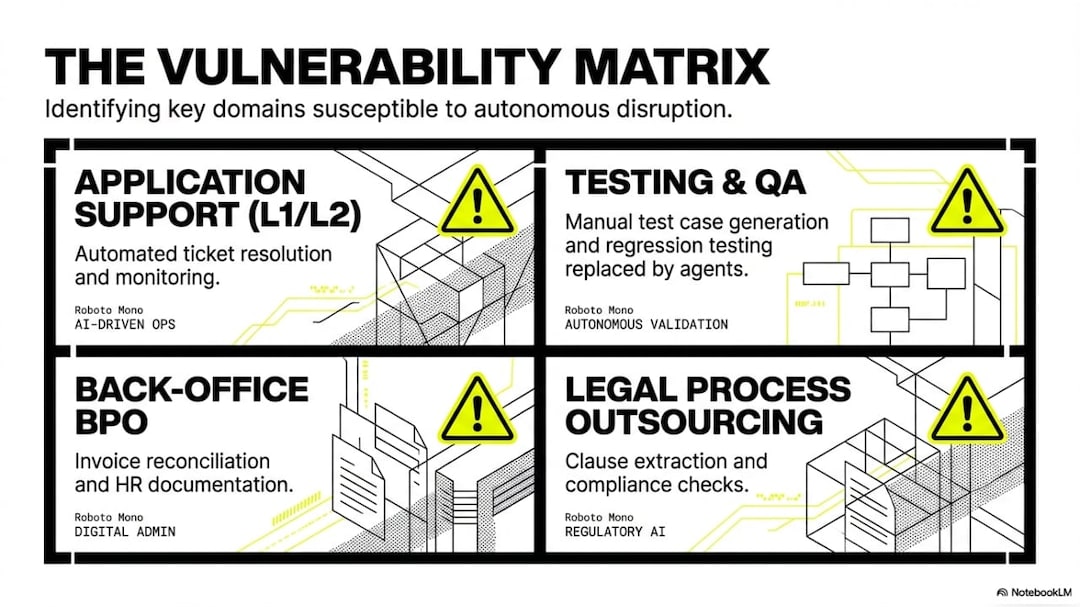
Photo Credit: Notebook LM
Key domains once considered the backbone of outsourcing, such as Application Support (L1/L2), Manual Testing, and Back-Office BPO, are now highly susceptible to disruption.
The Vulnerability Matrix highlights how autonomous agents are rapidly replacing human-led workflows in areas like invoice reconciliation and regulatory compliance.
Wall Street’s Panic
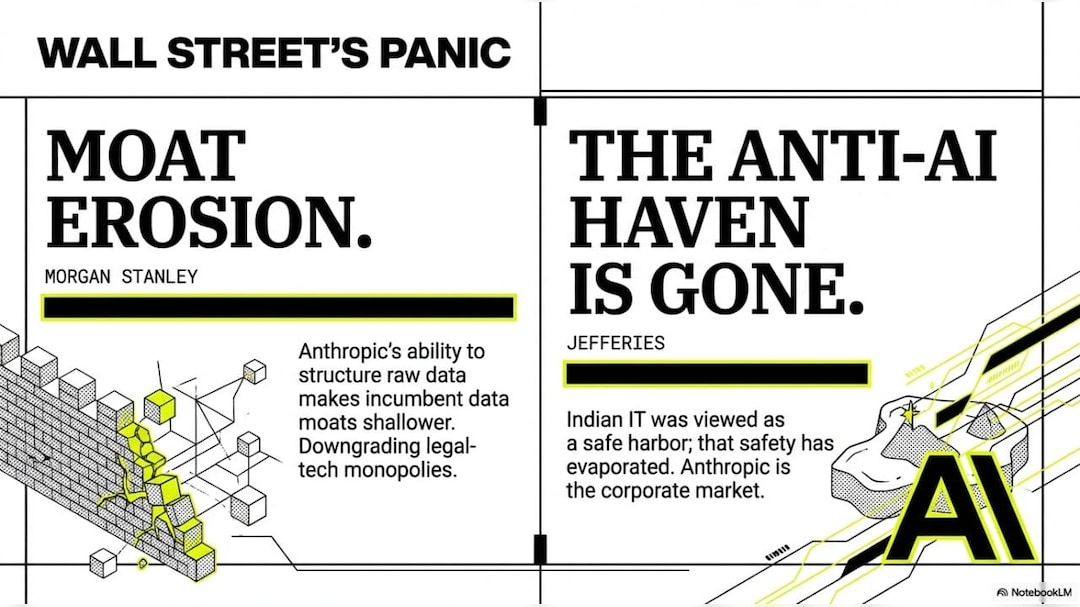
Photo Credit: Notebook LM
Global brokerages were quick to issue warnings, with Morgan Stanley citing “Moat Erosion” as Anthropic’s ability to structure raw data makes incumbents vulnerable. Jefferies declared that the “Anti-AI Haven”, which Indian IT has long been associated with ever since the launch of ChatGPT, has evaporated, forcing investors to liquidate positions in a state of outright panic.
The Valuation Crisis
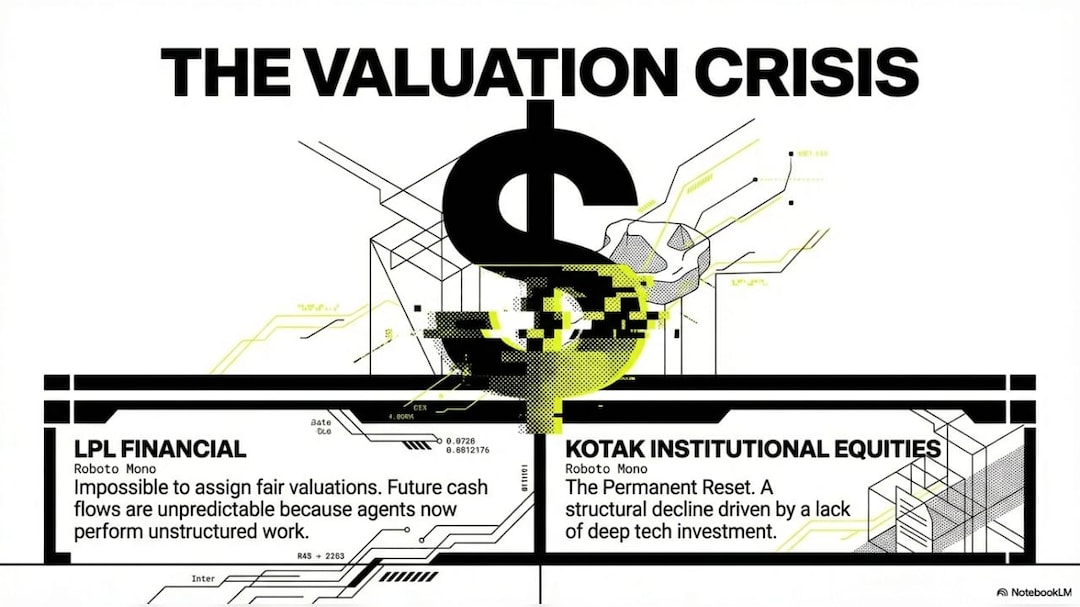
Photo Credit: Notebook LM
LPL Financial and Kotak Institutional Equities have described this as a “Permanent Reset,” where it is nearly impossible to assign fair valuations to traditional software firms.
The unpredictability of future cash flows in an agent-led world has driven a structural decline in multiples, particularly for companies that lacked deep tech investment.
Reinvention, Not Extinction
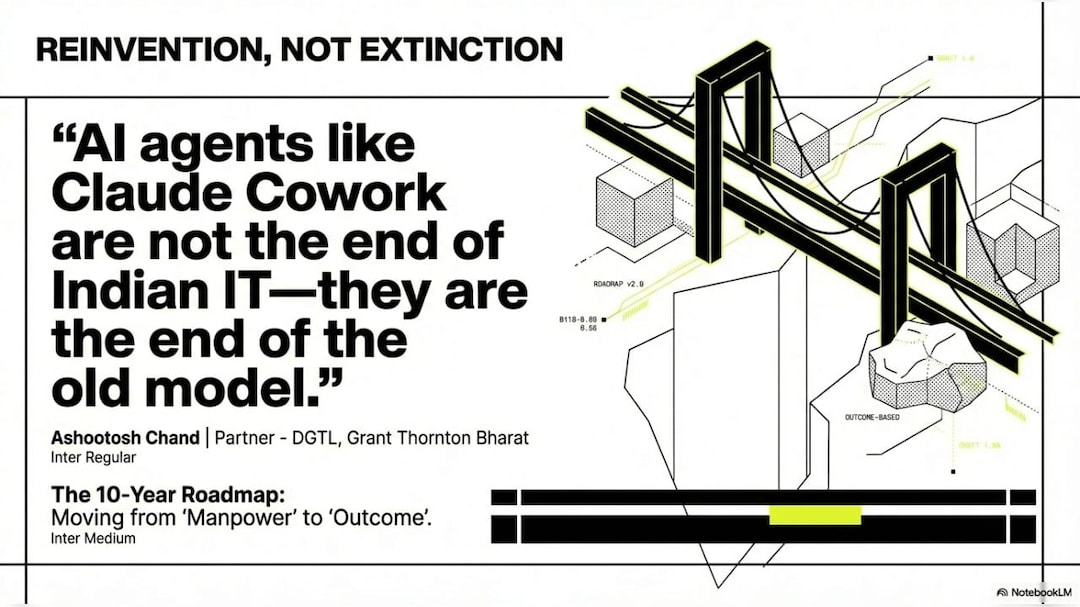
Photo Credit: Notebook LM
Despite the market carnage, sector experts like Ashootosh Chand, Partner – DGTL, Grant Thornton Bharat, argue that this marks a 10-year roadmap for reinvention.
The industry must now transition from a manpower-led services model to an outcome-based platform era where human expertise supervises fleets of AI agents.
Phase 1 & 2: Survival and the Business Model Shift
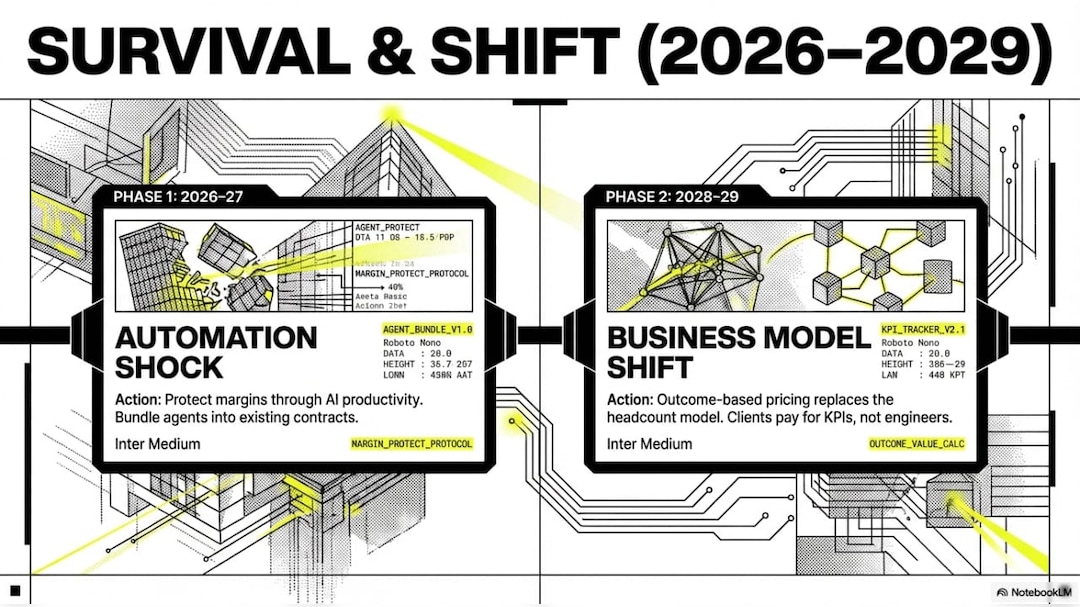
Photo Credit: Notebook LM
The initial years (2026–2027) focus on weathering the “Automation Shock” by embedding AI productivity tools into every delivery team to protect margins and bundle agents into existing contracts.
By 2029, the industry must successfully pivot to an outcome-based pricing model, where clients pay for specific business KPIs—such as the number of resolved incidents or compliant contracts—rather than the number of engineers assigned to a task.
Phase 3 & 4: Specialisation and Subscription Models
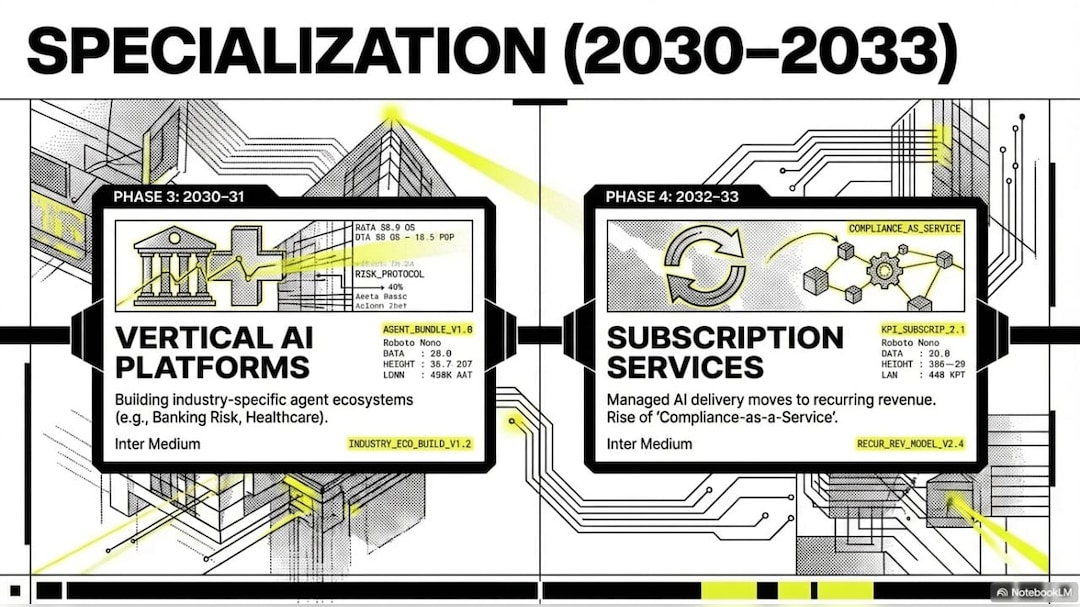
Photo Credit: Notebook LM
The turn of the decade (2030–2033) marks the era of vertical AI domination, as Indian firms build proprietary agent ecosystems tailored for specialised industries like banking risk, healthcare documentation, and manufacturing.
This period sees the rise of managed AI subscription services, where recurring revenue streams such as “Compliance-as-a-Service” replace the traditional staffing and implementation fees.
Phase 5: The Endgame—Global AI Infrastructure
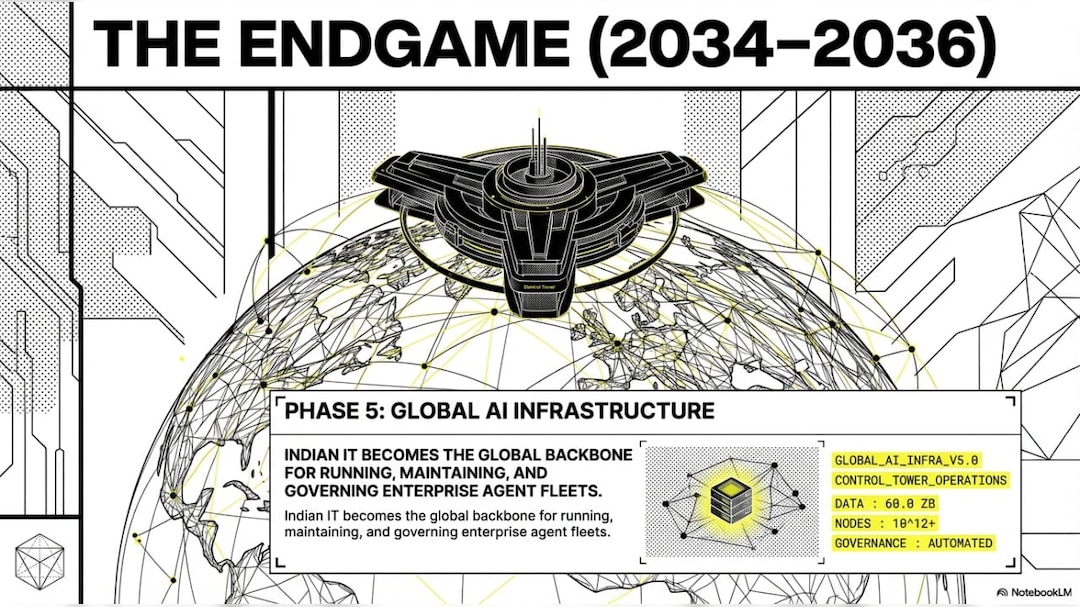
Photo Credit: Notebook LM
By 2036, the transformation is complete as Indian IT emerges as the essential global utility for running, maintaining, and governing enterprise agent fleets. The sector will move from being a “body shop” for talent to acting as the global backbone for autonomous business operations, exporting trusted AI-managed outcomes to the rest of the world.
The New Reality: Trust + Platforms
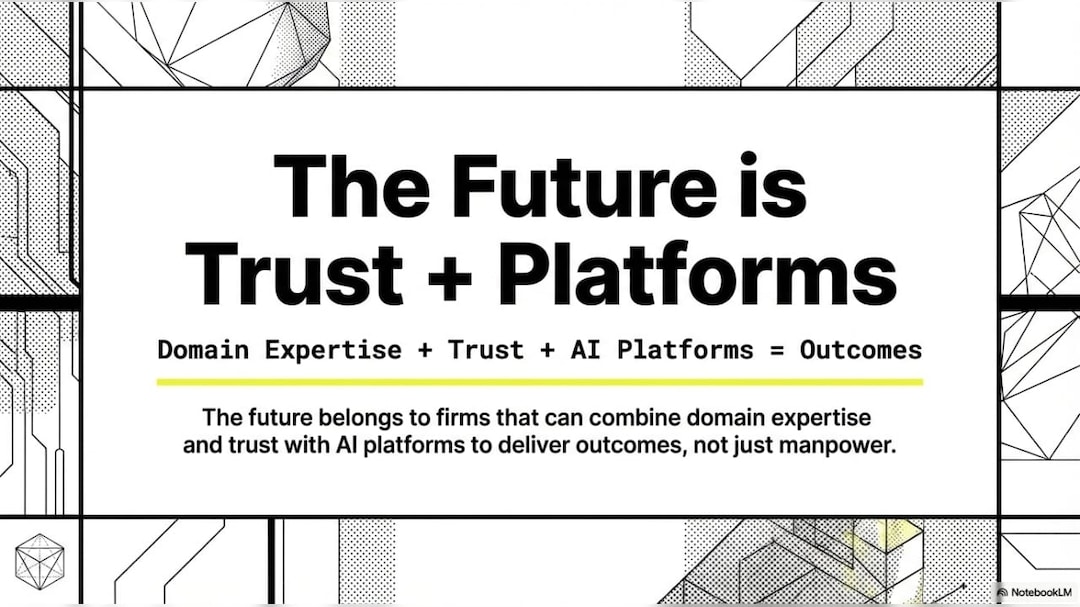
Photo Credit: Notebook LM
The ultimate winners in this new economy will be the firms that recognise that AI agents are not merely tools, but digital teammates that require human oversight and domain context.
The future of the industry belongs to those who can master the ‘collaboration paradox’—combining deep human expertise and enterprise trust with proprietary AI platforms to deliver guaranteed business results
Essential Business Intelligence,
Continuous LIVE TV,
Sharp Market Insights,
Practical Personal Finance Advice and
Latest Stories — On NDTV Profit.

