


Underwhelming returns in India, a tepid 4.7% in the last 12 months, and underperforming earnings growth has Indian retail investors scouting for greener pastures abroad lured by the promise of higher returns.
The proliferation of do-it-yourself or DIY investment routes via brokers such as Vested Finance, Borderless, Appreciate, among others, that make investing abroad easier compared to high thresholds for investing in destinations such as GIFT City, India’s only operational international finance services centre.
When an investor has to invest directly in global markets, he can start with installing apps of the likes of Appreciate, Vested, or Borderless, for instance. Once the KYC or know your customer verification, which is mostly digital, is done, the user’s bank account is linked with the platform for setting up a liberalized remittance scheme, or LRS, account.
Under this Reserve Bank of India scheme, resident Indians are allowed to send up to $250,000 abroad for purposes such as education expenses, purchase of property, investments, and other purposes. Once the LRS account is up and running, the platform creates a US stock wallet for the retail investor to which money can be transferred and trades carried out.
Traction at brokers
Mint collated data from some of the top brokers who facilitate investments in global stocks and exchange traded funds for Indian investors. For Mumbai-based Appreciate Wealth, the total number of overseas trades put by Indian retail investors has increased 44% year-on-year (y-o-y) in October with the value of trades expanding much faster at 164% for the same month.
The growing share of overseas equity investments, said Shlok Srivastav, founder at Appreciate Wealth, “signals a maturing investor base prioritizing global diversification, currency hedging, and access to innovation-led sectors like artificial intelligence, semiconductors, and healthcare that remain underrepresented in domestic markets.”
Software engineer Sidhoji Sawant, who’s been investing overseas for a year now, is a case in point. “Coming from a tech background I was always interested in tech companies. And when I got to know we can buy US stocks directly, I started investing in 2024,” he said.
Sidhoji, who uses platforms like IND Money and India INX for his trades, currently owns shares in Nvidia, Alibaba, Intercontinental Exchange, and other global companies.
Brazil’s not far
Appreciate is one among the top two brokers by volumes for investing abroad; the other being Borderless.
At Borderless, monthly trading volumes have more than doubled y-o-y as of October. In the first seven months of the financial year so far, Borderless has carried out trades worth over $600 million versus some $300 million for all of FY25.
In the first seven months of the financial year so far, Borderless has carried out trades worth over $600 million versus some $300 million for all of FY25.
“Not just the US, but we are seeing a rising participation from Indian investors for Chinese and Brazilian markets also,” said Sitashwa Srivastava, founder and CEO of Borderless.
For Vested Finance, another broker in the same space, the value of trades is even bigger. This year so far, Vested, which follows a January-to-December accounting year, has carried out trades of $2 billion. Trading volume is expected to increase by 100% year-on-year in CY2025, said Viram Shah, co-founder and CEO.
New retail users at Vested are already up 49% y-o-y so far this calendar year compared to a modest 8% in CY23 over the previous year. The numbers for CY24 were not shared by the company.
Aggregate trend
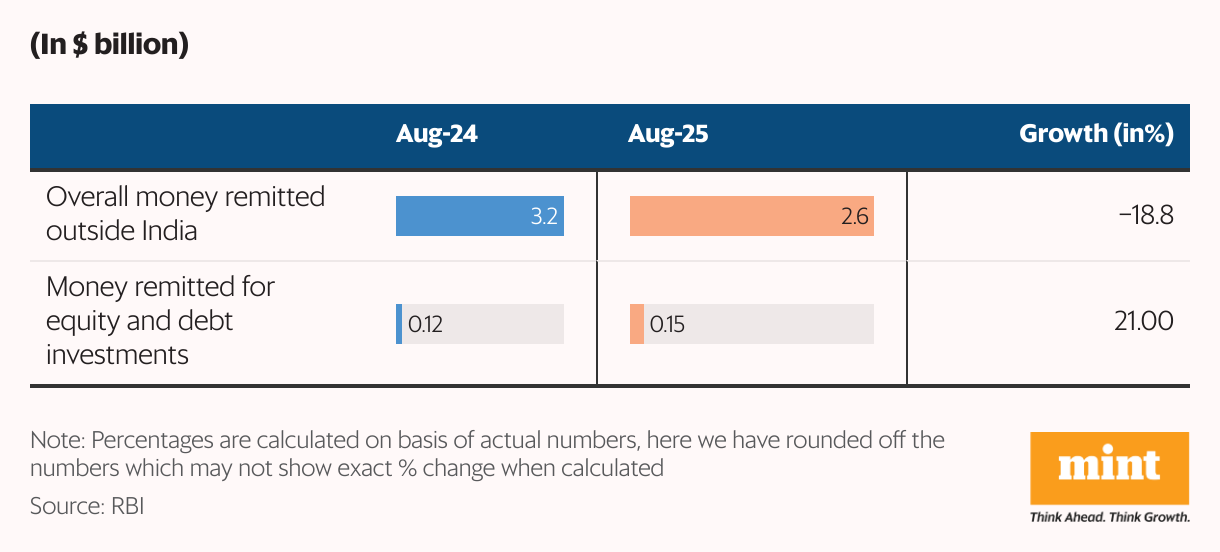
What individual brokers are seeing is reflected in broader data for the country as a whole from the RBI. The latest data under LRS shows investments into equity and debt overseas have increased 21% y-o-y as of August. These investments into equity and debt made up 5.7% of the total LRS transfers in August up from 3.8% the same month last year.
In FY25, remittances for investments in equity and debt under LRS had increased 12% to $1.6 billion. The share of investments in equity and debt had increased from 4.76% of total LRS in FY24 to 5.75% in FY25.
This strong increase in investments abroad came at a time overall remittances by resident Indians under the scheme had declined by 7% to $2.9 billion in FY25.
The underperformance of India markets vis-a-vis global peers have led to a surge in flow of money overseas. The Nifty 50 index has given 4.7% returns in the last one year while the US’s S&P 500 index 12.51%, China’s CSI 300 12.98%, and Brazil’s IBOVESPA at 18.24%. German’s DAX index has returned 22.58% returns in the same period.
A word of caution
Besides better relative returns overseas, limited access to global markets via mutual funds and accessibility to it via direct investing are among the factors retail investors preferring the direct route more to foreign equity and debt, say experts.
Nirmal Bari, director and principal officer at PPFAS GIFT City, which is soon to start a fund for global investing, said that retail investors earlier typically took global exposure through mutual funds however, that route has been unavailable since February 2022. With that channel closed, investors have turned to direct routes, aided by the rise of platforms that have made it much easier for Indians to buy global stocks, Bari added.
The limit for overseas investment of mutual funds is capped at $7 billion at an industry level, which was breached in 2022. It has not increased since then.
However, there are certain things which investors should keep in mind before using the direct route, an expert said.
Bari of PPFAS GIFT City said that investors need to do their own research and need to be careful that in global investing, long-term capital gains tax is when stocks are held for more than two years unlike India where it is set at one year. “So, someone cannot just buy and sell quickly without knowing the implications,” he said.
Investors must navigate complexities such as inheritance tax, dividend withholding tax, and differing tax treaties across countries, Bari added with other factors such as varying levels of corporate governance and disclosure standards to be watched out for. While developed markets like the US and Europe are well-regulated, developing or frontier markets may not be as transparent, he cautioned.

