


India’s market’s glitter dimmed over this period. India’s benchmark Nifty 50 index delivered 7.17% returns in Samvat 2081. In comparison, the US’s Nasdaq Composite index gained 25.2% and the S&P 500 rose 17.8% during this period. Europe’s Euro Stoxx 50 gained 18.5%, the UK’s FTSE 100 rose 18.4%, France’s CAC 40 was up 14.1%, and Germany’s DAX climbed 23.8%.
Among sectoral indices on the National Stock Exchange, the Nifty Media index was the worst hit, down by about 24% in the past Samvat year, followed by Nifty IT (-18%), and Nifty Energy (-10.5%).
The Nifty Financial Services index gained the most, rising over 14%. The Nifty Auto was the second-best performer, up 13.6%, while the Nifty PSU Bank index was close behind, with a 13.4% gain.
Precious metals stole the spotlight in Samvat 2081, with gold prices surging 62%, and silver outshining it with an 83% leap.
Samvat 2082, which begins on 21 October, could, however, see better fortunes for Indian equities.
“In Samvat 2082, the technical setup looks stronger, with Nifty having upside potential of 26,300–27,000 and key supports at 24,500–24,000,” Axis Direct said in a Diwali note.
Earnings momentum
On Friday, 17 October, the Nifty 50 and the Sensex climbed to 52-week highs of 25,781.50 and 84,172.24 points, respectively, in intraday trade. However, the indices lost some of their gains, with the Nifty 50 closing 0.5% higher at 25,709.85 points and the Sensex ending 0.6% up at 83,952.19 points.
From Friday’s close, the Nifty 50 is 2% away from reaching its lifetime high of 26,216 points, while the Sensex is 2.2% away from its lifetime high of 85,836.12. Both the indices hit their lifetime highs on 26 September 2024.
According to Axis Direct, a recovery in midcap and smallcap stocks is also on the cards.
Several market participants expect market momentum to gather speed as corporate earnings improve.
According to Motilal Oswal Wealth Management, improving corporate earnings trajectory, significant pick-up in consumption, and revival in private capital expenditure should lend support to Indian equities.
“We perceive H2FY26 (October 2025–March 2026, the second half of 2025-26) to mark the crossing-over from a subdued low-single-digit earnings growth to a more sustainable double-digit earnings growth,” Motilal Oswal Wealth Management said in a report. “Nifty earnings growth is expected at a healthy 8%/16% YoY in FY26/FY27 as compared to 1% in FY25.”
‘Like a turtle’
Nilesh Shah, managing director of Kotak Mahindra AMC, is less sanguine about the immediate prospects of India’s equity markets. “Stocks may fluctuate, but the broader market will progress slowly, like a turtle,” he said.
Shah added that while India’s consumption trend played out well last year, his bets on India’s information technology (IT) sector didn’t perform as expected.
The biggest driver for India’s equity market is earnings growth, Shah said, adding that if earnings rebound to double digits—supported by India striking a tariff deal with the US, domestic stimulus, and revival in private capital expenditure—the market will move north.
Saurabh Mukherjea, chief investment officer and co-founder of Marcellus Investment Managers, echoed a similar sentiment.
Muted corporate earnings growth makes it tough for a market already trading at record valuations to gain any further, he said, adding that earnings growth and stock market returns are likely to remain subdued. “Valuations are steep, which is why the market is struggling to move ahead.”
But a big worry troubling investors is if the delay in concluding trade negotiations with the US would further slow India’s earnings growth recovery?
Mukherjea said Trump’s 50% tariffs on Indian goods are already hurting workers. “I saw the impact firsthand in Tirupur (a textile hub in Tamil Nadu) and Eastern UP (Uttar Pradesh). Textiles, handmade carpets, gems and jewellery, leather, jute, and sports goods are all disrupted, affecting 20–30 million workers.”
While the government’s consumption stimulus measures such as the GST rate cuts may kick in over the next 3–6 months, a large part of the gains could be offset by the US’s tariffs, Mukherjea added.
Another big worry is the escalating US-China trade war, HDFC Securities said in a Diwali note. The US plans to impose an extra 100% tariff on Chinese goods from 1 November, while China has restricted exports of rare earth minerals and warned of retaliatory steps.
“There is a high risk of continued tit-for-tat retaliation into early 2026, especially if no diplomatic breakthrough emerges during planned (but now uncertain) summits between President Trump and President Xi,” HDFC Securities said.
Foreign investors—set to return?
Foreign institutional investors (FIIs) net sold ₹1,49,861 crore in Samvat 2081, after being net buyers in the past two Samvat years.
On the other hand, domestic institutional investors (DIIs) have been net buyers over four Samvat years. In Samvat 2081, they net bought Indian shares worth ₹6,72,398 crore.
“India remains materially underweight in EM (emerging market) portfolios, with FII allocations 3 percentage points below its EM funds weight of 17.5%—the deepest underweight positioning since 2009,” Elara Capital said in a 16 October strategy report.
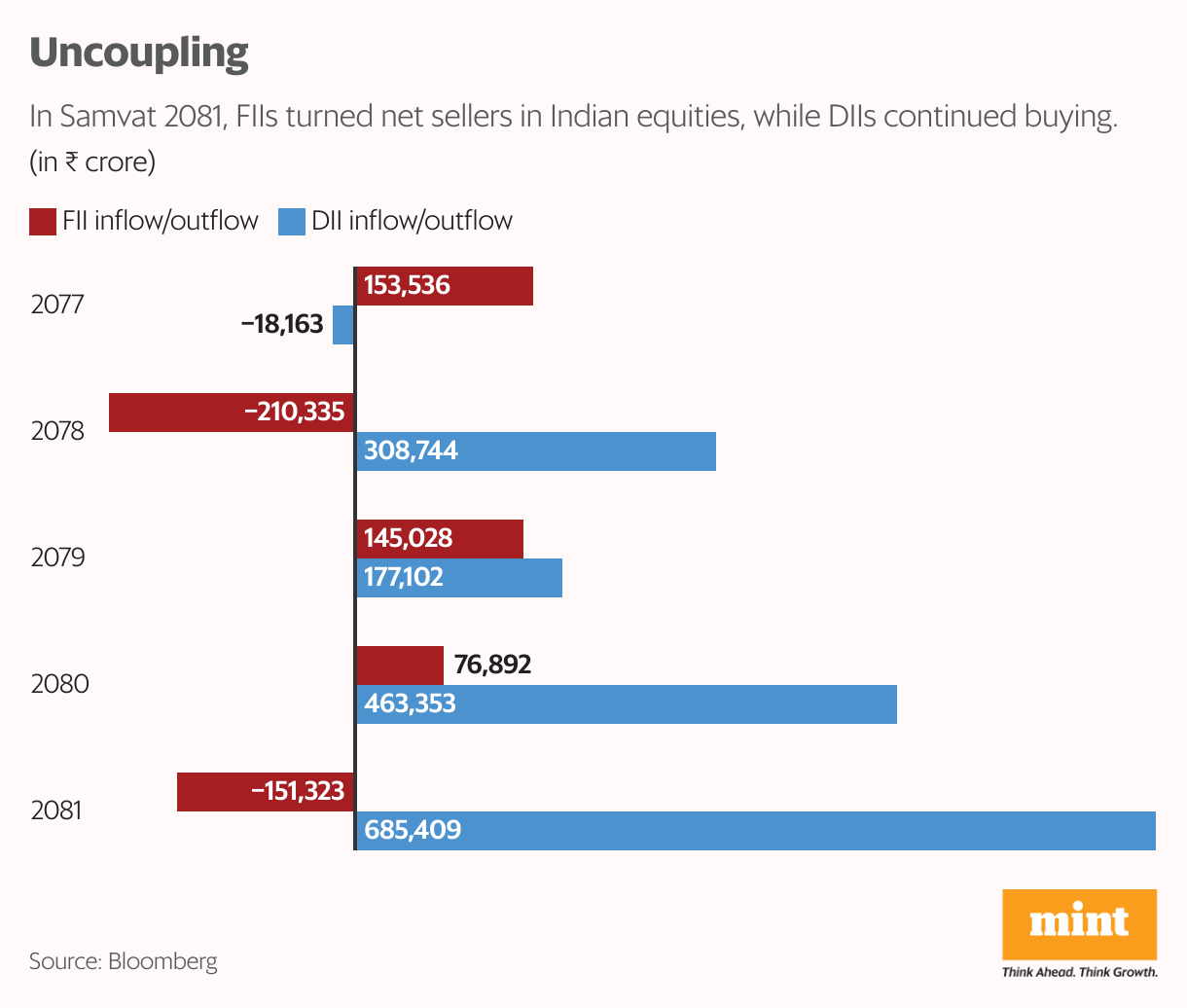
This disconnect has persisted even as the macro conditions of emerging markets remain strong. India’s strong fiscal and monetary support, expected GDP growth above 7%, projected 13–15% Nifty EPS (earnings per share) growth in FY25–27, and low inflation create a solid foundation for continued domestic equity flows, according to Elara Capital.
With valuation premiums moderating and earnings revisions stabilizing, current market conditions favours gradual FII reallocation and sustained domestic investor leadership, it added.

