


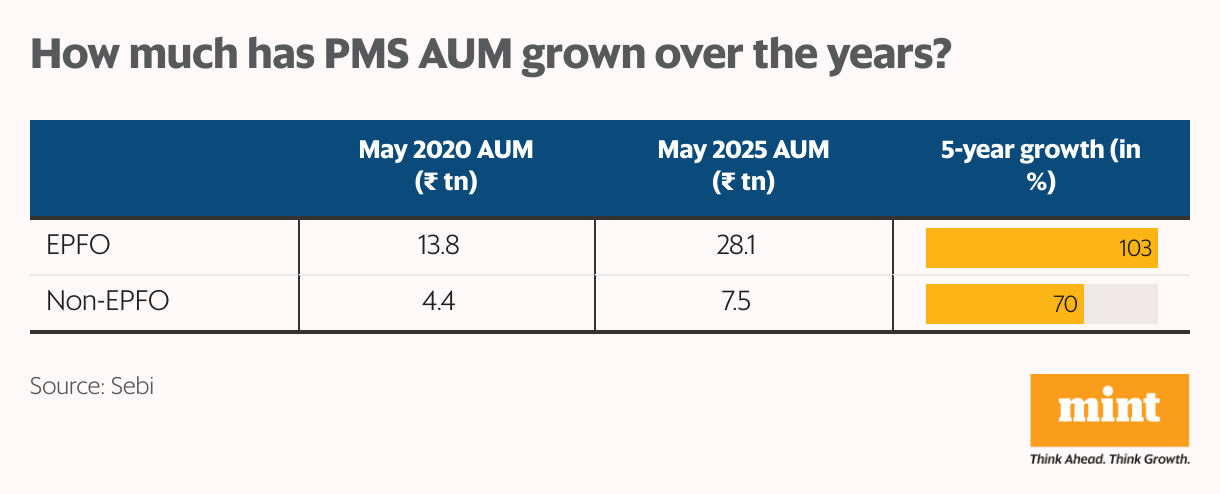
These schemes, where you must put up a minimum of ₹50 lakh, managed assets worth ₹35 trillion as of May 2025, data from the Securities and Exchange Board of India (Sebi) showed. Of this, 79%, or ₹28 trillion, came from the EPFO. Five years earlier, the number stood at 75%. Meanwhile, the share of PMS assets from other sources — read HNIs — shrank from 24% to 21%.
The EPFO, which manages retirement funds of nearly 70 million Indians, invests a slice of its investable corpus in debt instruments. This is mandated to be done via a PMS, funneling a deluge of funds to the PMS industry. While the PMS clientele is often seen as wealthy, EPFO’s money comes from regular employees, who set aside a share of their monthly earnings to fund retirement.
“The EPFO utilizes a sophisticated outsourced model where the day-to-day management of its extensive corpus including debt instruments is delegated to a select group of appointed external fund managers,” said Kalyani Sharma, partner, Singhania & Co. Between 45% and 65% of the EPFO portfolio should be in government securities, and 35-45% in various debt instruments, Sharma said.
Key Takeaways
- As of May 2025, 79% of PMS assets ( ₹28 trillion of ₹35 trillion) come from EPFO, up from 75% five years ago, reducing HNIs’ share.
- EPFO is mandated to invest its debt portfolio via PMS, channeling massive pension savings into the industry.
- Higher ticket size, capital gains tax on churn, and rising compliance costs have dampened HNI participation.
- PMS providers now file up to 12 reports monthly to Sebi, pushing the break-even AUM from ₹50 crore to ₹200 crore.
EPFO’s debt corpus is managed by SBI Funds and UTI Asset Management. Emails sent to both remained unanswered. An email sent to EPFO also remained unanswered.
“EPFO is also allowed to invest in equity markets through exchange-traded funds like BSE Sensex, NSE Nifty and ETFs constructed specifically for CPSE disinvestments to the tune of 5-15%. But the majority of the EPFO investments remain in debt-related investments,” said Shikhar Kacker, partner at Khaitan & Co.
PMS assets from non-EPFO sources, primarily HNIs, have grown 70% over the last five years (till May end), while those from EPFO doubled in the same period, Sebi data showed. A tax on churning stocks, increased compliance, and higher ticket size has slowed the growth of the non-EPFO part, primarily comprising HNIs, experts said.
Meanwhile, other avenues where HNIs invest have seen better growth. Total commitments raised by Category-III alternate investment funds, another type of investment vehicle, is up 4.7 times since FY20, while mutual funds’ assets rose 2.95 times to ₹65.7 trillion in the same period.
Mutual fund vs PMS
Many investors could prefer mutual funds over PMS given their tax efficiency, said Pramod Gubbi, co-founder at Marcellus Investment Managers. In PMS, every time the manager sells a stock and books a gain, the investor is liable to pay capital gains tax even if they haven’t redeemed their investment. In contrast, mutual funds are tax-exempt at the fund level; so any short-term churn within the fund does not trigger a tax for the investor, who only pays capital gains tax upon redemption, which makes them more tax efficient, said Gubbi.
The PMS industry, once known for its light-touch regulation, is now facing significantly higher compliance demands, experts say.
Over the past year and a half, PMS providers have been required to submit as many as 12 reports a month to Sebi, covering quantitative information like client information, transaction details, expense and employee roles, besides routine monthly reports to Sebi and the Association of Portfolio Managers of India, said Bhavin Shah, CIO at Sameeksha Capital and board member of APMI.
Shah said this burden could be eased if Sebi sourced the data directly from custodians or fund accountants, who already serve as the central repository for information related to PMS accounts.
The added compliance requirements have raised costs, pushing the break-even AUM for PMS providers from about ₹50 crore earlier to ₹200 crore now. Considering a startup puts capital of ₹10 crore while starting a PMS, it could take up to five years for a new player to break even, Shah added.
In 2019, the minimum ticket size for a PMS was increased from ₹25 lakhs to ₹50 lakhs, which could be another reason for the slower growth, experts say.
“Increased minimum ticket size could deter investors from putting money into a new PMS,” said Sushant Bhansali, CEO of Ambit Asset Management. “Adding incremental funds to an existing PMS is manageable, but committing another ₹50 lakh to start afresh with a new PMS becomes a challenge for many investors.”
Moreover, unlike AIFs, PMSes aren’t allowed to invest in unlisted equities, which could be another the industry’Es slower growth, Bhansali added.

